

Extinctions, Periodic Orbits, and Domains of Attraction
139
2~--__ ----__ --~----~--~----T---~----T---~--~
L,. = 0,1 hlg P] liter'! d'!
Lp = 0.5 hlg P] liter' d"
60
120
180
Time (d)
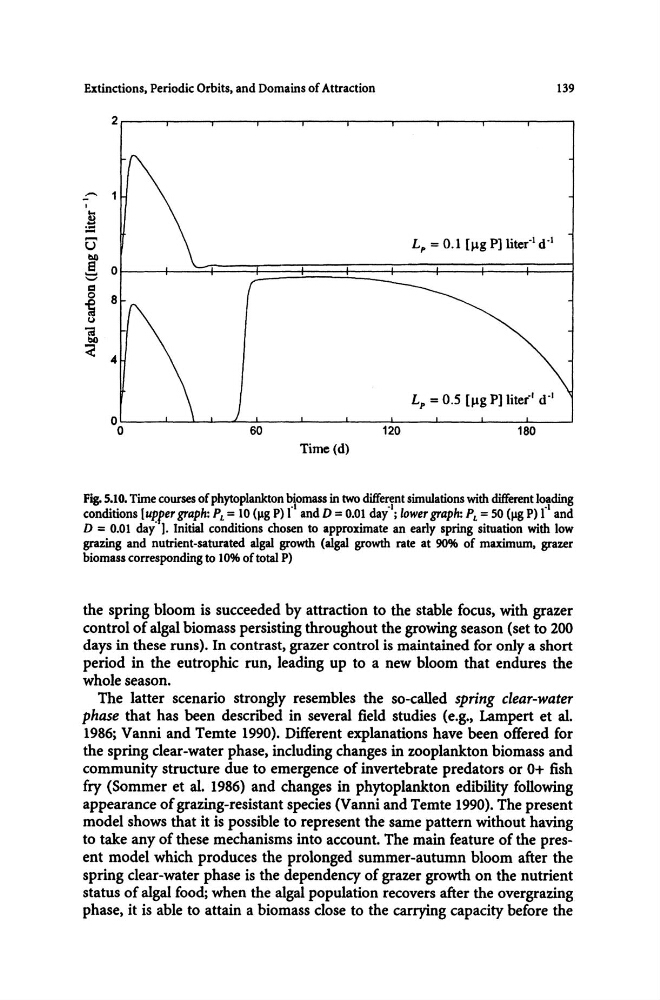
Fig. 5.10. Time courses of phytoplankton ~\omass in two diff~t simulations with different l~ding
conditions [u~p"er graph: PL = 10 (1'8 P) I and D = 0.01 day ; lower graph: P L = 50 (1'8 P) I and
D = 0.01 day J. Initial conditions chosen to approximate an early spring situation with low
grazing and nutrient-saturated algal growth (algal growth rate at 90% of maximum, grazer
biomass corresponding to 1096 of total P)
the spring bloom is succeeded by attraction to the stable focus, with grazer
control of algal biomass persisting throughout the growing season (set to 200
days in these runs). In contrast, grazer control is maintained for only a short
period in the eutrophic run, leading up to a new bloom that endures the
whole season.
The latter scenario strongly resembles the so-called spring clear-water
phase that has been descn"bed in several field studies (e.g., Lampert et al.
1986; Vanni and Temte 1990). Different explanations have been offered for
the spring clear-water phase, including changes in zooplankton biomass and
community structure due to emergence of invertebrate predators or 0+ fish
fry (Sommer et al. 1986) and changes in phytoplankton ech"bility following
appearance of grazing-resistant species (Vanni and Temte 1990). The present
model shows that it is possible to represent the same pattern without having
to take any of these mechanisms into account. The main feature of the present model which produces the prolonged summer-autumn bloom after the
spring clear-water phase is the dependency of grazer growth on the nutrient
status of algal food; when the algal population recovers after the overgrazing
phase, it is able to attain a biomass close to the carrying capacity before the
139
2~--__ ----__ --~----~--~----T---~----T---~--~
L,. = 0,1 hlg P] liter'! d'!
Lp = 0.5 hlg P] liter' d"
60
120
180
Time (d)
Fig. 5.10. Time courses of phytoplankton ~\omass in two diff~t simulations with different l~ding
conditions [u~p"er graph: PL = 10 (1'8 P) I and D = 0.01 day ; lower graph: P L = 50 (1'8 P) I and
D = 0.01 day J. Initial conditions chosen to approximate an early spring situation with low
grazing and nutrient-saturated algal growth (algal growth rate at 90% of maximum, grazer
biomass corresponding to 1096 of total P)
the spring bloom is succeeded by attraction to the stable focus, with grazer
control of algal biomass persisting throughout the growing season (set to 200
days in these runs). In contrast, grazer control is maintained for only a short
period in the eutrophic run, leading up to a new bloom that endures the
whole season.
The latter scenario strongly resembles the so-called spring clear-water
phase that has been descn"bed in several field studies (e.g., Lampert et al.
1986; Vanni and Temte 1990). Different explanations have been offered for
the spring clear-water phase, including changes in zooplankton biomass and
community structure due to emergence of invertebrate predators or 0+ fish
fry (Sommer et al. 1986) and changes in phytoplankton ech"bility following
appearance of grazing-resistant species (Vanni and Temte 1990). The present
model shows that it is possible to represent the same pattern without having
to take any of these mechanisms into account. The main feature of the present model which produces the prolonged summer-autumn bloom after the
spring clear-water phase is the dependency of grazer growth on the nutrient
status of algal food; when the algal population recovers after the overgrazing
phase, it is able to attain a biomass close to the carrying capacity before the