

104
Herbivores and Algae: Food Utilization. Growth and Reproduction ...
0.4 ~-------------------r-t
-
I
~ ......., 0.3
.B
e!
~
.g 0.2
....
0
~
.0
(.)
0.1
~
• .-4
(.)
Q)
Q.,
til
O+----------r----==--~----------~------~
-0.4
-0.2
o
0.2
0.4
Intrinsic rate of increase A. (d -1 )
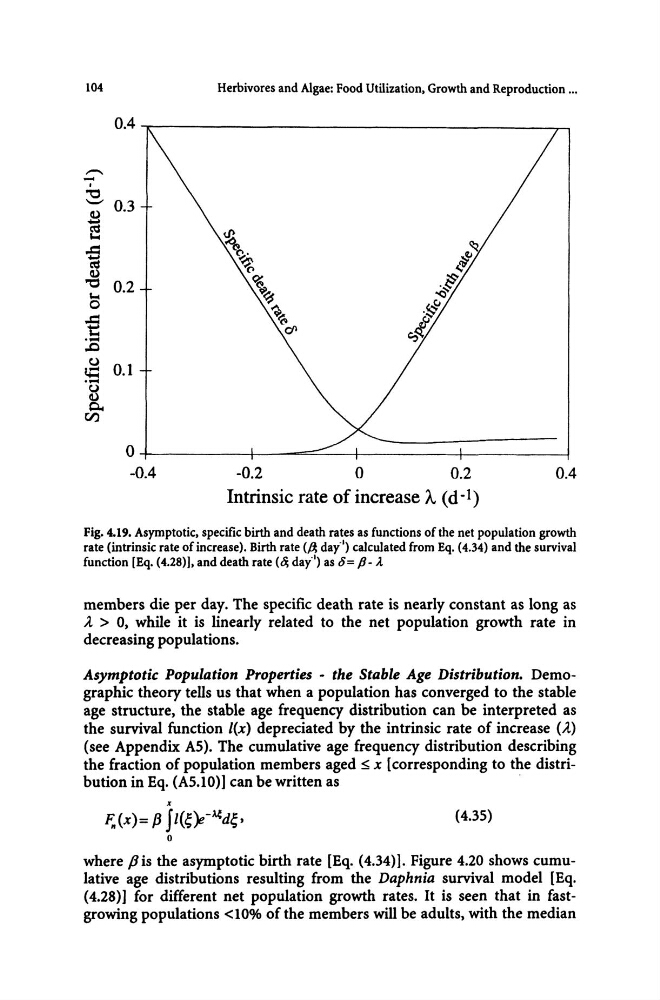
Fig. 4.19. Asymptotic. specific birth and death rates as functions of the net population growth
rate (intrinsic rate of increase). Birth rate (A day"l) calculated from Eq. (4.34) and the survival
function (Eq. (4.28». and death rate (~ day"l) as 6= P -A
members die per day. The specific death rate is nearly constant as long as
A. > 0, while it is linearly related to the net population growth rate in
decreasing populations.
Asymptotic Population Properties - the Stable Age Distribution. Demographic theory tells us that when a population has converged to the stable
age structure, the stable age frequency distribution can be interpreted as
the survival function lex) depreciated by the intrinsic rate of increase (A.)
(see Appendix AS). The cumulative age frequency distribution describing
the fraction of population members aged ~ x [corresponding to the distribution in Eq. (AS.10)) can be written as
.
Jl
~(x)= P Jl(~)e-Aed~,
(4.35)
o
where Pis the asymptotic birth rate [Eq. (4.34)]. Figure 4.20 shows cumulative age distributions resulting from the Daphnia survival model [Eq.
(4.28)] for different net population growth rates. It is seen that in fastgrowing populations <10% of the members will be adults, with the median
Herbivores and Algae: Food Utilization. Growth and Reproduction ...
0.4 ~-------------------r-t
-
I
~ ......., 0.3
.B
e!
~
.g 0.2
....
0
~
.0
(.)
0.1
~
• .-4
(.)
Q)
Q.,
til
O+----------r----==--~----------~------~
-0.4
-0.2
o
0.2
0.4
Intrinsic rate of increase A. (d -1 )
Fig. 4.19. Asymptotic. specific birth and death rates as functions of the net population growth
rate (intrinsic rate of increase). Birth rate (A day"l) calculated from Eq. (4.34) and the survival
function (Eq. (4.28». and death rate (~ day"l) as 6= P -A
members die per day. The specific death rate is nearly constant as long as
A. > 0, while it is linearly related to the net population growth rate in
decreasing populations.
Asymptotic Population Properties - the Stable Age Distribution. Demographic theory tells us that when a population has converged to the stable
age structure, the stable age frequency distribution can be interpreted as
the survival function lex) depreciated by the intrinsic rate of increase (A.)
(see Appendix AS). The cumulative age frequency distribution describing
the fraction of population members aged ~ x [corresponding to the distribution in Eq. (AS.10)) can be written as
.
Jl
~(x)= P Jl(~)e-Aed~,
(4.35)
o
where Pis the asymptotic birth rate [Eq. (4.34)]. Figure 4.20 shows cumulative age distributions resulting from the Daphnia survival model [Eq.
(4.28)] for different net population growth rates. It is seen that in fastgrowing populations <10% of the members will be adults, with the median