

Population Survival and Proliferation: Demography
105
1.0 -r----:::::::::::::::===--:::::::::===---::::::==-----:::::=----:::::o-,
0.8
>g
0
=' 0.6
0'"
~
0
>
. .z:
=
0.4
- =
9
8 0.2
0.0 -f'-==-------I---------+------~
o
20
40
60
Age (d)
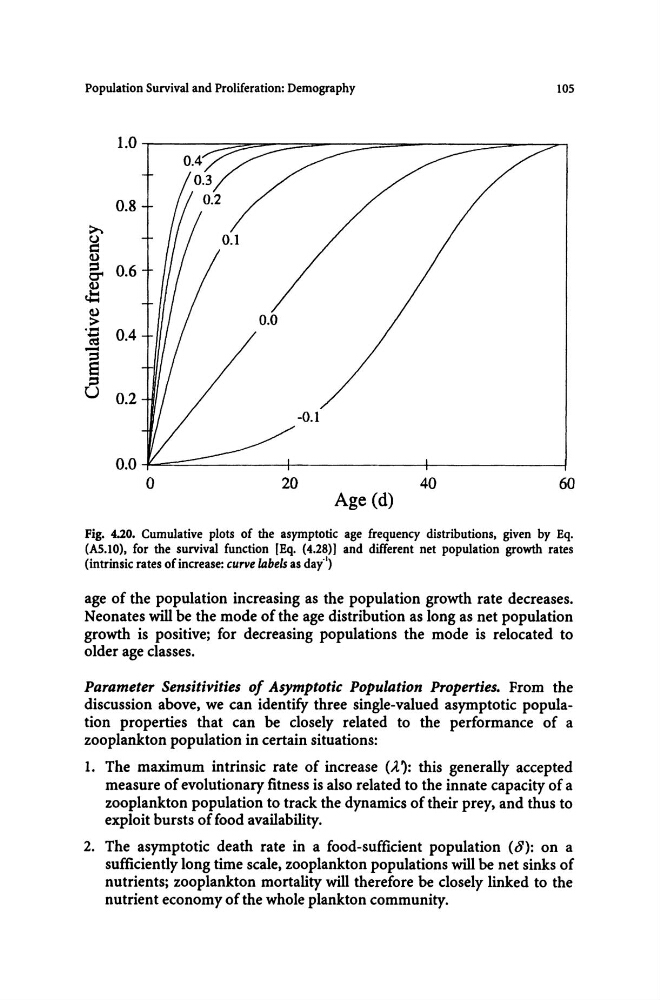
Fig. 4.20. Cumulative plots of the asymptotic age frequency distributions, given by Eq.
(AS.lO), for the survival function IRq. (4.28)] and different net population growth rates
(intrinsic rates of increase: curve labels as day·l)
age of the population increasing as the population growth rate decreases.
Neonates will be the mode of the age distribution as long as net population
growth is positive; for decreasing populations the mode is relocated to
older age classes.
Parameter Sensitivities of Asymptotic Population Properties. From the
discussion above, we can identify three single-valued asymptotic population properties that can be closely related to the performance of a
zooplankton population in certain situations:
1. The maximum intrinsic rate of increase (A.?: this generally accepted
measure of evolutionary fitness is also related to the innate capacity of a
zooplankton population to track the dynamics of their prey, and thus to
exploit bursts of food availability.
2. The asymptotic death rate in a food-sufficient population (8): on a
sufficiently long time scale, zooplankton populations will be net sinks of
nutrients; zooplankton mortality will therefore be closely linked to the
nutrient economy of the whole plankton community.
105
1.0 -r----:::::::::::::::===--:::::::::===---::::::==-----:::::=----:::::o-,
0.8
>g
0
=' 0.6
0'"
~
0
>
. .z:
=
0.4
- =
9
8 0.2
0.0 -f'-==-------I---------+------~
o
20
40
60
Age (d)
Fig. 4.20. Cumulative plots of the asymptotic age frequency distributions, given by Eq.
(AS.lO), for the survival function IRq. (4.28)] and different net population growth rates
(intrinsic rates of increase: curve labels as day·l)
age of the population increasing as the population growth rate decreases.
Neonates will be the mode of the age distribution as long as net population
growth is positive; for decreasing populations the mode is relocated to
older age classes.
Parameter Sensitivities of Asymptotic Population Properties. From the
discussion above, we can identify three single-valued asymptotic population properties that can be closely related to the performance of a
zooplankton population in certain situations:
1. The maximum intrinsic rate of increase (A.?: this generally accepted
measure of evolutionary fitness is also related to the innate capacity of a
zooplankton population to track the dynamics of their prey, and thus to
exploit bursts of food availability.
2. The asymptotic death rate in a food-sufficient population (8): on a
sufficiently long time scale, zooplankton populations will be net sinks of
nutrients; zooplankton mortality will therefore be closely linked to the
nutrient economy of the whole plankton community.