

origin of North Atlantic and Eastern Tropical Pacific echinoderm faunas. Currently, both areas (Caribbean and West Indies) are quite similar in temperature
regimes (maximum 31.21 °C in both areas, minimum 5.28 and 2.80 °C, mean
25.61 and 27.25 °C in the Caribbean and West Indian respectively), but differ in
chlorophyll concentration (0.64 and 0.28 mg m
-3 respectively).
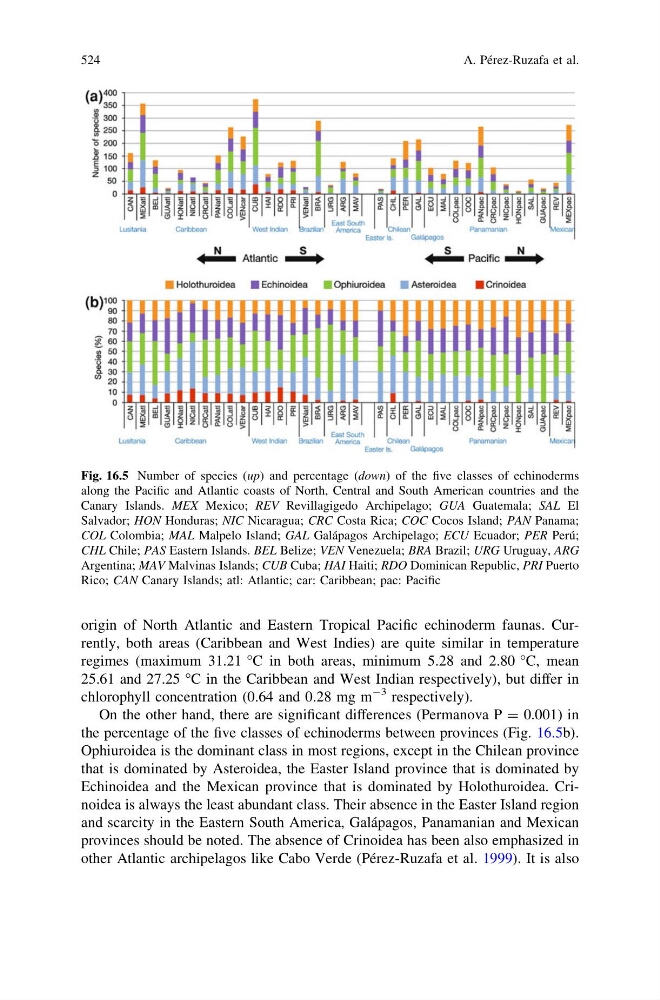
On the other hand, there are significant differences (Permanova P = 0.001) in
the percentage of the five classes of echinoderms between provinces (Fig. 16.5b).
Ophiuroidea is the dominant class in most regions, except in the Chilean province
that is dominated by Asteroidea, the Easter Island province that is dominated by
Echinoidea and the Mexican province that is dominated by Holothuroidea. Crinoidea is always the least abundant class. Their absence in the Easter Island region
and scarcity in the Eastern South America, Galápagos, Panamanian and Mexican
provinces should be noted. The absence of Crinoidea has been also emphasized in
other Atlantic archipelagos like Cabo Verde (Pérez-Ruzafa et al. 1999). It is also
Fig. 16.5 Number of species (up) and percentage (down) of the five classes of echinoderms
along the Pacific and Atlantic coasts of North, Central and South American countries and the
Canary Islands. MEX Mexico; REV Revillagigedo Archipelago; GUA Guatemala; SAL El
Salvador; HON Honduras; NIC Nicaragua; CRC Costa Rica; COC Cocos Island; PAN Panama;
COL Colombia; MAL Malpelo Island; GAL Galápagos Archipelago; ECU Ecuador; PER Perú;
CHL Chile; PAS Eastern Islands. BEL Belize; VEN Venezuela; BRA Brazil; URG Uruguay, ARG
Argentina; MAV Malvinas Islands; CUB Cuba; HAI Haiti; RDO Dominican Republic, PRI Puerto
Rico; CAN Canary Islands; atl: Atlantic; car: Caribbean; pac: Pacific
524
A. Pérez-Ruzafa et al.
regimes (maximum 31.21 °C in both areas, minimum 5.28 and 2.80 °C, mean
25.61 and 27.25 °C in the Caribbean and West Indian respectively), but differ in
chlorophyll concentration (0.64 and 0.28 mg m
-3 respectively).
On the other hand, there are significant differences (Permanova P = 0.001) in
the percentage of the five classes of echinoderms between provinces (Fig. 16.5b).
Ophiuroidea is the dominant class in most regions, except in the Chilean province
that is dominated by Asteroidea, the Easter Island province that is dominated by
Echinoidea and the Mexican province that is dominated by Holothuroidea. Crinoidea is always the least abundant class. Their absence in the Easter Island region
and scarcity in the Eastern South America, Galápagos, Panamanian and Mexican
provinces should be noted. The absence of Crinoidea has been also emphasized in
other Atlantic archipelagos like Cabo Verde (Pérez-Ruzafa et al. 1999). It is also
Fig. 16.5 Number of species (up) and percentage (down) of the five classes of echinoderms
along the Pacific and Atlantic coasts of North, Central and South American countries and the
Canary Islands. MEX Mexico; REV Revillagigedo Archipelago; GUA Guatemala; SAL El
Salvador; HON Honduras; NIC Nicaragua; CRC Costa Rica; COC Cocos Island; PAN Panama;
COL Colombia; MAL Malpelo Island; GAL Galápagos Archipelago; ECU Ecuador; PER Perú;
CHL Chile; PAS Eastern Islands. BEL Belize; VEN Venezuela; BRA Brazil; URG Uruguay, ARG
Argentina; MAV Malvinas Islands; CUB Cuba; HAI Haiti; RDO Dominican Republic, PRI Puerto
Rico; CAN Canary Islands; atl: Atlantic; car: Caribbean; pac: Pacific
524
A. Pérez-Ruzafa et al.