

worthwhile to note the negative relationship that exists between the dominance of
holothurians in the faunas and the presence of crinoids (Fig. 16.8).
The echinoderm fauna of the different countries is consistent with their
belonging to one of the above mentioned regions and provinces. NMDS analyses,
performed with Bray-Curtis similarity calculated on species presence-absence
(Bray and Curtis 1957), spatially distributed the countries according to their
geographic location and importance to a given province (Fig. 16.9). The plot
shows two well-established clusters. One includes the Panamanian, Galápagos and
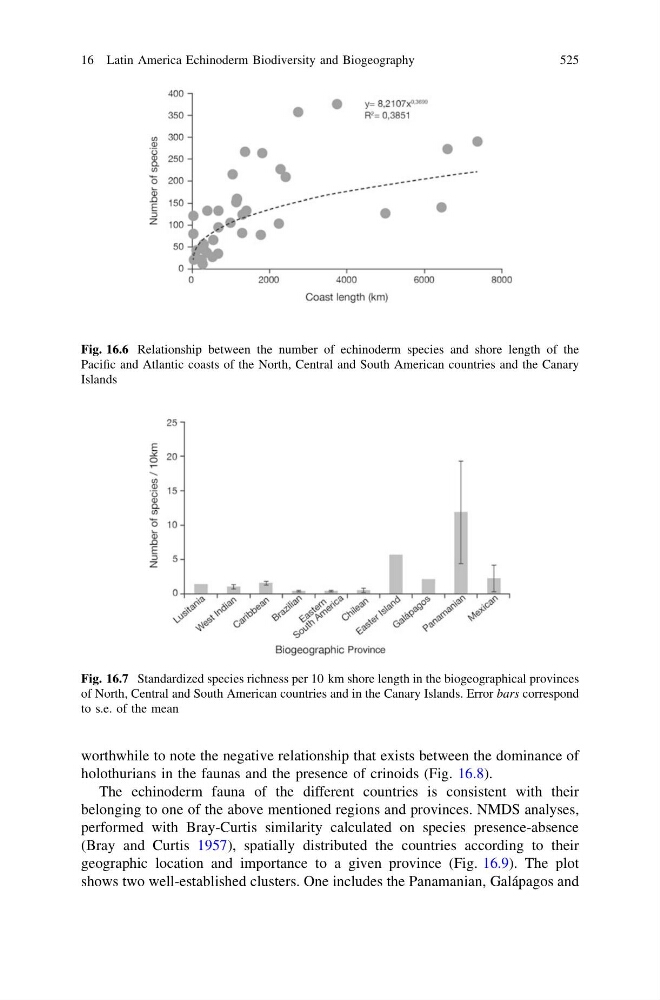
Fig. 16.6 Relationship between the number of echinoderm species and shore length of the
Pacific and Atlantic coasts of the North, Central and South American countries and the Canary
Islands
Fig. 16.7 Standardized species richness per 10 km shore length in the biogeographical provinces
of North, Central and South American countries and in the Canary Islands. Error bars correspond
to s.e. of the mean
16 Latin America Echinoderm Biodiversity and Biogeography
525
holothurians in the faunas and the presence of crinoids (Fig. 16.8).
The echinoderm fauna of the different countries is consistent with their
belonging to one of the above mentioned regions and provinces. NMDS analyses,
performed with Bray-Curtis similarity calculated on species presence-absence
(Bray and Curtis 1957), spatially distributed the countries according to their
geographic location and importance to a given province (Fig. 16.9). The plot
shows two well-established clusters. One includes the Panamanian, Galápagos and
Fig. 16.6 Relationship between the number of echinoderm species and shore length of the
Pacific and Atlantic coasts of the North, Central and South American countries and the Canary
Islands
Fig. 16.7 Standardized species richness per 10 km shore length in the biogeographical provinces
of North, Central and South American countries and in the Canary Islands. Error bars correspond
to s.e. of the mean
16 Latin America Echinoderm Biodiversity and Biogeography
525