

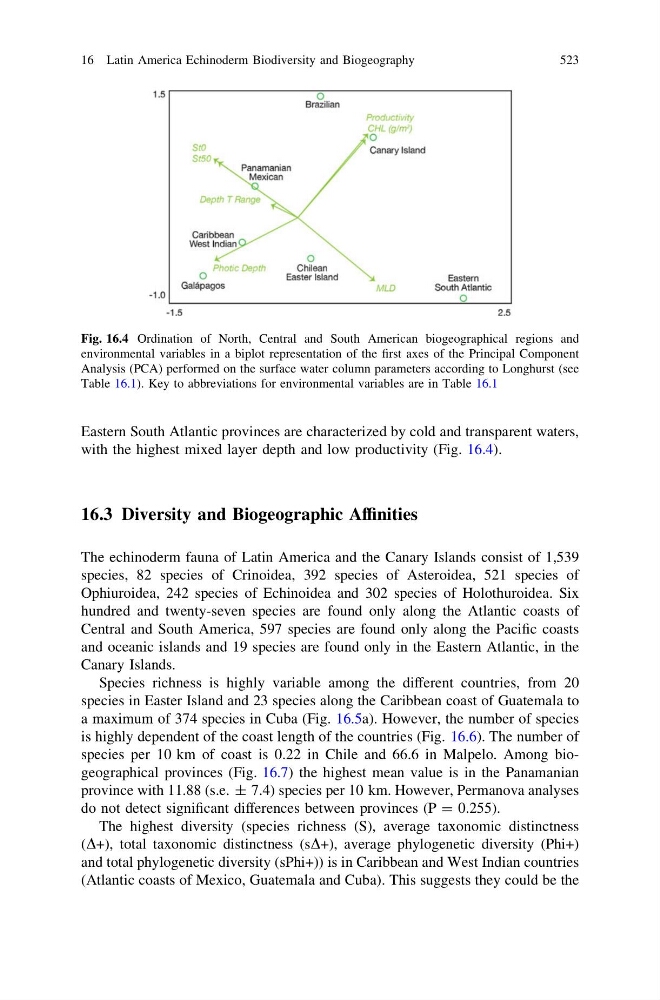
Eastern South Atlantic provinces are characterized by cold and transparent waters,
with the highest mixed layer depth and low productivity (Fig. 16.4).
16.3 Diversity and Biogeographic Affinities
The echinoderm fauna of Latin America and the Canary Islands consist of 1,539
species, 82 species of Crinoidea, 392 species of Asteroidea, 521 species of
Ophiuroidea, 242 species of Echinoidea and 302 species of Holothuroidea. Six
hundred and twenty-seven species are found only along the Atlantic coasts of
Central and South America, 597 species are found only along the Pacific coasts
and oceanic islands and 19 species are found only in the Eastern Atlantic, in the
Canary Islands.
Species richness is highly variable among the different countries, from 20
species in Easter Island and 23 species along the Caribbean coast of Guatemala to
a maximum of 374 species in Cuba (Fig. 16.5a). However, the number of species
is highly dependent of the coast length of the countries (Fig. 16.6). The number of
species per 10 km of coast is 0.22 in Chile and 66.6 in Malpelo. Among biogeographical provinces (Fig. 16.7) the highest mean value is in the Panamanian
province with 11.88 (s.e. ± 7.4) species per 10 km. However, Permanova analyses
do not detect significant differences between provinces (P = 0.255).
The highest diversity (species richness (S), average taxonomic distinctness
(D+), total taxonomic distinctness (sD+), average phylogenetic diversity (Phi+)
and total phylogenetic diversity (sPhi+)) is in Caribbean and West Indian countries
(Atlantic coasts of Mexico, Guatemala and Cuba). This suggests they could be the
Fig. 16.4 Ordination of North, Central and South American biogeographical regions and
environmental variables in a biplot representation of the first axes of the Principal Component
Analysis (PCA) performed on the surface water column parameters according to Longhurst (see
Table 16.1). Key to abbreviations for environmental variables are in Table 16.1
16 Latin America Echinoderm Biodiversity and Biogeography
523
with the highest mixed layer depth and low productivity (Fig. 16.4).
16.3 Diversity and Biogeographic Affinities
The echinoderm fauna of Latin America and the Canary Islands consist of 1,539
species, 82 species of Crinoidea, 392 species of Asteroidea, 521 species of
Ophiuroidea, 242 species of Echinoidea and 302 species of Holothuroidea. Six
hundred and twenty-seven species are found only along the Atlantic coasts of
Central and South America, 597 species are found only along the Pacific coasts
and oceanic islands and 19 species are found only in the Eastern Atlantic, in the
Canary Islands.
Species richness is highly variable among the different countries, from 20
species in Easter Island and 23 species along the Caribbean coast of Guatemala to
a maximum of 374 species in Cuba (Fig. 16.5a). However, the number of species
is highly dependent of the coast length of the countries (Fig. 16.6). The number of
species per 10 km of coast is 0.22 in Chile and 66.6 in Malpelo. Among biogeographical provinces (Fig. 16.7) the highest mean value is in the Panamanian
province with 11.88 (s.e. ± 7.4) species per 10 km. However, Permanova analyses
do not detect significant differences between provinces (P = 0.255).
The highest diversity (species richness (S), average taxonomic distinctness
(D+), total taxonomic distinctness (sD+), average phylogenetic diversity (Phi+)
and total phylogenetic diversity (sPhi+)) is in Caribbean and West Indian countries
(Atlantic coasts of Mexico, Guatemala and Cuba). This suggests they could be the
Fig. 16.4 Ordination of North, Central and South American biogeographical regions and
environmental variables in a biplot representation of the first axes of the Principal Component
Analysis (PCA) performed on the surface water column parameters according to Longhurst (see
Table 16.1). Key to abbreviations for environmental variables are in Table 16.1
16 Latin America Echinoderm Biodiversity and Biogeography
523