

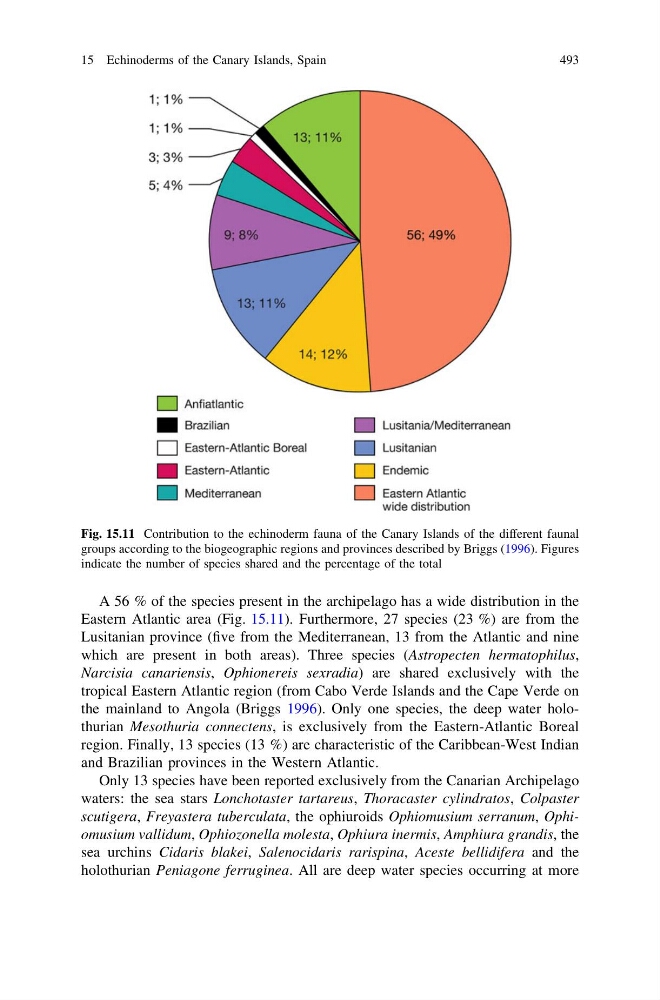
A 56 % of the species present in the archipelago has a wide distribution in the
Eastern Atlantic area (Fig. 15.11). Furthermore, 27 species (23 %) are from the
Lusitanian province (five from the Mediterranean, 13 from the Atlantic and nine
which are present in both areas). Three species (Astropecten hermatophilus,
Narcisia canariensis, Ophionereis sexradia) are shared exclusively with the
tropical Eastern Atlantic region (from Cabo Verde Islands and the Cape Verde on
the mainland to Angola (Briggs 1996). Only one species, the deep water holothurian Mesothuria connectens, is exclusively from the Eastern-Atlantic Boreal
region. Finally, 13 species (13 %) are characteristic of the Caribbean-West Indian
and Brazilian provinces in the Western Atlantic.
Only 13 species have been reported exclusively from the Canarian Archipelago
waters: the sea stars Lonchotaster tartareus, Thoracaster cylindratos, Colpaster
scutigera, Freyastera tuberculata, the ophiuroids Ophiomusium serranum, Ophiomusium vallidum, Ophiozonella molesta, Ophiura inermis, Amphiura grandis, the
sea urchins Cidaris blakei, Salenocidaris rarispina, Aceste bellidifera and the
holothurian Peniagone ferruginea. All are deep water species occurring at more
Fig. 15.11 Contribution to the echinoderm fauna of the Canary Islands of the different faunal
groups according to the biogeographic regions and provinces described by Briggs (1996). Figures
indicate the number of species shared and the percentage of the total
15 Echinoderms of the Canary Islands, Spain
493
Eastern Atlantic area (Fig. 15.11). Furthermore, 27 species (23 %) are from the
Lusitanian province (five from the Mediterranean, 13 from the Atlantic and nine
which are present in both areas). Three species (Astropecten hermatophilus,
Narcisia canariensis, Ophionereis sexradia) are shared exclusively with the
tropical Eastern Atlantic region (from Cabo Verde Islands and the Cape Verde on
the mainland to Angola (Briggs 1996). Only one species, the deep water holothurian Mesothuria connectens, is exclusively from the Eastern-Atlantic Boreal
region. Finally, 13 species (13 %) are characteristic of the Caribbean-West Indian
and Brazilian provinces in the Western Atlantic.
Only 13 species have been reported exclusively from the Canarian Archipelago
waters: the sea stars Lonchotaster tartareus, Thoracaster cylindratos, Colpaster
scutigera, Freyastera tuberculata, the ophiuroids Ophiomusium serranum, Ophiomusium vallidum, Ophiozonella molesta, Ophiura inermis, Amphiura grandis, the
sea urchins Cidaris blakei, Salenocidaris rarispina, Aceste bellidifera and the
holothurian Peniagone ferruginea. All are deep water species occurring at more
Fig. 15.11 Contribution to the echinoderm fauna of the Canary Islands of the different faunal
groups according to the biogeographic regions and provinces described by Briggs (1996). Figures
indicate the number of species shared and the percentage of the total
15 Echinoderms of the Canary Islands, Spain
493