

guineensis, Ophiactis virens, Ophiothrix maculata, Centrostephaus longispinus,
Brissopsis atlantica mediterranea, Holothuria (Holothuria) dakarensis, Holothuria (Platyperona) sanctori, Holothuria (Vaneyothuria) lentiginosa lentiginosa and
Molpadia musculus. There are also some anfiatlantic species as Coscinasterias
tenuispina, Ophioderma appressum, Ophiactis savignyi, Arbacia lixula, Genocidaris maculata, Brissus unicolor, Benthodites lingua and Psychropotes depressa.
There are few analyses on the distribution and biogeography of Atlantic echinoderms (Clark and Downey 1992). The relationships of the echinoderm fauna of
the Canary Islands with other Atlantic faunas were analyzed for the class Holothuroidea (Pérez-Ruzafa et al. 1984b) and in the context of South-Western Mediterranean echinoderm fauna relationships (Pérez-Ruzafa and Marcos 1987).
The shallow water echinoderm fauna of Canary Islands is a consequence of its
oceanography and location in the Atlantic. The number of species shared with
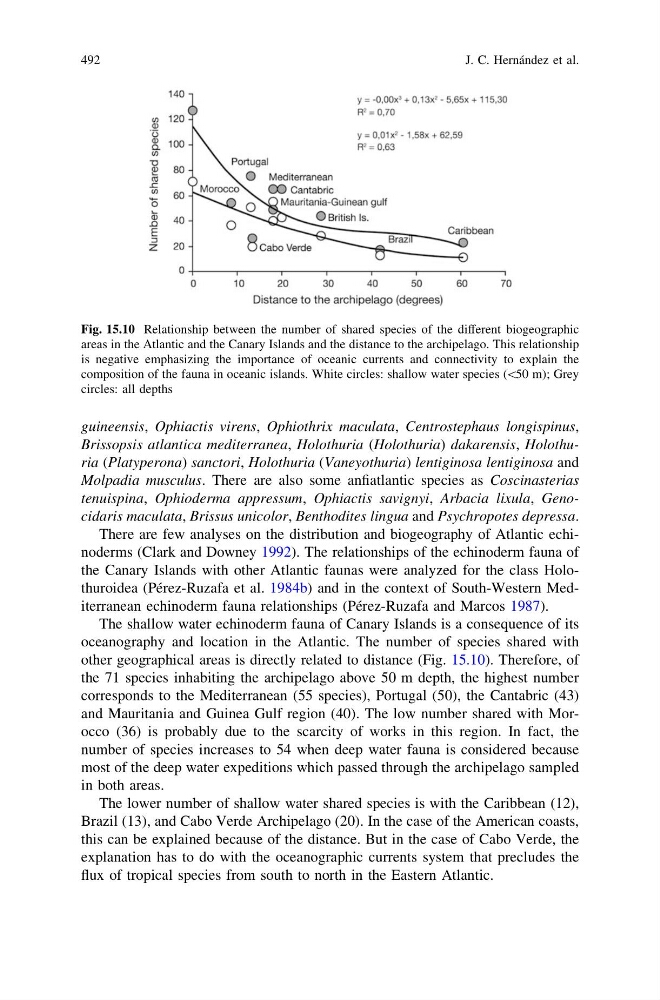
other geographical areas is directly related to distance (Fig. 15.10). Therefore, of
the 71 species inhabiting the archipelago above 50 m depth, the highest number
corresponds to the Mediterranean (55 species), Portugal (50), the Cantabric (43)
and Mauritania and Guinea Gulf region (40). The low number shared with Morocco (36) is probably due to the scarcity of works in this region. In fact, the
number of species increases to 54 when deep water fauna is considered because
most of the deep water expeditions which passed through the archipelago sampled
in both areas.
The lower number of shallow water shared species is with the Caribbean (12),
Brazil (13), and Cabo Verde Archipelago (20). In the case of the American coasts,
this can be explained because of the distance. But in the case of Cabo Verde, the
explanation has to do with the oceanographic currents system that precludes the
flux of tropical species from south to north in the Eastern Atlantic.
Fig. 15.10 Relationship between the number of shared species of the different biogeographic
areas in the Atlantic and the Canary Islands and the distance to the archipelago. This relationship
is negative emphasizing the importance of oceanic currents and connectivity to explain the
composition of the fauna in oceanic islands. White circles: shallow water species (\50 m); Grey
circles: all depths
492
J. C. Hernández et al.
Brissopsis atlantica mediterranea, Holothuria (Holothuria) dakarensis, Holothuria (Platyperona) sanctori, Holothuria (Vaneyothuria) lentiginosa lentiginosa and
Molpadia musculus. There are also some anfiatlantic species as Coscinasterias
tenuispina, Ophioderma appressum, Ophiactis savignyi, Arbacia lixula, Genocidaris maculata, Brissus unicolor, Benthodites lingua and Psychropotes depressa.
There are few analyses on the distribution and biogeography of Atlantic echinoderms (Clark and Downey 1992). The relationships of the echinoderm fauna of
the Canary Islands with other Atlantic faunas were analyzed for the class Holothuroidea (Pérez-Ruzafa et al. 1984b) and in the context of South-Western Mediterranean echinoderm fauna relationships (Pérez-Ruzafa and Marcos 1987).
The shallow water echinoderm fauna of Canary Islands is a consequence of its
oceanography and location in the Atlantic. The number of species shared with
other geographical areas is directly related to distance (Fig. 15.10). Therefore, of
the 71 species inhabiting the archipelago above 50 m depth, the highest number
corresponds to the Mediterranean (55 species), Portugal (50), the Cantabric (43)
and Mauritania and Guinea Gulf region (40). The low number shared with Morocco (36) is probably due to the scarcity of works in this region. In fact, the
number of species increases to 54 when deep water fauna is considered because
most of the deep water expeditions which passed through the archipelago sampled
in both areas.
The lower number of shallow water shared species is with the Caribbean (12),
Brazil (13), and Cabo Verde Archipelago (20). In the case of the American coasts,
this can be explained because of the distance. But in the case of Cabo Verde, the
explanation has to do with the oceanographic currents system that precludes the
flux of tropical species from south to north in the Eastern Atlantic.
Fig. 15.10 Relationship between the number of shared species of the different biogeographic
areas in the Atlantic and the Canary Islands and the distance to the archipelago. This relationship
is negative emphasizing the importance of oceanic currents and connectivity to explain the
composition of the fauna in oceanic islands. White circles: shallow water species (\50 m); Grey
circles: all depths
492
J. C. Hernández et al.