

than 900 m depth. Diadema africana has been described for Madeira, Canary
Islands and Cape Verde, but as this species had been reported until now as Diadema antillarum or Diadema aff. antillarum, a review of the distribution of the
species in the Eastern Atlantic must be done.
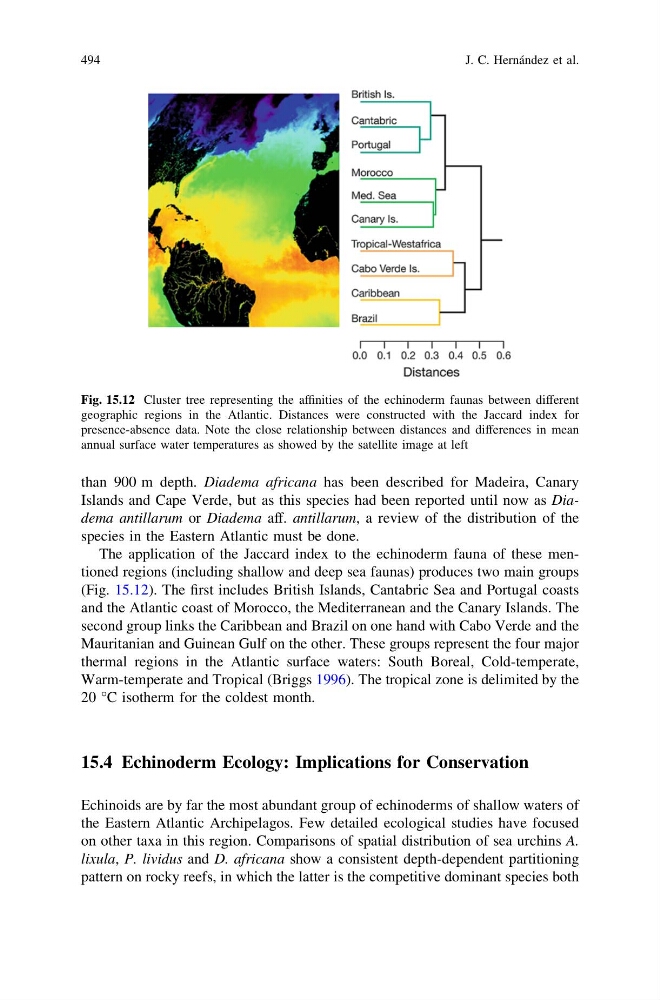
The application of the Jaccard index to the echinoderm fauna of these mentioned regions (including shallow and deep sea faunas) produces two main groups
(Fig. 15.12). The first includes British Islands, Cantabric Sea and Portugal coasts
and the Atlantic coast of Morocco, the Mediterranean and the Canary Islands. The
second group links the Caribbean and Brazil on one hand with Cabo Verde and the
Mauritanian and Guinean Gulf on the other. These groups represent the four major
thermal regions in the Atlantic surface waters: South Boreal, Cold-temperate,
Warm-temperate and Tropical (Briggs 1996). The tropical zone is delimited by the
20 °C isotherm for the coldest month.
15.4 Echinoderm Ecology: Implications for Conservation
Echinoids are by far the most abundant group of echinoderms of shallow waters of
the Eastern Atlantic Archipelagos. Few detailed ecological studies have focused
on other taxa in this region. Comparisons of spatial distribution of sea urchins A.
lixula, P. lividus and D. africana show a consistent depth-dependent partitioning
pattern on rocky reefs, in which the latter is the competitive dominant species both
Fig. 15.12 Cluster tree representing the affinities of the echinoderm faunas between different
geographic regions in the Atlantic. Distances were constructed with the Jaccard index for
presence-absence data. Note the close relationship between distances and differences in mean
annual surface water temperatures as showed by the satellite image at left
494
J. C. Hernández et al.
Islands and Cape Verde, but as this species had been reported until now as Diadema antillarum or Diadema aff. antillarum, a review of the distribution of the
species in the Eastern Atlantic must be done.
The application of the Jaccard index to the echinoderm fauna of these mentioned regions (including shallow and deep sea faunas) produces two main groups
(Fig. 15.12). The first includes British Islands, Cantabric Sea and Portugal coasts
and the Atlantic coast of Morocco, the Mediterranean and the Canary Islands. The
second group links the Caribbean and Brazil on one hand with Cabo Verde and the
Mauritanian and Guinean Gulf on the other. These groups represent the four major
thermal regions in the Atlantic surface waters: South Boreal, Cold-temperate,
Warm-temperate and Tropical (Briggs 1996). The tropical zone is delimited by the
20 °C isotherm for the coldest month.
15.4 Echinoderm Ecology: Implications for Conservation
Echinoids are by far the most abundant group of echinoderms of shallow waters of
the Eastern Atlantic Archipelagos. Few detailed ecological studies have focused
on other taxa in this region. Comparisons of spatial distribution of sea urchins A.
lixula, P. lividus and D. africana show a consistent depth-dependent partitioning
pattern on rocky reefs, in which the latter is the competitive dominant species both
Fig. 15.12 Cluster tree representing the affinities of the echinoderm faunas between different
geographic regions in the Atlantic. Distances were constructed with the Jaccard index for
presence-absence data. Note the close relationship between distances and differences in mean
annual surface water temperatures as showed by the satellite image at left
494
J. C. Hernández et al.