

found in rocky shores with high wave action and is usually in close associations
with the sea urchin Arbacia punctulata (Lamarck). Although the original goal of
the laboratory focused on the regeneration of the digestive tract, spin-off research
from the laboratory has produced important information on holothurian anatomy,
neurobiology, immunology, evolution and genomics among other research areas.
Here we will summarize some of the findings that have resulted from this research.
In summary, the studies in H. glaberrima have provided information of interest
to many research areas other than the field of regenerative biology. Ongoing
studies of the transcriptome of nervous and intestinal systems are expected to
increase the interest of other colleagues in related fields to expand the number of
investigations using not only this species but also other holothurians.
Evisceration
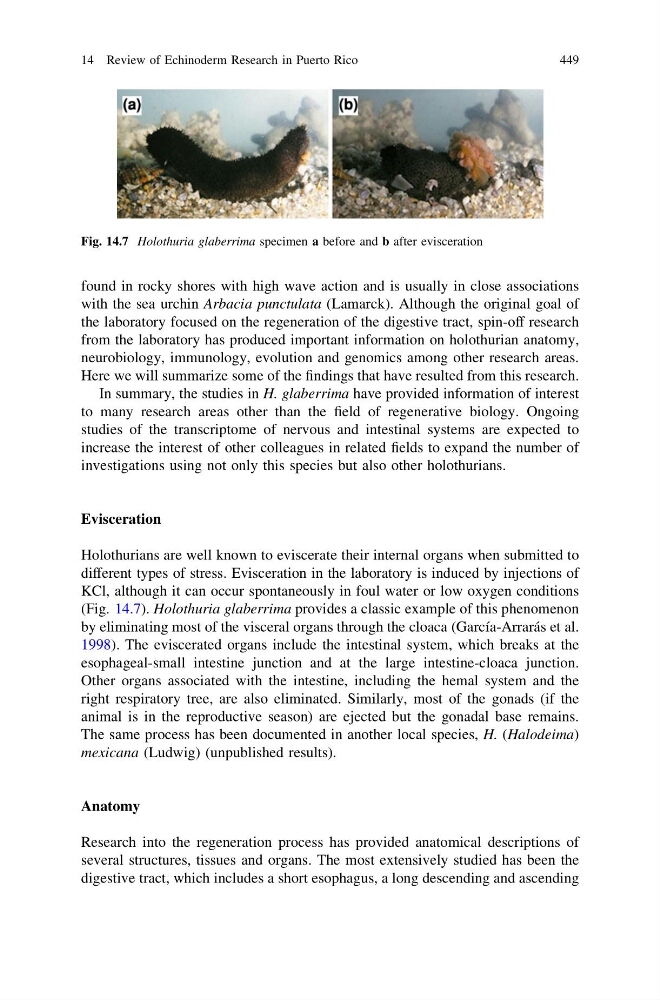
Holothurians are well known to eviscerate their internal organs when submitted to
different types of stress. Evisceration in the laboratory is induced by injections of
KCl, although it can occur spontaneously in foul water or low oxygen conditions
(Fig. 14.7). Holothuria glaberrima provides a classic example of this phenomenon
by eliminating most of the visceral organs through the cloaca (García-Arrarás et al.
1998). The eviscerated organs include the intestinal system, which breaks at the
esophageal-small intestine junction and at the large intestine-cloaca junction.
Other organs associated with the intestine, including the hemal system and the
right respiratory tree, are also eliminated. Similarly, most of the gonads (if the
animal is in the reproductive season) are ejected but the gonadal base remains.
The same process has been documented in another local species, H. (Halodeima)
mexicana (Ludwig) (unpublished results).
Anatomy
Research into the regeneration process has provided anatomical descriptions of
several structures, tissues and organs. The most extensively studied has been the
digestive tract, which includes a short esophagus, a long descending and ascending
Fig. 14.7 Holothuria glaberrima specimen a before and b after evisceration
14 Review of Echinoderm Research in Puerto Rico
449
with the sea urchin Arbacia punctulata (Lamarck). Although the original goal of
the laboratory focused on the regeneration of the digestive tract, spin-off research
from the laboratory has produced important information on holothurian anatomy,
neurobiology, immunology, evolution and genomics among other research areas.
Here we will summarize some of the findings that have resulted from this research.
In summary, the studies in H. glaberrima have provided information of interest
to many research areas other than the field of regenerative biology. Ongoing
studies of the transcriptome of nervous and intestinal systems are expected to
increase the interest of other colleagues in related fields to expand the number of
investigations using not only this species but also other holothurians.
Evisceration
Holothurians are well known to eviscerate their internal organs when submitted to
different types of stress. Evisceration in the laboratory is induced by injections of
KCl, although it can occur spontaneously in foul water or low oxygen conditions
(Fig. 14.7). Holothuria glaberrima provides a classic example of this phenomenon
by eliminating most of the visceral organs through the cloaca (García-Arrarás et al.
1998). The eviscerated organs include the intestinal system, which breaks at the
esophageal-small intestine junction and at the large intestine-cloaca junction.
Other organs associated with the intestine, including the hemal system and the
right respiratory tree, are also eliminated. Similarly, most of the gonads (if the
animal is in the reproductive season) are ejected but the gonadal base remains.
The same process has been documented in another local species, H. (Halodeima)
mexicana (Ludwig) (unpublished results).
Anatomy
Research into the regeneration process has provided anatomical descriptions of
several structures, tissues and organs. The most extensively studied has been the
digestive tract, which includes a short esophagus, a long descending and ascending
Fig. 14.7 Holothuria glaberrima specimen a before and b after evisceration
14 Review of Echinoderm Research in Puerto Rico
449