

(amount of CaCO 3 removed) was estimated and measured in fecal pellets produced over 24 h by urchins from depths of 1–3 m. The size ranges of the urchins
varied between 2 and 2.5 cm in diameter. They repeated four different treatments
11 times during March and April 1998 with different sea urchins. Substrate (pieces
of dead coral) was the same for each treatment. In the different treatments they
estimated (1) endolithic and external CaCO 3 sediment production by urchins, (2)
endolithic bioerosion only, (3) the amount of particulate CaCO 3 the sea urchins
had in their gut, and (4) control for external sedimentation. Fecal pellets were
rinsed with fresh water, dried for 24 h at 70 °C, and then burned in a furnace at
555 °C to eliminate organic matter, and finally at 1,000 °C to determine calcium
carbonate (CaCO 3 ). They found that bioerosion rates of E. viridis were higher in
the shallow areas (1–3 m), areas of high densities. Average densities of E. viridis
ranged from 0.77 to 62 ind m
-2 and size ranged from 2.01 to 2.44 cm at both reefs.
They found the average daily individual bioerosion rate to be 0.18 g day
-1 and the
mean annual bioerosion rates between 1.14 to 4.14 kg m
-2 year
-1 . Bioerosion
rates measured in this study were lower than that reported for many other species
of sea urchins, for example D. antillarum, endolithic sponges and parrotfishes.
However, they found that bioerosion activity of E. viridis had an important effect
on the morphology on the reefs and that the high densities of E. viridis at Palmas
might account for the degradation of coral at this site.
14.2.6 Physiology
Holothuria (Selenkothuria) glaberrima (Selenka) as a Novel Model System
for Cellular/Molecular Studies
The laboratory of Dr. José E. García-Arrarás at the University of Puerto Rico has
made use of a local echinoderm species, the sea cucumber Holothuria glaberrima,
as a novel model system to probe the phenomenon of tissue and organ regeneration.
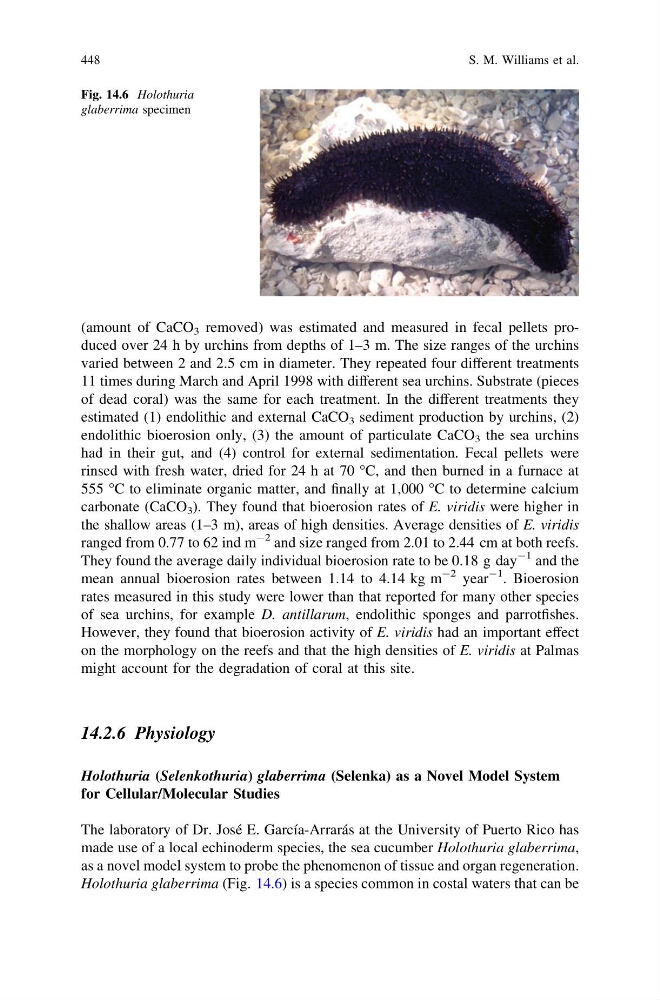
Holothuria glaberrima (Fig. 14.6) is a species common in costal waters that can be
Fig. 14.6 Holothuria
glaberrima specimen
448
S. M. Williams et al.
varied between 2 and 2.5 cm in diameter. They repeated four different treatments
11 times during March and April 1998 with different sea urchins. Substrate (pieces
of dead coral) was the same for each treatment. In the different treatments they
estimated (1) endolithic and external CaCO 3 sediment production by urchins, (2)
endolithic bioerosion only, (3) the amount of particulate CaCO 3 the sea urchins
had in their gut, and (4) control for external sedimentation. Fecal pellets were
rinsed with fresh water, dried for 24 h at 70 °C, and then burned in a furnace at
555 °C to eliminate organic matter, and finally at 1,000 °C to determine calcium
carbonate (CaCO 3 ). They found that bioerosion rates of E. viridis were higher in
the shallow areas (1–3 m), areas of high densities. Average densities of E. viridis
ranged from 0.77 to 62 ind m
-2 and size ranged from 2.01 to 2.44 cm at both reefs.
They found the average daily individual bioerosion rate to be 0.18 g day
-1 and the
mean annual bioerosion rates between 1.14 to 4.14 kg m
-2 year
-1 . Bioerosion
rates measured in this study were lower than that reported for many other species
of sea urchins, for example D. antillarum, endolithic sponges and parrotfishes.
However, they found that bioerosion activity of E. viridis had an important effect
on the morphology on the reefs and that the high densities of E. viridis at Palmas
might account for the degradation of coral at this site.
14.2.6 Physiology
Holothuria (Selenkothuria) glaberrima (Selenka) as a Novel Model System
for Cellular/Molecular Studies
The laboratory of Dr. José E. García-Arrarás at the University of Puerto Rico has
made use of a local echinoderm species, the sea cucumber Holothuria glaberrima,
as a novel model system to probe the phenomenon of tissue and organ regeneration.
Holothuria glaberrima (Fig. 14.6) is a species common in costal waters that can be
Fig. 14.6 Holothuria
glaberrima specimen
448
S. M. Williams et al.