

settlement mainly occurred during the summer (July–September). In 2010, settlers
of D. antillarum were collected during 12 of the 13 sampled months, confirming
year-round reproduction in La Parguera (Lugo 2004; Williams et al. 2009, 2010).
Spatial variations of D. antillarum settlement were evident. There were significantly more recruits collected at the shelf-edge than at the inshore reefs (Miller
et al. 2009; Williams et al. 2010, 2011). Williams et al. (2010) suggested three
non-mutually exclusive explanations for the low settlement at the inshore reefs: (1)
stochastic variation, (2) a shelf-edge reef larval ‘filtering effect’ (Gaines et al.
1985), and (3) high abundance of fleshy macroalgae colonizing the artificial turf
plates precluded settlement at inshore reefs. However, it was proven that fouling of
the substrate was not a major factor precluding the settlement of D. antillarum at
the inshore sites in La Parguera (Williams et al. 2011). Settler mortality and/or low
larval supply were two other possible explanations for the low settlement at
inshore sites in La Parguera. Settlement in all studies was concentrated at the shelfedge where adult D. antillarum are rare. Therefore, D. antillarum recruitment in
La Parguera may be independent of local adult density (Lessios 1988). Postsettlement mortality on D. antillarum at the shelf-edge may be high, which
explains the absence of adults in this area.
14.2.5 Bioerosion
Sea urchins are considered a major bioeroder on coral reef communities. Griffin
et al. (2003) studied the bioerosion of Echinometra viridis on coral reef communities in La Parguera, Puerto Rico. The mean size and densities of E. viridis were
determined at two patch reefs: Palmas and Mario. The daily rate of bioerosion
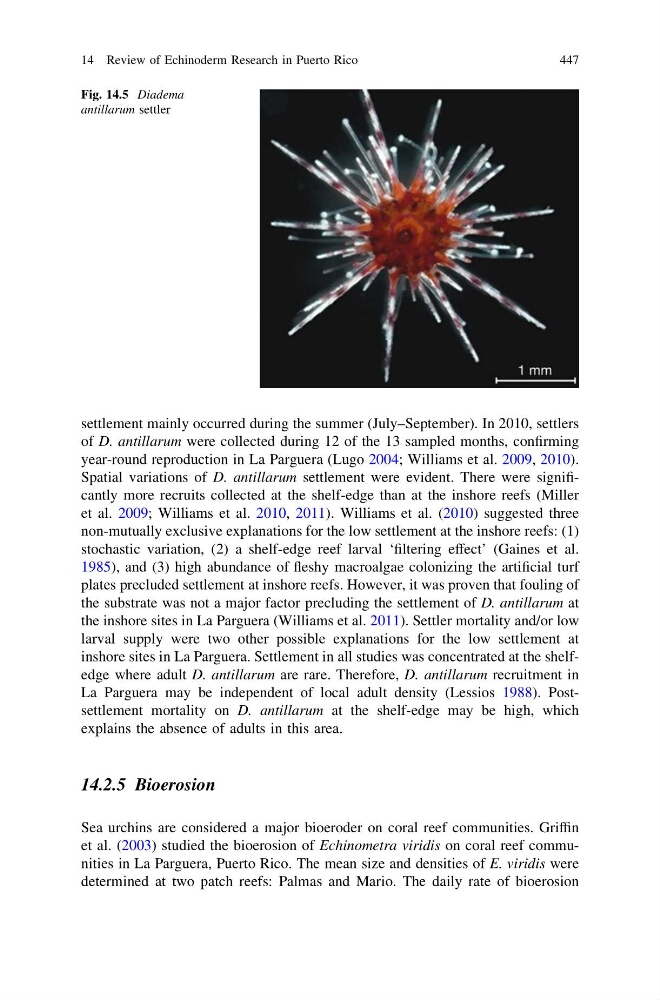
Fig. 14.5 Diadema
antillarum settler
14 Review of Echinoderm Research in Puerto Rico
447
of D. antillarum were collected during 12 of the 13 sampled months, confirming
year-round reproduction in La Parguera (Lugo 2004; Williams et al. 2009, 2010).
Spatial variations of D. antillarum settlement were evident. There were significantly more recruits collected at the shelf-edge than at the inshore reefs (Miller
et al. 2009; Williams et al. 2010, 2011). Williams et al. (2010) suggested three
non-mutually exclusive explanations for the low settlement at the inshore reefs: (1)
stochastic variation, (2) a shelf-edge reef larval ‘filtering effect’ (Gaines et al.
1985), and (3) high abundance of fleshy macroalgae colonizing the artificial turf
plates precluded settlement at inshore reefs. However, it was proven that fouling of
the substrate was not a major factor precluding the settlement of D. antillarum at
the inshore sites in La Parguera (Williams et al. 2011). Settler mortality and/or low
larval supply were two other possible explanations for the low settlement at
inshore sites in La Parguera. Settlement in all studies was concentrated at the shelfedge where adult D. antillarum are rare. Therefore, D. antillarum recruitment in
La Parguera may be independent of local adult density (Lessios 1988). Postsettlement mortality on D. antillarum at the shelf-edge may be high, which
explains the absence of adults in this area.
14.2.5 Bioerosion
Sea urchins are considered a major bioeroder on coral reef communities. Griffin
et al. (2003) studied the bioerosion of Echinometra viridis on coral reef communities in La Parguera, Puerto Rico. The mean size and densities of E. viridis were
determined at two patch reefs: Palmas and Mario. The daily rate of bioerosion
Fig. 14.5 Diadema
antillarum settler
14 Review of Echinoderm Research in Puerto Rico
447