

Larval settlement of D. antillarum was assessed in three separate surveys
(Miller et al. 2009; Williams et al. 2010, 2011) in La Parguera, Puerto Rico. Miller
et al. (2009) assessed the rates of D. antillarum larval settlement at two sites
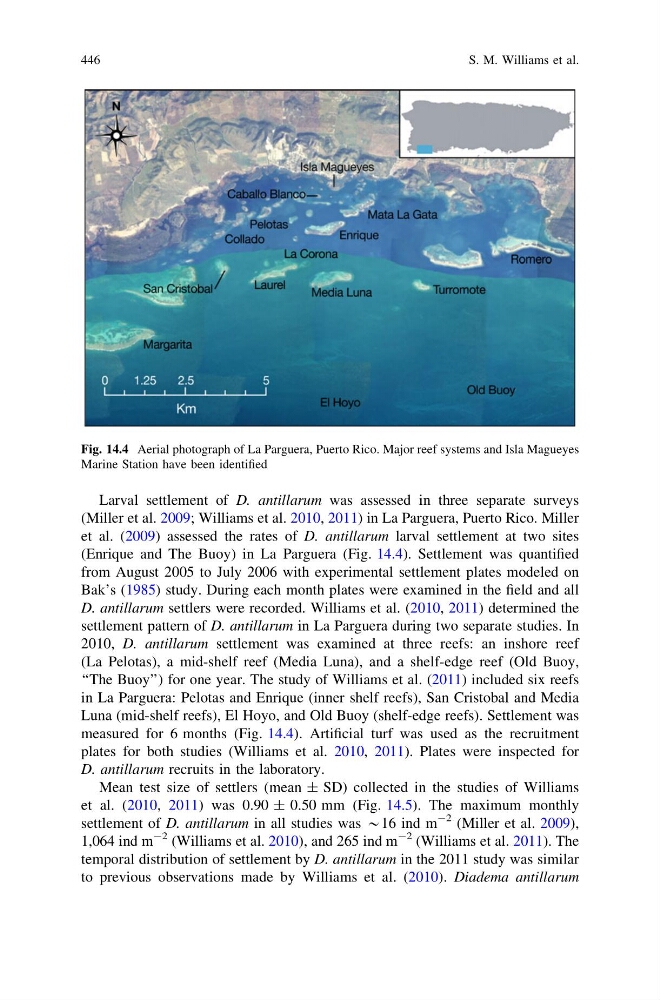
(Enrique and The Buoy) in La Parguera (Fig. 14.4). Settlement was quantified
from August 2005 to July 2006 with experimental settlement plates modeled on
Bak’s (1985) study. During each month plates were examined in the field and all
D. antillarum settlers were recorded. Williams et al. (2010, 2011) determined the
settlement pattern of D. antillarum in La Parguera during two separate studies. In
2010, D. antillarum settlement was examined at three reefs: an inshore reef
(La Pelotas), a mid-shelf reef (Media Luna), and a shelf-edge reef (Old Buoy,
‘‘The Buoy’’) for one year. The study of Williams et al. (2011) included six reefs
in La Parguera: Pelotas and Enrique (inner shelf reefs), San Cristobal and Media
Luna (mid-shelf reefs), El Hoyo, and Old Buoy (shelf-edge reefs). Settlement was
measured for 6 months (Fig. 14.4). Artificial turf was used as the recruitment
plates for both studies (Williams et al. 2010, 2011). Plates were inspected for
D. antillarum recruits in the laboratory.
Mean test size of settlers (mean ± SD) collected in the studies of Williams
et al. (2010, 2011) was 0.90 ± 0.50 mm (Fig. 14.5). The maximum monthly
settlement of D. antillarum in all studies was *16 ind m
-2 (Miller et al. 2009),
1,064 ind m
-2 (Williams et al. 2010), and 265 ind m
-2 (Williams et al. 2011). The
temporal distribution of settlement by D. antillarum in the 2011 study was similar
to previous observations made by Williams et al. (2010). Diadema antillarum
Fig. 14.4 Aerial photograph of La Parguera, Puerto Rico. Major reef systems and Isla Magueyes
Marine Station have been identified
446
S. M. Williams et al.
(Miller et al. 2009; Williams et al. 2010, 2011) in La Parguera, Puerto Rico. Miller
et al. (2009) assessed the rates of D. antillarum larval settlement at two sites
(Enrique and The Buoy) in La Parguera (Fig. 14.4). Settlement was quantified
from August 2005 to July 2006 with experimental settlement plates modeled on
Bak’s (1985) study. During each month plates were examined in the field and all
D. antillarum settlers were recorded. Williams et al. (2010, 2011) determined the
settlement pattern of D. antillarum in La Parguera during two separate studies. In
2010, D. antillarum settlement was examined at three reefs: an inshore reef
(La Pelotas), a mid-shelf reef (Media Luna), and a shelf-edge reef (Old Buoy,
‘‘The Buoy’’) for one year. The study of Williams et al. (2011) included six reefs
in La Parguera: Pelotas and Enrique (inner shelf reefs), San Cristobal and Media
Luna (mid-shelf reefs), El Hoyo, and Old Buoy (shelf-edge reefs). Settlement was
measured for 6 months (Fig. 14.4). Artificial turf was used as the recruitment
plates for both studies (Williams et al. 2010, 2011). Plates were inspected for
D. antillarum recruits in the laboratory.
Mean test size of settlers (mean ± SD) collected in the studies of Williams
et al. (2010, 2011) was 0.90 ± 0.50 mm (Fig. 14.5). The maximum monthly
settlement of D. antillarum in all studies was *16 ind m
-2 (Miller et al. 2009),
1,064 ind m
-2 (Williams et al. 2010), and 265 ind m
-2 (Williams et al. 2011). The
temporal distribution of settlement by D. antillarum in the 2011 study was similar
to previous observations made by Williams et al. (2010). Diadema antillarum
Fig. 14.4 Aerial photograph of La Parguera, Puerto Rico. Major reef systems and Isla Magueyes
Marine Station have been identified
446
S. M. Williams et al.