

(June–July 2001) to 11.2 (December 2001). High gonad indices were observed
during the late fall (9.5) to winter during times when sea surface temperatures were
at its lowest values (26 °C). Lugo (2004) estimated that D. antillarum spawn
during early spring and early summer. He also found a significant negative relationship between monthly mean gonad indices and sea surface temperature. The
smallest sexually mature urchin was 3.8 cm in diameter. The male:female ratio
was 0.89:1 during his study.
Williams et al. (2009) measured the temporal variations of early larval stages in
neritic waters of La Parguera. They also measured the water current velocities and
directions of inshore areas of La Parguera. During April 2005, six drogues were
deployed. They also deployed an Acoustic Doppler Current Profiler (ADCP)
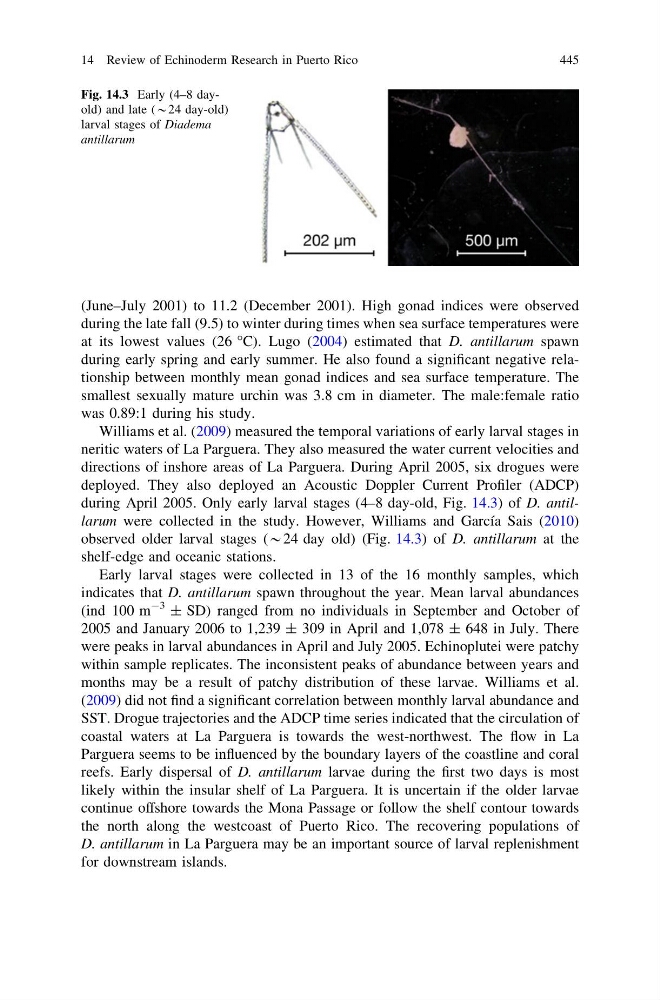
during April 2005. Only early larval stages (4–8 day-old, Fig. 14.3) of D. antillarum were collected in the study. However, Williams and García Sais (2010)
observed older larval stages (*24 day old) (Fig. 14.3) of D. antillarum at the
shelf-edge and oceanic stations.
Early larval stages were collected in 13 of the 16 monthly samples, which
indicates that D. antillarum spawn throughout the year. Mean larval abundances
(ind 100 m
-3 ± SD) ranged from no individuals in September and October of
2005 and January 2006 to 1,239 ± 309 in April and 1,078 ± 648 in July. There
were peaks in larval abundances in April and July 2005. Echinoplutei were patchy
within sample replicates. The inconsistent peaks of abundance between years and
months may be a result of patchy distribution of these larvae. Williams et al.
(2009) did not find a significant correlation between monthly larval abundance and
SST. Drogue trajectories and the ADCP time series indicated that the circulation of
coastal waters at La Parguera is towards the west-northwest. The flow in La
Parguera seems to be influenced by the boundary layers of the coastline and coral
reefs. Early dispersal of D. antillarum larvae during the first two days is most
likely within the insular shelf of La Parguera. It is uncertain if the older larvae
continue offshore towards the Mona Passage or follow the shelf contour towards
the north along the westcoast of Puerto Rico. The recovering populations of
D. antillarum in La Parguera may be an important source of larval replenishment
for downstream islands.
Fig. 14.3 Early (4–8 dayold) and late (*24 day-old)
larval stages of Diadema
antillarum
14 Review of Echinoderm Research in Puerto Rico
445
during the late fall (9.5) to winter during times when sea surface temperatures were
at its lowest values (26 °C). Lugo (2004) estimated that D. antillarum spawn
during early spring and early summer. He also found a significant negative relationship between monthly mean gonad indices and sea surface temperature. The
smallest sexually mature urchin was 3.8 cm in diameter. The male:female ratio
was 0.89:1 during his study.
Williams et al. (2009) measured the temporal variations of early larval stages in
neritic waters of La Parguera. They also measured the water current velocities and
directions of inshore areas of La Parguera. During April 2005, six drogues were
deployed. They also deployed an Acoustic Doppler Current Profiler (ADCP)
during April 2005. Only early larval stages (4–8 day-old, Fig. 14.3) of D. antillarum were collected in the study. However, Williams and García Sais (2010)
observed older larval stages (*24 day old) (Fig. 14.3) of D. antillarum at the
shelf-edge and oceanic stations.
Early larval stages were collected in 13 of the 16 monthly samples, which
indicates that D. antillarum spawn throughout the year. Mean larval abundances
(ind 100 m
-3 ± SD) ranged from no individuals in September and October of
2005 and January 2006 to 1,239 ± 309 in April and 1,078 ± 648 in July. There
were peaks in larval abundances in April and July 2005. Echinoplutei were patchy
within sample replicates. The inconsistent peaks of abundance between years and
months may be a result of patchy distribution of these larvae. Williams et al.
(2009) did not find a significant correlation between monthly larval abundance and
SST. Drogue trajectories and the ADCP time series indicated that the circulation of
coastal waters at La Parguera is towards the west-northwest. The flow in La
Parguera seems to be influenced by the boundary layers of the coastline and coral
reefs. Early dispersal of D. antillarum larvae during the first two days is most
likely within the insular shelf of La Parguera. It is uncertain if the older larvae
continue offshore towards the Mona Passage or follow the shelf contour towards
the north along the westcoast of Puerto Rico. The recovering populations of
D. antillarum in La Parguera may be an important source of larval replenishment
for downstream islands.
Fig. 14.3 Early (4–8 dayold) and late (*24 day-old)
larval stages of Diadema
antillarum
14 Review of Echinoderm Research in Puerto Rico
445