

Ten years after the mass mortality densities remained at less than 3.5 % of their
pre-mortality levels, with D. antillarum being absent in its preferred habits in San
Blas (Lessios 1995). Moreover, the mean size of individuals remained low
(17.3–35.2 mm). This was thought to be a direct result of the disease, as food
availability was not a limiting factor (Lessios 1995).
Twenty years after the mass mortality populations remained at less than 6.5 %
of their pre-mortality levels in San Blas (Lessios 2005b). Some successful
recruitment events have been observed on a few reefs. However, these have not
been sustained over time (Lessios 2005b). The lack of apparent recruitment could
have been caused by too few adults in upstream areas to reproduce at a rate that
would overcome the normal sources of mortality (the Allee effect) or by the
continuing presence of the pathogen that devastated the populations in 1983–1984.
Recent observations (2010) on some San Blas reefs indicate a slight recovery
(Fig. 4.12), however, it remains to be seen if these populations will be sustained.
On 27 April 1986 more than 8 million liters of crude oil spilled into a complex
region of mangroves, seagrassses, and coral reefs east of the Caribbean entrance to
the Panama Canal (Jackson et al. 1989). At the seaward edge, numbers of the most
abundant sea urchin E. lucunter was reduced by 80 % within a few days of the
spill, and the reef flat was littered with its skeletons (Jackson et al. 1989). However, further inshore no such mortality of E. lucunter was reported (Jackson et al.
1989).
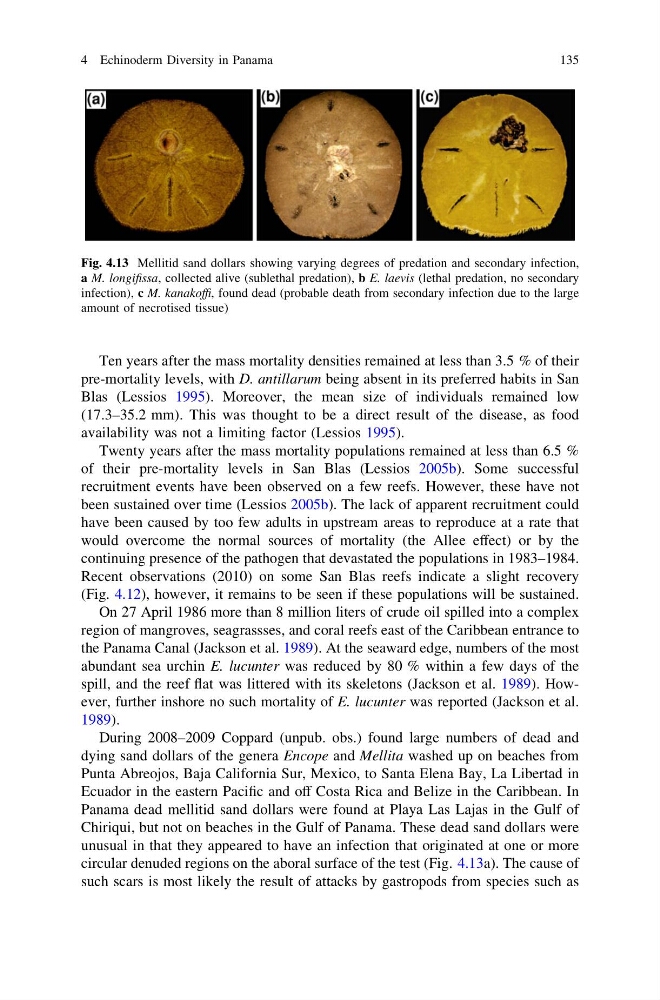
During 2008–2009 Coppard (unpub. obs.) found large numbers of dead and
dying sand dollars of the genera Encope and Mellita washed up on beaches from
Punta Abreojos, Baja California Sur, Mexico, to Santa Elena Bay, La Libertad in
Ecuador in the eastern Pacific and off Costa Rica and Belize in the Caribbean. In
Panama dead mellitid sand dollars were found at Playa Las Lajas in the Gulf of
Chiriqui, but not on beaches in the Gulf of Panama. These dead sand dollars were
unusual in that they appeared to have an infection that originated at one or more
circular denuded regions on the aboral surface of the test (Fig. 4.13a). The cause of
such scars is most likely the result of attacks by gastropods from species such as
Fig. 4.13 Mellitid sand dollars showing varying degrees of predation and secondary infection,
a M. longifissa, collected alive (sublethal predation), b E. laevis (lethal predation, no secondary
infection), c M. kanakoffi, found dead (probable death from secondary infection due to the large
amount of necrotised tissue)
4 Echinoderm Diversity in Panama
135
pre-mortality levels, with D. antillarum being absent in its preferred habits in San
Blas (Lessios 1995). Moreover, the mean size of individuals remained low
(17.3–35.2 mm). This was thought to be a direct result of the disease, as food
availability was not a limiting factor (Lessios 1995).
Twenty years after the mass mortality populations remained at less than 6.5 %
of their pre-mortality levels in San Blas (Lessios 2005b). Some successful
recruitment events have been observed on a few reefs. However, these have not
been sustained over time (Lessios 2005b). The lack of apparent recruitment could
have been caused by too few adults in upstream areas to reproduce at a rate that
would overcome the normal sources of mortality (the Allee effect) or by the
continuing presence of the pathogen that devastated the populations in 1983–1984.
Recent observations (2010) on some San Blas reefs indicate a slight recovery
(Fig. 4.12), however, it remains to be seen if these populations will be sustained.
On 27 April 1986 more than 8 million liters of crude oil spilled into a complex
region of mangroves, seagrassses, and coral reefs east of the Caribbean entrance to
the Panama Canal (Jackson et al. 1989). At the seaward edge, numbers of the most
abundant sea urchin E. lucunter was reduced by 80 % within a few days of the
spill, and the reef flat was littered with its skeletons (Jackson et al. 1989). However, further inshore no such mortality of E. lucunter was reported (Jackson et al.
1989).
During 2008–2009 Coppard (unpub. obs.) found large numbers of dead and
dying sand dollars of the genera Encope and Mellita washed up on beaches from
Punta Abreojos, Baja California Sur, Mexico, to Santa Elena Bay, La Libertad in
Ecuador in the eastern Pacific and off Costa Rica and Belize in the Caribbean. In
Panama dead mellitid sand dollars were found at Playa Las Lajas in the Gulf of
Chiriqui, but not on beaches in the Gulf of Panama. These dead sand dollars were
unusual in that they appeared to have an infection that originated at one or more
circular denuded regions on the aboral surface of the test (Fig. 4.13a). The cause of
such scars is most likely the result of attacks by gastropods from species such as
Fig. 4.13 Mellitid sand dollars showing varying degrees of predation and secondary infection,
a M. longifissa, collected alive (sublethal predation), b E. laevis (lethal predation, no secondary
infection), c M. kanakoffi, found dead (probable death from secondary infection due to the large
amount of necrotised tissue)
4 Echinoderm Diversity in Panama
135