

January 1984 the die-off had spread throughout the rest of the Caribbean with
population densities in Panama reduced to 5.8 % of their previous levels (Lessios
et al. 1984a). The first symptom of the presumed disease was accumulation of
sediment on the spines and sloughing off of the spine ectoderm. This was followed
by loss of pigmentation in the skin covering the spine muscles, the peristome, and
in the periproctal cone. Spines became brittle and broke, while others fell off
completely, exposing areoles and tubercules. Tube feet became flaccid, no longer
retracted fully upon stimulation, and were unable to cling to the substrate. Many
individuals at this stage were found on their sides or being moved to and fro by the
surge. In advanced stages large patches of skin pealed off the test, the peristome
and the anal cone lost practically all pigmentation, and the spines could be pulled
off with little force (Lessios et al. 1984b).
Before the mass mortality, mean densities of D. antillarum on reefs at Punta
Galeta and San Blas where 1.82 and 1.91 ind m
-2 , respectively (Lessios et al.
1984b). After the mass mortality the densities dropped to an average of 0.05 ind
m
-2 in San Blas, and to 0.004 ind m
-2 in Punta Galeta. This density reduction was
not observed in other species of echinoids (E. lucunter, E. viridis, Echinoneus
cyclostomus (Leske, 1758), E. tribuloides, L. variegatus and T. ventricosus (Lamarck 1816)) on the same reefs. In San Blas, the mean sizes were reduced from
48.6 mm to 25.0 mm (Lessios et al. 1984b). However, this mass reduction on the
population did not have any consequence on its genetic variability (Lessios
1985b).
Five years after the event, Lessios (1988) did not observe any recovery of the
populations on the San Blas reefs, with little influx of juveniles and no increase in
population densities of other sea urchins species (E. viridis, E. lucunter, E. tribuloides,
T. ventricosus, or L. variegatus). He reported no alteration in the reproductive
behaviour of D. antillarum, proposing that the low recruitment success could be an
effect of low populations densities and low adult numbers.
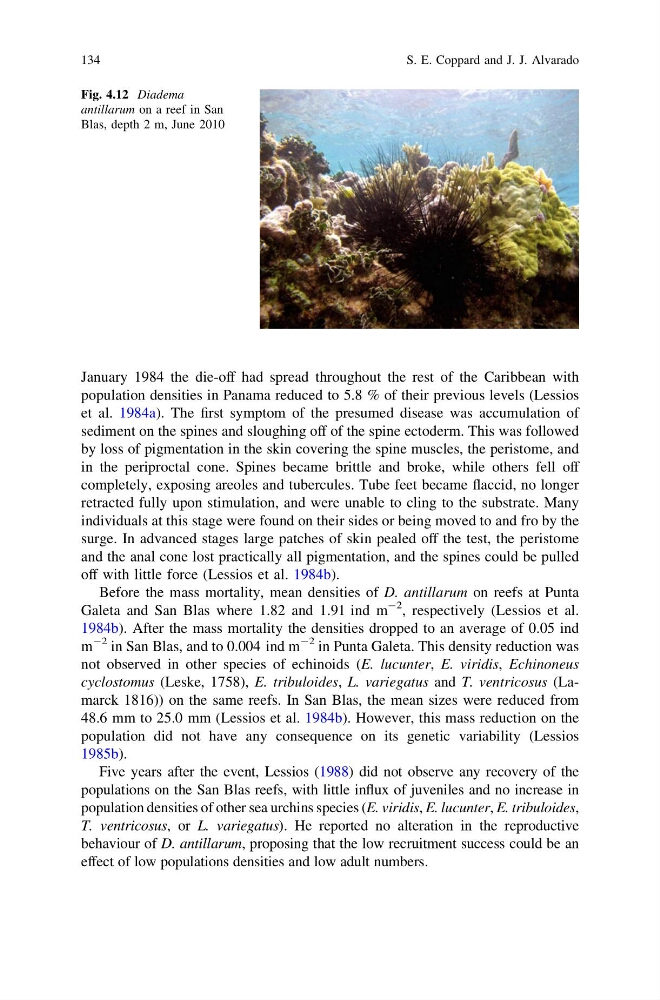
Fig. 4.12 Diadema
antillarum on a reef in San
Blas, depth 2 m, June 2010
134
S. E. Coppard and J. J. Alvarado
population densities in Panama reduced to 5.8 % of their previous levels (Lessios
et al. 1984a). The first symptom of the presumed disease was accumulation of
sediment on the spines and sloughing off of the spine ectoderm. This was followed
by loss of pigmentation in the skin covering the spine muscles, the peristome, and
in the periproctal cone. Spines became brittle and broke, while others fell off
completely, exposing areoles and tubercules. Tube feet became flaccid, no longer
retracted fully upon stimulation, and were unable to cling to the substrate. Many
individuals at this stage were found on their sides or being moved to and fro by the
surge. In advanced stages large patches of skin pealed off the test, the peristome
and the anal cone lost practically all pigmentation, and the spines could be pulled
off with little force (Lessios et al. 1984b).
Before the mass mortality, mean densities of D. antillarum on reefs at Punta
Galeta and San Blas where 1.82 and 1.91 ind m
-2 , respectively (Lessios et al.
1984b). After the mass mortality the densities dropped to an average of 0.05 ind
m
-2 in San Blas, and to 0.004 ind m
-2 in Punta Galeta. This density reduction was
not observed in other species of echinoids (E. lucunter, E. viridis, Echinoneus
cyclostomus (Leske, 1758), E. tribuloides, L. variegatus and T. ventricosus (Lamarck 1816)) on the same reefs. In San Blas, the mean sizes were reduced from
48.6 mm to 25.0 mm (Lessios et al. 1984b). However, this mass reduction on the
population did not have any consequence on its genetic variability (Lessios
1985b).
Five years after the event, Lessios (1988) did not observe any recovery of the
populations on the San Blas reefs, with little influx of juveniles and no increase in
population densities of other sea urchins species (E. viridis, E. lucunter, E. tribuloides,
T. ventricosus, or L. variegatus). He reported no alteration in the reproductive
behaviour of D. antillarum, proposing that the low recruitment success could be an
effect of low populations densities and low adult numbers.
Fig. 4.12 Diadema
antillarum on a reef in San
Blas, depth 2 m, June 2010
134
S. E. Coppard and J. J. Alvarado