

species of holothuroids would collapse within a very short period of time
(305 days for H. (H.) mexicana, 221 days I. badionotus and only 9 days for
A. multifidus), based on a catch effort of 25,000 ind day
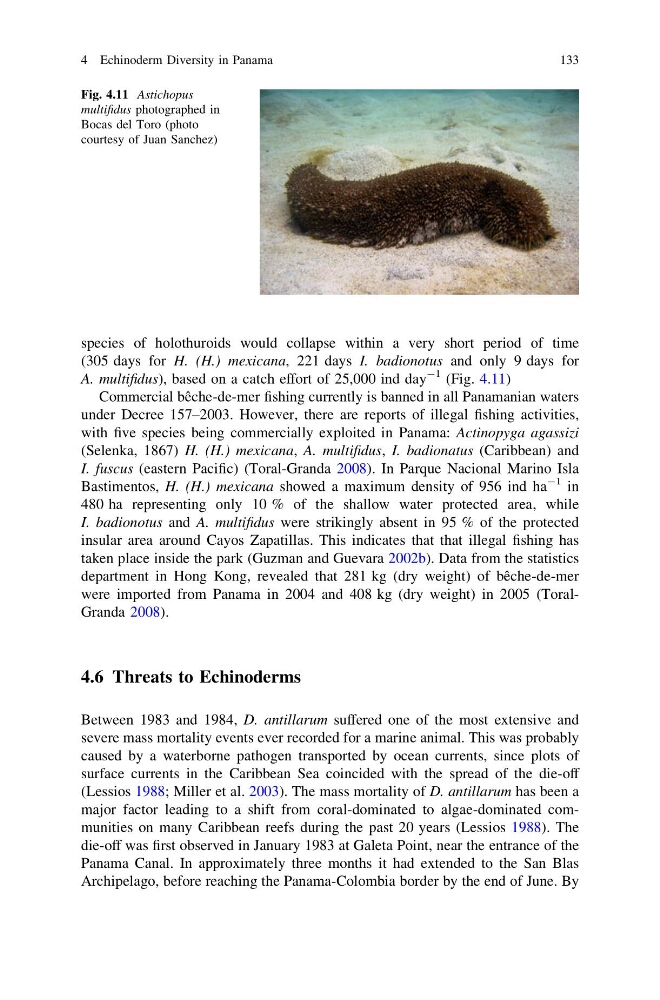
-1 (Fig. 4.11)
Commercial bêche-de-mer fishing currently is banned in all Panamanian waters
under Decree 157–2003. However, there are reports of illegal fishing activities,
with five species being commercially exploited in Panama: Actinopyga agassizi
(Selenka, 1867) H. (H.) mexicana, A. multifidus, I. badionatus (Caribbean) and
I. fuscus (eastern Pacific) (Toral-Granda 2008). In Parque Nacional Marino Isla
Bastimentos, H. (H.) mexicana showed a maximum density of 956 ind ha
-1 in
480 ha representing only 10 % of the shallow water protected area, while
I. badionotus and A. multifidus were strikingly absent in 95 % of the protected
insular area around Cayos Zapatillas. This indicates that that illegal fishing has
taken place inside the park (Guzman and Guevara 2002b). Data from the statistics
department in Hong Kong, revealed that 281 kg (dry weight) of bêche-de-mer
were imported from Panama in 2004 and 408 kg (dry weight) in 2005 (ToralGranda 2008).
4.6 Threats to Echinoderms
Between 1983 and 1984, D. antillarum suffered one of the most extensive and
severe mass mortality events ever recorded for a marine animal. This was probably
caused by a waterborne pathogen transported by ocean currents, since plots of
surface currents in the Caribbean Sea coincided with the spread of the die-off
(Lessios 1988; Miller et al. 2003). The mass mortality of D. antillarum has been a
major factor leading to a shift from coral-dominated to algae-dominated communities on many Caribbean reefs during the past 20 years (Lessios 1988). The
die-off was first observed in January 1983 at Galeta Point, near the entrance of the
Panama Canal. In approximately three months it had extended to the San Blas
Archipelago, before reaching the Panama-Colombia border by the end of June. By
Fig. 4.11 Astichopus
multifidus photographed in
Bocas del Toro (photo
courtesy of Juan Sanchez)
4 Echinoderm Diversity in Panama
133
(305 days for H. (H.) mexicana, 221 days I. badionotus and only 9 days for
A. multifidus), based on a catch effort of 25,000 ind day
-1 (Fig. 4.11)
Commercial bêche-de-mer fishing currently is banned in all Panamanian waters
under Decree 157–2003. However, there are reports of illegal fishing activities,
with five species being commercially exploited in Panama: Actinopyga agassizi
(Selenka, 1867) H. (H.) mexicana, A. multifidus, I. badionatus (Caribbean) and
I. fuscus (eastern Pacific) (Toral-Granda 2008). In Parque Nacional Marino Isla
Bastimentos, H. (H.) mexicana showed a maximum density of 956 ind ha
-1 in
480 ha representing only 10 % of the shallow water protected area, while
I. badionotus and A. multifidus were strikingly absent in 95 % of the protected
insular area around Cayos Zapatillas. This indicates that that illegal fishing has
taken place inside the park (Guzman and Guevara 2002b). Data from the statistics
department in Hong Kong, revealed that 281 kg (dry weight) of bêche-de-mer
were imported from Panama in 2004 and 408 kg (dry weight) in 2005 (ToralGranda 2008).
4.6 Threats to Echinoderms
Between 1983 and 1984, D. antillarum suffered one of the most extensive and
severe mass mortality events ever recorded for a marine animal. This was probably
caused by a waterborne pathogen transported by ocean currents, since plots of
surface currents in the Caribbean Sea coincided with the spread of the die-off
(Lessios 1988; Miller et al. 2003). The mass mortality of D. antillarum has been a
major factor leading to a shift from coral-dominated to algae-dominated communities on many Caribbean reefs during the past 20 years (Lessios 1988). The
die-off was first observed in January 1983 at Galeta Point, near the entrance of the
Panama Canal. In approximately three months it had extended to the San Blas
Archipelago, before reaching the Panama-Colombia border by the end of June. By
Fig. 4.11 Astichopus
multifidus photographed in
Bocas del Toro (photo
courtesy of Juan Sanchez)
4 Echinoderm Diversity in Panama
133