

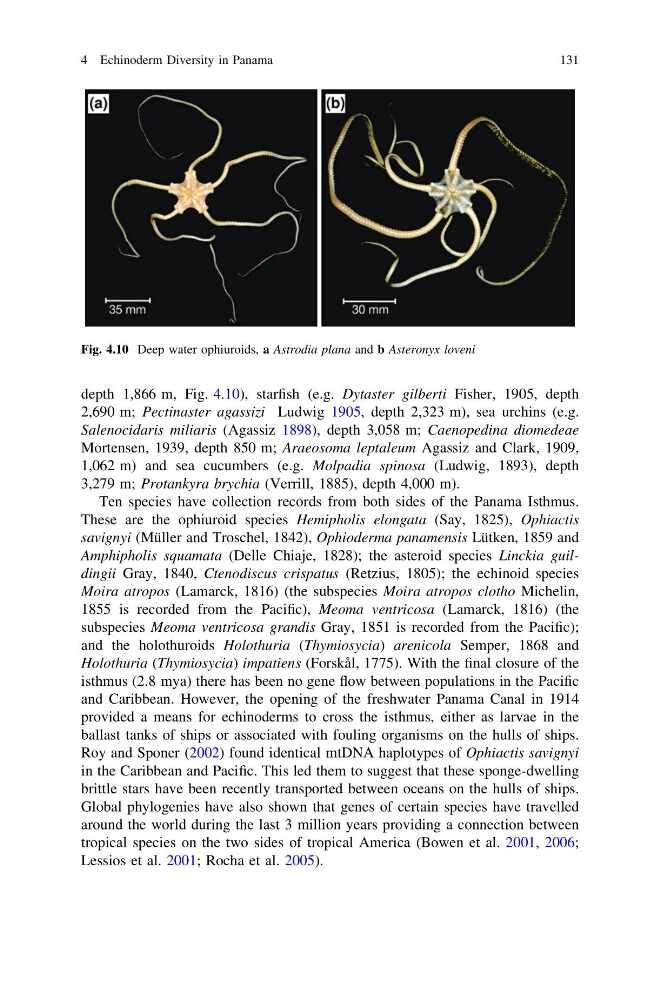
depth 1,866 m, Fig. 4.10), starfish (e.g. Dytaster gilberti Fisher, 1905, depth
2,690 m; Pectinaster agassizi Ludwig 1905, depth 2,323 m), sea urchins (e.g.
Salenocidaris miliaris (Agassiz 1898), depth 3,058 m; Caenopedina diomedeae
Mortensen, 1939, depth 850 m; Araeosoma leptaleum Agassiz and Clark, 1909,
1,062 m) and sea cucumbers (e.g. Molpadia spinosa (Ludwig, 1893), depth
3,279 m; Protankyra brychia (Verrill, 1885), depth 4,000 m).
Ten species have collection records from both sides of the Panama Isthmus.
These are the ophiuroid species Hemipholis elongata (Say, 1825), Ophiactis
savignyi (Müller and Troschel, 1842), Ophioderma panamensis Lütken, 1859 and
Amphipholis squamata (Delle Chiaje, 1828); the asteroid species Linckia guildingii Gray, 1840, Ctenodiscus crispatus (Retzius, 1805); the echinoid species
Moira atropos (Lamarck, 1816) (the subspecies Moira atropos clotho Michelin,
1855 is recorded from the Pacific), Meoma ventricosa (Lamarck, 1816) (the
subspecies Meoma ventricosa grandis Gray, 1851 is recorded from the Pacific);
and the holothuroids Holothuria (Thymiosycia) arenicola Semper, 1868 and
Holothuria (Thymiosycia) impatiens (Forskål, 1775). With the final closure of the
isthmus (2.8 mya) there has been no gene flow between populations in the Pacific
and Caribbean. However, the opening of the freshwater Panama Canal in 1914
provided a means for echinoderms to cross the isthmus, either as larvae in the
ballast tanks of ships or associated with fouling organisms on the hulls of ships.
Roy and Sponer (2002) found identical mtDNA haplotypes of Ophiactis savignyi
in the Caribbean and Pacific. This led them to suggest that these sponge-dwelling
brittle stars have been recently transported between oceans on the hulls of ships.
Global phylogenies have also shown that genes of certain species have travelled
around the world during the last 3 million years providing a connection between
tropical species on the two sides of tropical America (Bowen et al. 2001, 2006;
Lessios et al. 2001; Rocha et al. 2005).
Fig. 4.10 Deep water ophiuroids, a Astrodia plana and b Asteronyx loveni
4 Echinoderm Diversity in Panama
131
2,690 m; Pectinaster agassizi Ludwig 1905, depth 2,323 m), sea urchins (e.g.
Salenocidaris miliaris (Agassiz 1898), depth 3,058 m; Caenopedina diomedeae
Mortensen, 1939, depth 850 m; Araeosoma leptaleum Agassiz and Clark, 1909,
1,062 m) and sea cucumbers (e.g. Molpadia spinosa (Ludwig, 1893), depth
3,279 m; Protankyra brychia (Verrill, 1885), depth 4,000 m).
Ten species have collection records from both sides of the Panama Isthmus.
These are the ophiuroid species Hemipholis elongata (Say, 1825), Ophiactis
savignyi (Müller and Troschel, 1842), Ophioderma panamensis Lütken, 1859 and
Amphipholis squamata (Delle Chiaje, 1828); the asteroid species Linckia guildingii Gray, 1840, Ctenodiscus crispatus (Retzius, 1805); the echinoid species
Moira atropos (Lamarck, 1816) (the subspecies Moira atropos clotho Michelin,
1855 is recorded from the Pacific), Meoma ventricosa (Lamarck, 1816) (the
subspecies Meoma ventricosa grandis Gray, 1851 is recorded from the Pacific);
and the holothuroids Holothuria (Thymiosycia) arenicola Semper, 1868 and
Holothuria (Thymiosycia) impatiens (Forskål, 1775). With the final closure of the
isthmus (2.8 mya) there has been no gene flow between populations in the Pacific
and Caribbean. However, the opening of the freshwater Panama Canal in 1914
provided a means for echinoderms to cross the isthmus, either as larvae in the
ballast tanks of ships or associated with fouling organisms on the hulls of ships.
Roy and Sponer (2002) found identical mtDNA haplotypes of Ophiactis savignyi
in the Caribbean and Pacific. This led them to suggest that these sponge-dwelling
brittle stars have been recently transported between oceans on the hulls of ships.
Global phylogenies have also shown that genes of certain species have travelled
around the world during the last 3 million years providing a connection between
tropical species on the two sides of tropical America (Bowen et al. 2001, 2006;
Lessios et al. 2001; Rocha et al. 2005).
Fig. 4.10 Deep water ophiuroids, a Astrodia plana and b Asteronyx loveni
4 Echinoderm Diversity in Panama
131