

corals (Glynn 1982), sponges (Van Soest 1994), benthic foraminiferans (Collins
1999), cheilostome bryozoans (Cheetham et al. 2001) and cupuladriid bryozoans
(O’Dea et al. 2004). With the exception of crinoids, the diversity of echinoderms
off Panama shows a very different trend, with a far greater diversity in the Pacific
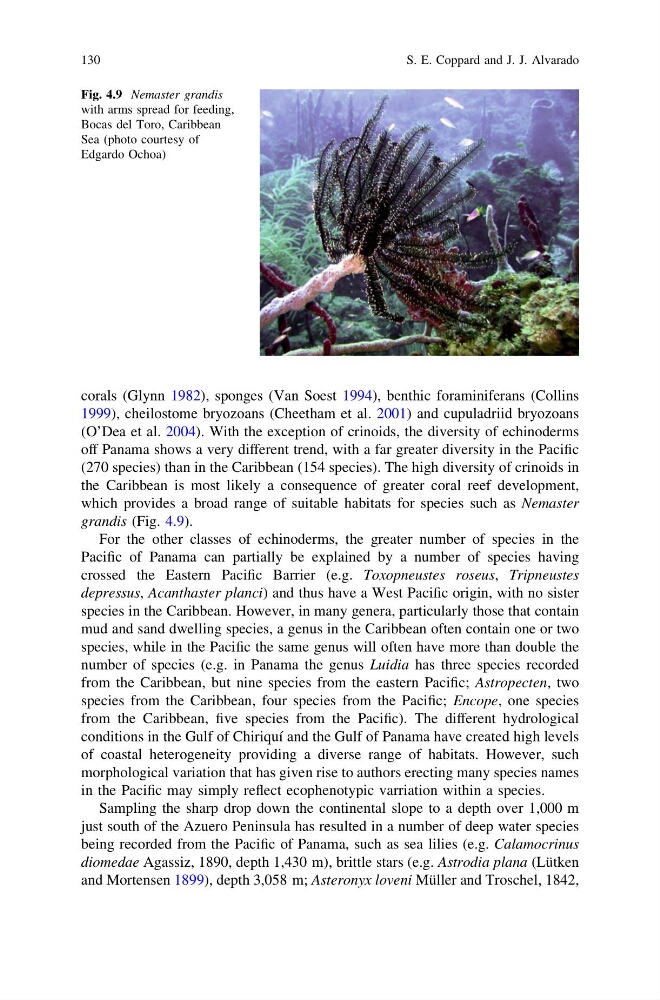
(270 species) than in the Caribbean (154 species). The high diversity of crinoids in
the Caribbean is most likely a consequence of greater coral reef development,
which provides a broad range of suitable habitats for species such as Nemaster
grandis (Fig. 4.9).
For the other classes of echinoderms, the greater number of species in the
Pacific of Panama can partially be explained by a number of species having
crossed the Eastern Pacific Barrier (e.g. Toxopneustes roseus, Tripneustes
depressus, Acanthaster planci) and thus have a West Pacific origin, with no sister
species in the Caribbean. However, in many genera, particularly those that contain
mud and sand dwelling species, a genus in the Caribbean often contain one or two
species, while in the Pacific the same genus will often have more than double the
number of species (e.g. in Panama the genus Luidia has three species recorded
from the Caribbean, but nine species from the eastern Pacific; Astropecten, two
species from the Caribbean, four species from the Pacific; Encope, one species
from the Caribbean, five species from the Pacific). The different hydrological
conditions in the Gulf of Chiriquí and the Gulf of Panama have created high levels
of coastal heterogeneity providing a diverse range of habitats. However, such
morphological variation that has given rise to authors erecting many species names
in the Pacific may simply reflect ecophenotypic varriation within a species.
Sampling the sharp drop down the continental slope to a depth over 1,000 m
just south of the Azuero Peninsula has resulted in a number of deep water species
being recorded from the Pacific of Panama, such as sea lilies (e.g. Calamocrinus
diomedae Agassiz, 1890, depth 1,430 m), brittle stars (e.g. Astrodia plana (Lütken
and Mortensen 1899), depth 3,058 m; Asteronyx loveni Müller and Troschel, 1842,
Fig. 4.9 Nemaster grandis
with arms spread for feeding,
Bocas del Toro, Caribbean
Sea (photo courtesy of
Edgardo Ochoa)
130
S. E. Coppard and J. J. Alvarado
1999), cheilostome bryozoans (Cheetham et al. 2001) and cupuladriid bryozoans
(O’Dea et al. 2004). With the exception of crinoids, the diversity of echinoderms
off Panama shows a very different trend, with a far greater diversity in the Pacific
(270 species) than in the Caribbean (154 species). The high diversity of crinoids in
the Caribbean is most likely a consequence of greater coral reef development,
which provides a broad range of suitable habitats for species such as Nemaster
grandis (Fig. 4.9).
For the other classes of echinoderms, the greater number of species in the
Pacific of Panama can partially be explained by a number of species having
crossed the Eastern Pacific Barrier (e.g. Toxopneustes roseus, Tripneustes
depressus, Acanthaster planci) and thus have a West Pacific origin, with no sister
species in the Caribbean. However, in many genera, particularly those that contain
mud and sand dwelling species, a genus in the Caribbean often contain one or two
species, while in the Pacific the same genus will often have more than double the
number of species (e.g. in Panama the genus Luidia has three species recorded
from the Caribbean, but nine species from the eastern Pacific; Astropecten, two
species from the Caribbean, four species from the Pacific; Encope, one species
from the Caribbean, five species from the Pacific). The different hydrological
conditions in the Gulf of Chiriquí and the Gulf of Panama have created high levels
of coastal heterogeneity providing a diverse range of habitats. However, such
morphological variation that has given rise to authors erecting many species names
in the Pacific may simply reflect ecophenotypic varriation within a species.
Sampling the sharp drop down the continental slope to a depth over 1,000 m
just south of the Azuero Peninsula has resulted in a number of deep water species
being recorded from the Pacific of Panama, such as sea lilies (e.g. Calamocrinus
diomedae Agassiz, 1890, depth 1,430 m), brittle stars (e.g. Astrodia plana (Lütken
and Mortensen 1899), depth 3,058 m; Asteronyx loveni Müller and Troschel, 1842,
Fig. 4.9 Nemaster grandis
with arms spread for feeding,
Bocas del Toro, Caribbean
Sea (photo courtesy of
Edgardo Ochoa)
130
S. E. Coppard and J. J. Alvarado