

Alvarado et al. (2010) documented the echinoderm diversity in the Pacific coast
of Central America, again providing faunal lists for each country. Although
Alvarado et al. (2010) included the paper by Lessios (2005a) in their bibliography
they unfortunately ignored Lessios’s comments and tables. These indicate echinoid
species that have distributions in the eastern Pacific that straddle Panama (but have
not been recorded from Panama), those unlikely to occur in Panama, and errors in
the literature. Alvarado et al. (2010) also incorrectly listed Encope grandis
Agassiz, 1841 in Guatemala, El Salvador, Honduras, Nicaragua and Panama. This
species is endemic to the Gulf of Mexico; Encope michelini Agassiz, 1841 in
Costa Rica (this is an Atlantic species that occurs off Florida), Dendraster
excentricus (Eschscholtz, 1829) in Panama (this temperate species has a distribution range from Alaska to Baja California), as well as including many junior and
senior synonyms as separate taxa (e.g. Ophionereis annulata (Le Conte, 1851) and
Ophionereis dictyota Ziesenhenne 1940; Sclerasterias alexandri (Ludwig 1905)
and Hydrasterias diomediae Ludwig 1905; Lissothuria ornata Verrill 1867 and
Thyonepsolus beebei Deichmann, 1937). Alvarado et al. (2010) list 253 species of
echinoderms from Panama, the country with the highest species richness in Central
America. This is explained by the long coastline (1,690 km) of Panama which
incorporates high levels of coastal heterogeneity and reflects the greater echinoderm research effort than in other Central America countries (Alvarado et al.
2010).
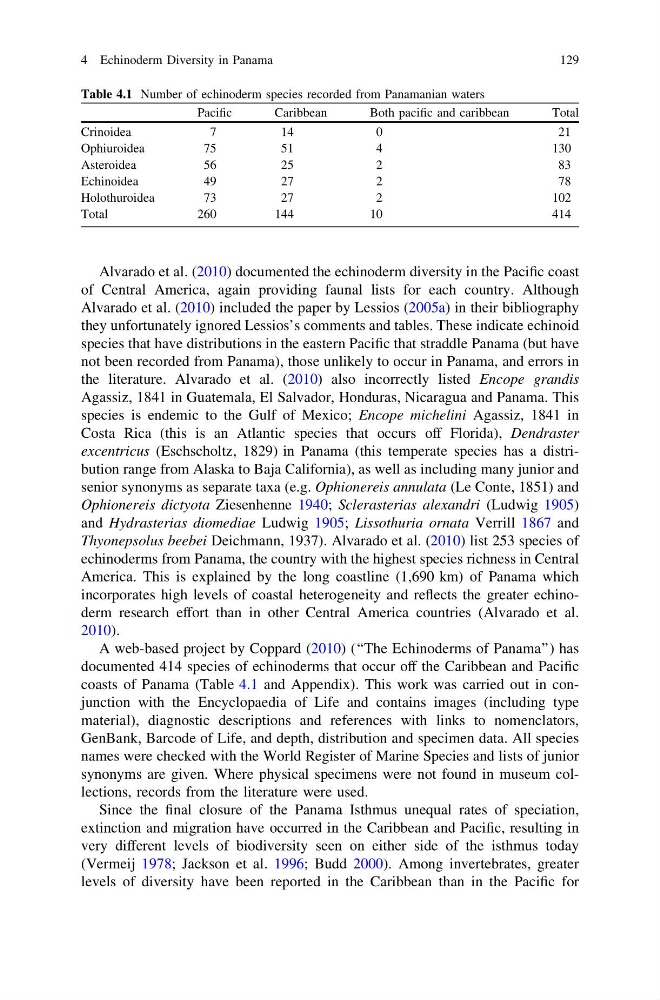
A web-based project by Coppard (2010) (‘‘The Echinoderms of Panama’’) has
documented 414 species of echinoderms that occur off the Caribbean and Pacific
coasts of Panama (Table 4.1 and Appendix). This work was carried out in conjunction with the Encyclopaedia of Life and contains images (including type
material), diagnostic descriptions and references with links to nomenclators,
GenBank, Barcode of Life, and depth, distribution and specimen data. All species
names were checked with the World Register of Marine Species and lists of junior
synonyms are given. Where physical specimens were not found in museum collections, records from the literature were used.
Since the final closure of the Panama Isthmus unequal rates of speciation,
extinction and migration have occurred in the Caribbean and Pacific, resulting in
very different levels of biodiversity seen on either side of the isthmus today
(Vermeij 1978; Jackson et al. 1996; Budd 2000). Among invertebrates, greater
levels of diversity have been reported in the Caribbean than in the Pacific for
Table 4.1 Number of echinoderm species recorded from Panamanian waters
Pacific
Caribbean
Both pacific and caribbean
Total
Crinoidea
7
14
0
21
Ophiuroidea
75
51
4
130
Asteroidea
56
25
2
83
Echinoidea
49
27
2
78
Holothuroidea
73
27
2
102
Total
260
144
10
414
4 Echinoderm Diversity in Panama
129
of Central America, again providing faunal lists for each country. Although
Alvarado et al. (2010) included the paper by Lessios (2005a) in their bibliography
they unfortunately ignored Lessios’s comments and tables. These indicate echinoid
species that have distributions in the eastern Pacific that straddle Panama (but have
not been recorded from Panama), those unlikely to occur in Panama, and errors in
the literature. Alvarado et al. (2010) also incorrectly listed Encope grandis
Agassiz, 1841 in Guatemala, El Salvador, Honduras, Nicaragua and Panama. This
species is endemic to the Gulf of Mexico; Encope michelini Agassiz, 1841 in
Costa Rica (this is an Atlantic species that occurs off Florida), Dendraster
excentricus (Eschscholtz, 1829) in Panama (this temperate species has a distribution range from Alaska to Baja California), as well as including many junior and
senior synonyms as separate taxa (e.g. Ophionereis annulata (Le Conte, 1851) and
Ophionereis dictyota Ziesenhenne 1940; Sclerasterias alexandri (Ludwig 1905)
and Hydrasterias diomediae Ludwig 1905; Lissothuria ornata Verrill 1867 and
Thyonepsolus beebei Deichmann, 1937). Alvarado et al. (2010) list 253 species of
echinoderms from Panama, the country with the highest species richness in Central
America. This is explained by the long coastline (1,690 km) of Panama which
incorporates high levels of coastal heterogeneity and reflects the greater echinoderm research effort than in other Central America countries (Alvarado et al.
2010).
A web-based project by Coppard (2010) (‘‘The Echinoderms of Panama’’) has
documented 414 species of echinoderms that occur off the Caribbean and Pacific
coasts of Panama (Table 4.1 and Appendix). This work was carried out in conjunction with the Encyclopaedia of Life and contains images (including type
material), diagnostic descriptions and references with links to nomenclators,
GenBank, Barcode of Life, and depth, distribution and specimen data. All species
names were checked with the World Register of Marine Species and lists of junior
synonyms are given. Where physical specimens were not found in museum collections, records from the literature were used.
Since the final closure of the Panama Isthmus unequal rates of speciation,
extinction and migration have occurred in the Caribbean and Pacific, resulting in
very different levels of biodiversity seen on either side of the isthmus today
(Vermeij 1978; Jackson et al. 1996; Budd 2000). Among invertebrates, greater
levels of diversity have been reported in the Caribbean than in the Pacific for
Table 4.1 Number of echinoderm species recorded from Panamanian waters
Pacific
Caribbean
Both pacific and caribbean
Total
Crinoidea
7
14
0
21
Ophiuroidea
75
51
4
130
Asteroidea
56
25
2
83
Echinoidea
49
27
2
78
Holothuroidea
73
27
2
102
Total
260
144
10
414
4 Echinoderm Diversity in Panama
129