

80
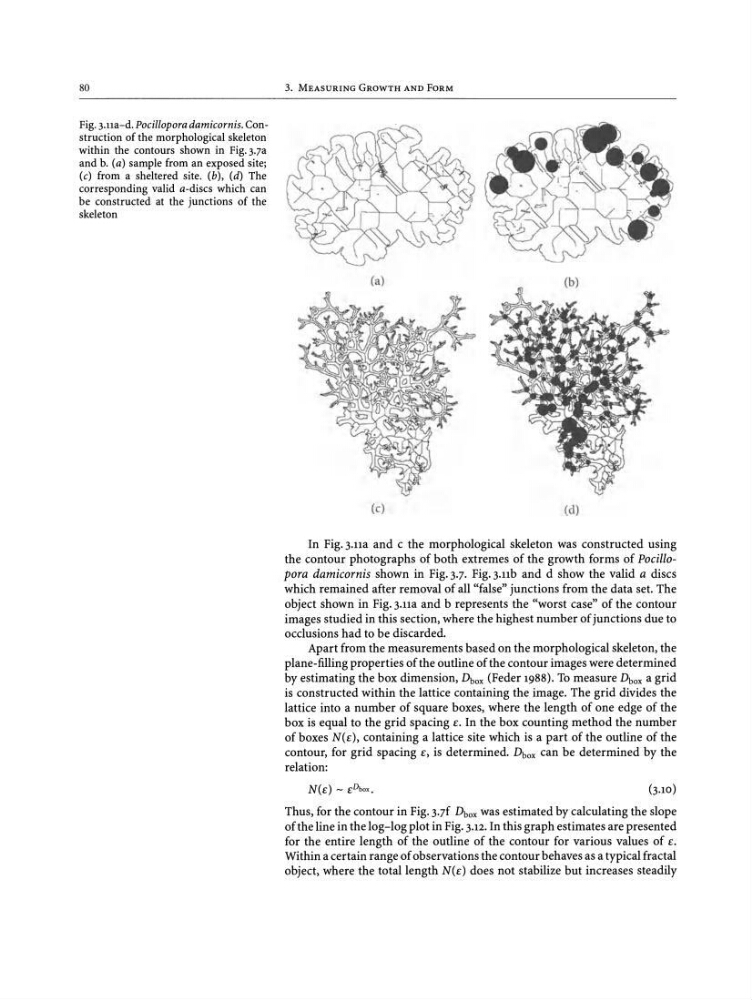
Fig. j.na-d. Pocillopora damicornis.Construction of the morphological skeleton
within the contours shown in Fig.3.7a
and b. (a) samplefrom an exposedsite;
(c) from a sheltered site. (b), (d) The
corresponding valid a-discs which can
be constructed at the junctions of the
skeleton
3. MEASURING GROWTH AND FORM
(a)
(c)
(d)
In Pig.j.na and c the morphological skeleton was constructed using
the contour photographs of both extremes of the growth forms of Pocillopora damicornis shown in Fig.3.7. Pig.j.ub and d show the valid a discs
which remained after removal of all "false" junctions from the data set. The
object shown in Pig.j.ua and b represents the "worst case" of the contour
images studied in this section, where the highest number of junctions due to
occlusions had to be discarded.
Apart from the measurements based on the morphological skeleton, the
plane-filling properties of the outline of the contour images were determined
by estimating the box dimension, Dbox (Feder 1988). To measure ~ox a grid
is constructed within the lattice containing the image. The grid divides the
lattice into a number of square boxes, where the length of one edge of the
box is equal to the grid spacing Eo In the box counting method the number
of boxes N(E), containing a lattice site which is a part of the outline of the
contour, for grid spacing E, is determined. D box can be determined by the
relation:
(3.10)
Thus, for the contour in Fig.3.7f Dbox was estimated by calculating the slope
of the line in the log-log plot in Fig. 3.12. In this graph estimates are presented
for the entire length of the outline of the contour for various values of E.
Within a certain range of observations the contour behaves as a typical fractal
object, where the total length N(E) does not stabilize but increases steadily
Fig. j.na-d. Pocillopora damicornis.Construction of the morphological skeleton
within the contours shown in Fig.3.7a
and b. (a) samplefrom an exposedsite;
(c) from a sheltered site. (b), (d) The
corresponding valid a-discs which can
be constructed at the junctions of the
skeleton
3. MEASURING GROWTH AND FORM
(a)
(c)
(d)
In Pig.j.na and c the morphological skeleton was constructed using
the contour photographs of both extremes of the growth forms of Pocillopora damicornis shown in Fig.3.7. Pig.j.ub and d show the valid a discs
which remained after removal of all "false" junctions from the data set. The
object shown in Pig.j.ua and b represents the "worst case" of the contour
images studied in this section, where the highest number of junctions due to
occlusions had to be discarded.
Apart from the measurements based on the morphological skeleton, the
plane-filling properties of the outline of the contour images were determined
by estimating the box dimension, Dbox (Feder 1988). To measure ~ox a grid
is constructed within the lattice containing the image. The grid divides the
lattice into a number of square boxes, where the length of one edge of the
box is equal to the grid spacing Eo In the box counting method the number
of boxes N(E), containing a lattice site which is a part of the outline of the
contour, for grid spacing E, is determined. D box can be determined by the
relation:
(3.10)
Thus, for the contour in Fig.3.7f Dbox was estimated by calculating the slope
of the line in the log-log plot in Fig. 3.12. In this graph estimates are presented
for the entire length of the outline of the contour for various values of E.
Within a certain range of observations the contour behaves as a typical fractal
object, where the total length N(E) does not stabilize but increases steadily