

3.3. TWO-DIMENSIONAL MORPHOLO GI CAL ANALYSIS OF R ANG ES OF G ROW T H FORMS
of the organism showing a tendency to develop away from the substrate.
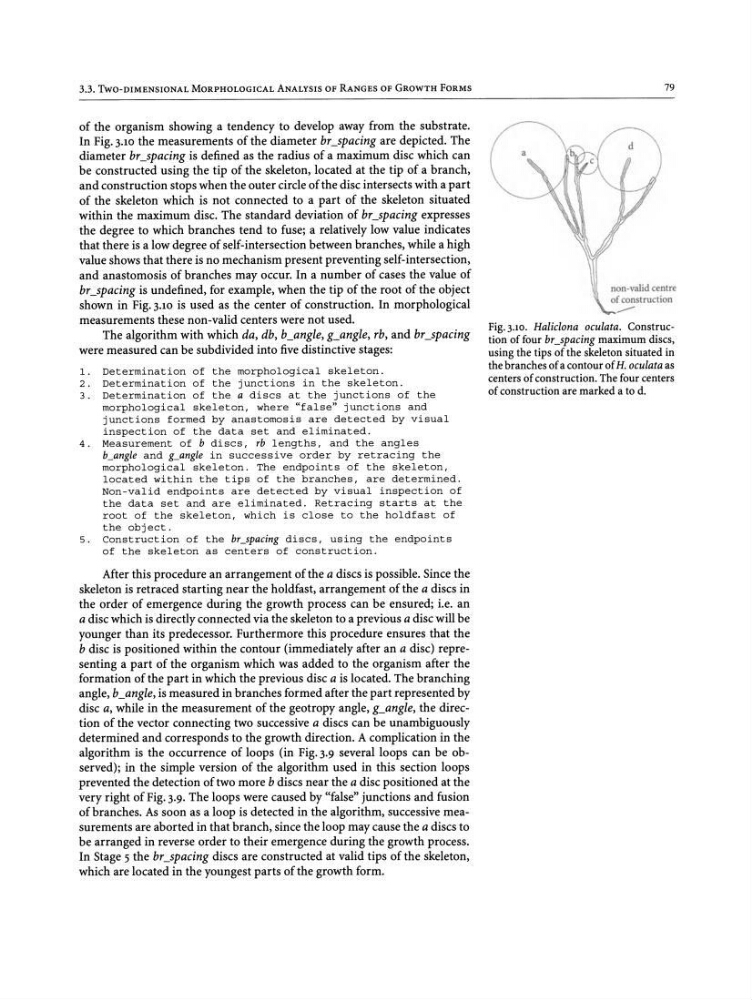
In Fig. 3 .10 the measurements of the diameter br_spacing are depicted. The
diameter br_spacing is defined as the radius of a maximum disc which can
be constructed using the tip of the skeleton, located at the tip of a branch,
and construction stops when the outer circle of the disc intersects with a part
of the skeleton which is not connected to a part of the skeleton situated
within the maximum disc. The standard deviation of br_spacing expresses
the degree to which branches tend to fuse; a relatively low value indicates
that there is a low degree of self-intersection between branches, while a high
value shows that there is no mechanism present preventing self-intersection,
and anastomosis of branches may occur. In a number of cases the value of
br_spacing is undefined, for example, when the tip of the root of the object
shown in Fig. po is used as the center of construction. In morphological
measurements these non-valid centers were not used .
The algorithm with which da, db, b_angle, g_angle, rb, and br_spacing
were measured can be subdivided into five distinctive stages:
1. De te r mi nation of the mo r phol o g i c al ske leton.
2 . Determi n at ion of t he junctions in the s kele ton .
3. Deter mi nation of t he a discs a t t h e junctions of t he
mo r p h ol og i c al ske leton , where "fa lse" j unctions and
junctions forme d by a n as t o mo s i s a r e detected by visual
inspection of the da ta se t and e liminated .
4 . Measurement of b d i s c s , rb lengths, and the angles
b_angle a n d g_angle in successive order by retracing the
morphological s k e l e t o n . The e ndpoints of the ske leton ,
located within the tips of the branches , are determined .
Non-valid endpoints are detected by visual inspection o f
t h e data s e t and are eliminated . Re tracing starts at the
root o f the ske leton , which i s c lose to t he holdfast of
the o b j e ct .
S . Cons truction o f the br_spacing d isc s , usi ng the e n d po ints
o f the ske leton as cen ters o f construct ion .
After this procedure an arrangement of the a discs is possible. Since the
skeleton is retraced starting near the holdfast, arrangement of the a discs in
the order of emergence during the growth process can be ensured; i.e. an
a disc which is directly connected via the skeleton to a previous a disc will be
younger than its predecessor. Furthermore this procedure ensures that the
b disc is positioned within the contour (immediately after an a disc) represent ing a part of the organism which was added to the organism after the
formation of the part in which the previous disc a is located . The branching
angle, b_angle, is measured in branches formed after the part represented by
disc a, while in the measurement of the geotropy angle, g_angle, the dire ction of the vector connecting two successive a discs can be un ambiguously
determined and corr esponds to the growth direction. A complication in the
algor ithm is the occurrence of loops (in Fig. 3.9 several loops can be observed); in the simple version of the algorithm used in this section loop s
prevented the detection of two more b discs near the a disc positioned at the
very right of Fig.3.9. The loops were caused by "false" jun ctions and fusion
of branches. As soon as a loop is detected in the algorithm, successive measurements are aborted in that branch, since the loop may cause the a discs to
be ar ranged in reverse order to their emergence during the growth process.
In Stage 5 the br_spacing discs are constructed at valid tips of the skeleton ,
which are located in the youngest parts of the growth form .
79
Fig. 3.10. Haliclona oculata. Construction of four br_spacing maximum discs,
using the tip s of the skeleton situated in
th e br anches of a contour of H. oculata as
centers of construc tion. The four centers
of construction are marked a to d.
of the organism showing a tendency to develop away from the substrate.
In Fig. 3 .10 the measurements of the diameter br_spacing are depicted. The
diameter br_spacing is defined as the radius of a maximum disc which can
be constructed using the tip of the skeleton, located at the tip of a branch,
and construction stops when the outer circle of the disc intersects with a part
of the skeleton which is not connected to a part of the skeleton situated
within the maximum disc. The standard deviation of br_spacing expresses
the degree to which branches tend to fuse; a relatively low value indicates
that there is a low degree of self-intersection between branches, while a high
value shows that there is no mechanism present preventing self-intersection,
and anastomosis of branches may occur. In a number of cases the value of
br_spacing is undefined, for example, when the tip of the root of the object
shown in Fig. po is used as the center of construction. In morphological
measurements these non-valid centers were not used .
The algorithm with which da, db, b_angle, g_angle, rb, and br_spacing
were measured can be subdivided into five distinctive stages:
1. De te r mi nation of the mo r phol o g i c al ske leton.
2 . Determi n at ion of t he junctions in the s kele ton .
3. Deter mi nation of t he a discs a t t h e junctions of t he
mo r p h ol og i c al ske leton , where "fa lse" j unctions and
junctions forme d by a n as t o mo s i s a r e detected by visual
inspection of the da ta se t and e liminated .
4 . Measurement of b d i s c s , rb lengths, and the angles
b_angle a n d g_angle in successive order by retracing the
morphological s k e l e t o n . The e ndpoints of the ske leton ,
located within the tips of the branches , are determined .
Non-valid endpoints are detected by visual inspection o f
t h e data s e t and are eliminated . Re tracing starts at the
root o f the ske leton , which i s c lose to t he holdfast of
the o b j e ct .
S . Cons truction o f the br_spacing d isc s , usi ng the e n d po ints
o f the ske leton as cen ters o f construct ion .
After this procedure an arrangement of the a discs is possible. Since the
skeleton is retraced starting near the holdfast, arrangement of the a discs in
the order of emergence during the growth process can be ensured; i.e. an
a disc which is directly connected via the skeleton to a previous a disc will be
younger than its predecessor. Furthermore this procedure ensures that the
b disc is positioned within the contour (immediately after an a disc) represent ing a part of the organism which was added to the organism after the
formation of the part in which the previous disc a is located . The branching
angle, b_angle, is measured in branches formed after the part represented by
disc a, while in the measurement of the geotropy angle, g_angle, the dire ction of the vector connecting two successive a discs can be un ambiguously
determined and corr esponds to the growth direction. A complication in the
algor ithm is the occurrence of loops (in Fig. 3.9 several loops can be observed); in the simple version of the algorithm used in this section loop s
prevented the detection of two more b discs near the a disc positioned at the
very right of Fig.3.9. The loops were caused by "false" jun ctions and fusion
of branches. As soon as a loop is detected in the algorithm, successive measurements are aborted in that branch, since the loop may cause the a discs to
be ar ranged in reverse order to their emergence during the growth process.
In Stage 5 the br_spacing discs are constructed at valid tips of the skeleton ,
which are located in the youngest parts of the growth form .
79
Fig. 3.10. Haliclona oculata. Construction of four br_spacing maximum discs,
using the tip s of the skeleton situated in
th e br anches of a contour of H. oculata as
centers of construc tion. The four centers
of construction are marked a to d.