

3.3. TWO-DIMENSIONAL MORPHOLOGICAL ANALYSIS OF RANGES OF GROWTH FORMS
81
3.84
3·66
3·47
3.29
3.10
2.18
1.81
1.62
* >,<
* *
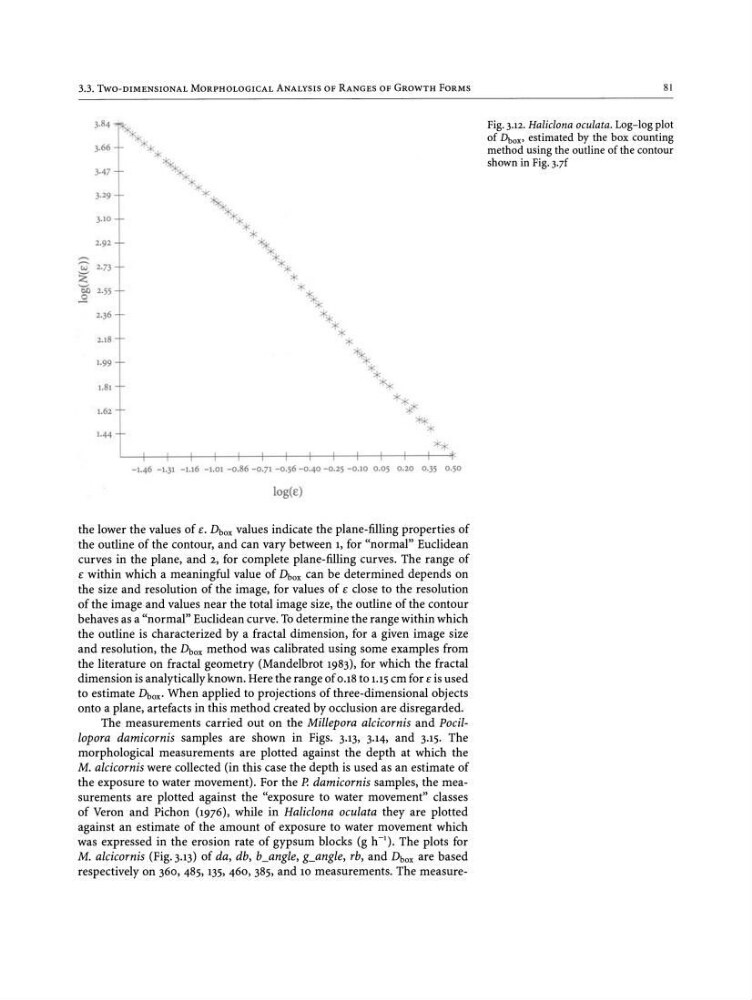
Fig. 3.12. Haliclona oculata. Log-log plot
of D box ' estimated by the box counting
method using the outline of the contour
shown in Fig. 3.7f
-1.46 -1.31 - 1.16 - 1.01 -0.86 - 0.71 - 0.56 -0.40 - 0.25 -0.10 0.05 0.20 0·35 0.50
log(e)
the lower the values of e. D box values indicate the plane-filling properties of
the outline of the contour, and can vary between 1, for "normal" Euclidean
curves in the plane, and 2, for complete plane-filling curves. The range of
E within which a meaningful value of D box can be determined depends on
the size and resolution of the image, for values of E close to the resolution
of the image and values near the total image size, the outline of the contour
behaves as a "normal" Euclidean curve. Todetermine the range within which
the outline is characterized by a fractal dimension, for a given image size
and resolution, the ~ox method was calibrated using some examples from
the literature on fractal geometry (Mandelbrot 1983), for which the fractal
dimension is analytically known . Here the range of 0 .18 to 1.15em for E is used
to estimate Dbox' When applied to projections of three-dimensional objects
onto a plane, artefacts in this method created by occlusion are disregarded.
The measurements carried out on the Millepora alcicornis and Pocillopora damicornis samples are shown in Figs. 3.13, 3-l4, and 3.15. The
morphological measurements are plotted against the depth at which the
M. alcicornis were collected (in this case the depth is used as an estimate of
the exposure to water movement). For the P. damicornis samples, the measurements are plotted against the "exposure to water movement" classes
of Veron and Pichon (1976), while in Haliclona oculata they are plotted
against an estimate of the amount of exposure to water movement which
was expressed in the erosion rate of gypsum blocks (g hI
) . The plots for
M. alcicornis (Fig. 3.13) of da, db, b_angle, g_angle, rb, and ~ox are based
respectively on 360, 485, 135, 460, 385, and 10 measurements. The measure-
81
3.84
3·66
3·47
3.29
3.10
2.18
1.81
1.62
* >,<
* *
Fig. 3.12. Haliclona oculata. Log-log plot
of D box ' estimated by the box counting
method using the outline of the contour
shown in Fig. 3.7f
-1.46 -1.31 - 1.16 - 1.01 -0.86 - 0.71 - 0.56 -0.40 - 0.25 -0.10 0.05 0.20 0·35 0.50
log(e)
the lower the values of e. D box values indicate the plane-filling properties of
the outline of the contour, and can vary between 1, for "normal" Euclidean
curves in the plane, and 2, for complete plane-filling curves. The range of
E within which a meaningful value of D box can be determined depends on
the size and resolution of the image, for values of E close to the resolution
of the image and values near the total image size, the outline of the contour
behaves as a "normal" Euclidean curve. Todetermine the range within which
the outline is characterized by a fractal dimension, for a given image size
and resolution, the ~ox method was calibrated using some examples from
the literature on fractal geometry (Mandelbrot 1983), for which the fractal
dimension is analytically known . Here the range of 0 .18 to 1.15em for E is used
to estimate Dbox' When applied to projections of three-dimensional objects
onto a plane, artefacts in this method created by occlusion are disregarded.
The measurements carried out on the Millepora alcicornis and Pocillopora damicornis samples are shown in Figs. 3.13, 3-l4, and 3.15. The
morphological measurements are plotted against the depth at which the
M. alcicornis were collected (in this case the depth is used as an estimate of
the exposure to water movement). For the P. damicornis samples, the measurements are plotted against the "exposure to water movement" classes
of Veron and Pichon (1976), while in Haliclona oculata they are plotted
against an estimate of the amount of exposure to water movement which
was expressed in the erosion rate of gypsum blocks (g hI
) . The plots for
M. alcicornis (Fig. 3.13) of da, db, b_angle, g_angle, rb, and ~ox are based
respectively on 360, 485, 135, 460, 385, and 10 measurements. The measure-