

74
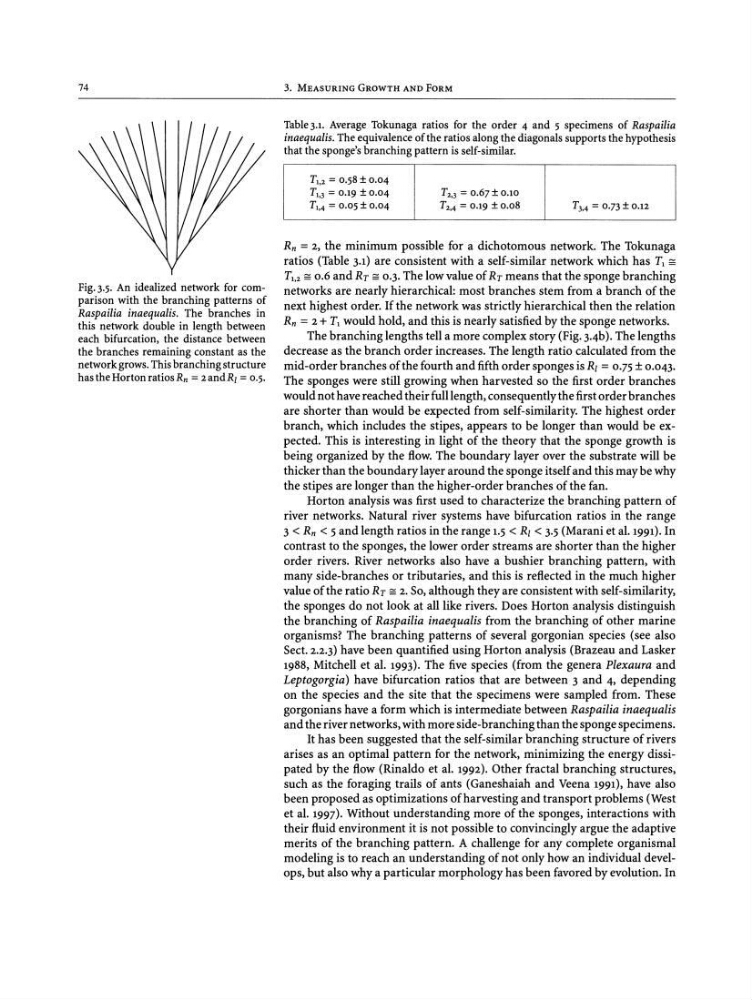
Fig.3.5. An idealized network for comparison with the branching patterns of
Raspailia inaequalis. The branches in
this network double in length between
each bifurcation, the distance between
the branches remaining constant as the
networkgrows. Thisbranchingstructure
hastheHortonratiosR n = 2andRl = 0.5.
3. MEASURING GROWTH AND FORM
Table 3.1. Average Tokunaga ratios for the order 4 and 5 specimens of Raspailia
inaequalis. The equivalence of the ratiosalongthe diagonals supports the hypothesis
that the sponge's branchingpattern is self-similar.
TI ,2 =0·58 ± 0.04
TI ,3 =0.19 ± 0.04
T2,3 =0.67 ± 0.10
TI ,4 =0.05 ± 0.04
T2,4 =0.19 ± 0.08
TJ,4 =0.73 ± 0.12
R n = 2, the minimum possible for a dichotomous network. The Tokunaga
ratios (Table 3.1) are consistent with a self-similar network which has T I ==
TI ,2 == 0.6 and RT == 0.3. The low value of RT means that the sponge branching
networks are nearly hierarchical: most branches stem from a branch of the
next highest order. If the network was strictly hierarchical then the relation
R n = 2 + T I would hold, and this is nearly satisfied by the sponge networks.
The branching lengths tell a more complex story (Fig. 3.4b). The lengths
decrease as the branch order increases. The length ratio calculated from the
mid-order branches of the fourth and fifth order sponges is RI = 0.75± 0.043.
The sponges were still growing when harvested so the first order branches
would not have reached their full length, consequently the first order branches
are shorter than would be expected from self-similarity. The highest order
branch, which includes the stipes, appears to be longer than would be expected. This is interesting in light of the theory that the sponge growth is
being organized by the flow. The boundary layer over the substrate will be
thicker than the boundary layer around the sponge itself and this may be why
the stipes are longer than the higher-order branches of the fan.
Horton analysis was first used to characterize the branching pattern of
river networks. Natural river systems have bifurcation ratios in the range
3 < Rn < 5 and length ratios in the range 1.5 < RI < 3.5 (Marani et al. 1991). In
contrast to the sponges, the lower order streams are shorter than the higher
order rivers . River networks also have a bushier branching pattern, with
many side-branches or tributaries, and this is reflected in the much higher
value of the ratio RT == 2. So, although they are consistent with self-similarity,
the sponges do not look at all like rivers. Does Horton analysis distinguish
the branching of Raspailia inaequalis from the branching of other marine
organisms? The branching patterns of several gorgonian species (see also
Sect. 2.2.3) have been quantified using Horton analysis (Brazeau and Lasker
1988, Mitchell et al. 1993). The five species (from the genera Plexaura and
Leptogorg ia) have bifurcation ratios that are between 3 and 4, depending
on the species and the site that the specimens were sampled from. These
gorgonians have a form which is intermediate between Raspailia inaequalis
and the river networks, with more side-branching than the sponge specimens.
It has been suggested that the self-similar branching structure of rivers
arises as an optimal pattern for the network, minimizing the energy dissipated by the flow (Rinaldo et al. 1992). Other fractal branching structures,
such as the foraging trails of ants (Ganeshaiah and Veena 1991), have also
been proposed as optimizations of harvesting and transport problems (West
et al. 1997). Without understanding more of the sponges, interactions with
their fluid environment it is not possible to convincingly argue the adaptive
merits of the branching pattern. A challenge for any complete organismal
modeling is to reach an understanding of not only how an individual develops, but also why a particular morphology has been favored by evolution. In
Fig.3.5. An idealized network for comparison with the branching patterns of
Raspailia inaequalis. The branches in
this network double in length between
each bifurcation, the distance between
the branches remaining constant as the
networkgrows. Thisbranchingstructure
hastheHortonratiosR n = 2andRl = 0.5.
3. MEASURING GROWTH AND FORM
Table 3.1. Average Tokunaga ratios for the order 4 and 5 specimens of Raspailia
inaequalis. The equivalence of the ratiosalongthe diagonals supports the hypothesis
that the sponge's branchingpattern is self-similar.
TI ,2 =0·58 ± 0.04
TI ,3 =0.19 ± 0.04
T2,3 =0.67 ± 0.10
TI ,4 =0.05 ± 0.04
T2,4 =0.19 ± 0.08
TJ,4 =0.73 ± 0.12
R n = 2, the minimum possible for a dichotomous network. The Tokunaga
ratios (Table 3.1) are consistent with a self-similar network which has T I ==
TI ,2 == 0.6 and RT == 0.3. The low value of RT means that the sponge branching
networks are nearly hierarchical: most branches stem from a branch of the
next highest order. If the network was strictly hierarchical then the relation
R n = 2 + T I would hold, and this is nearly satisfied by the sponge networks.
The branching lengths tell a more complex story (Fig. 3.4b). The lengths
decrease as the branch order increases. The length ratio calculated from the
mid-order branches of the fourth and fifth order sponges is RI = 0.75± 0.043.
The sponges were still growing when harvested so the first order branches
would not have reached their full length, consequently the first order branches
are shorter than would be expected from self-similarity. The highest order
branch, which includes the stipes, appears to be longer than would be expected. This is interesting in light of the theory that the sponge growth is
being organized by the flow. The boundary layer over the substrate will be
thicker than the boundary layer around the sponge itself and this may be why
the stipes are longer than the higher-order branches of the fan.
Horton analysis was first used to characterize the branching pattern of
river networks. Natural river systems have bifurcation ratios in the range
3 < Rn < 5 and length ratios in the range 1.5 < RI < 3.5 (Marani et al. 1991). In
contrast to the sponges, the lower order streams are shorter than the higher
order rivers . River networks also have a bushier branching pattern, with
many side-branches or tributaries, and this is reflected in the much higher
value of the ratio RT == 2. So, although they are consistent with self-similarity,
the sponges do not look at all like rivers. Does Horton analysis distinguish
the branching of Raspailia inaequalis from the branching of other marine
organisms? The branching patterns of several gorgonian species (see also
Sect. 2.2.3) have been quantified using Horton analysis (Brazeau and Lasker
1988, Mitchell et al. 1993). The five species (from the genera Plexaura and
Leptogorg ia) have bifurcation ratios that are between 3 and 4, depending
on the species and the site that the specimens were sampled from. These
gorgonians have a form which is intermediate between Raspailia inaequalis
and the river networks, with more side-branching than the sponge specimens.
It has been suggested that the self-similar branching structure of rivers
arises as an optimal pattern for the network, minimizing the energy dissipated by the flow (Rinaldo et al. 1992). Other fractal branching structures,
such as the foraging trails of ants (Ganeshaiah and Veena 1991), have also
been proposed as optimizations of harvesting and transport problems (West
et al. 1997). Without understanding more of the sponges, interactions with
their fluid environment it is not possible to convincingly argue the adaptive
merits of the branching pattern. A challenge for any complete organismal
modeling is to reach an understanding of not only how an individual develops, but also why a particular morphology has been favored by evolution. In