

3.3. TWO-DIMENSIONAL MORPHOLOGICAL ANALYSIS OF RANGES OF GROWTH FORMS
this light, it is interesting to note the variety of morphologies that are found
at a site such as the Sponge Garden . At least five different species from the
family Axinellidae grow there and Raspailia inaequalis is the only one which
has a planar branched form . Twoothers have a three -dimensional branching
structure, one grows as a single unbranched finger on a short stalk, and one
forms a solid vertical sheet which is set perpendicular to the flow. Explaining
the diversity of sponge growth patterns remains a great challenge.
75
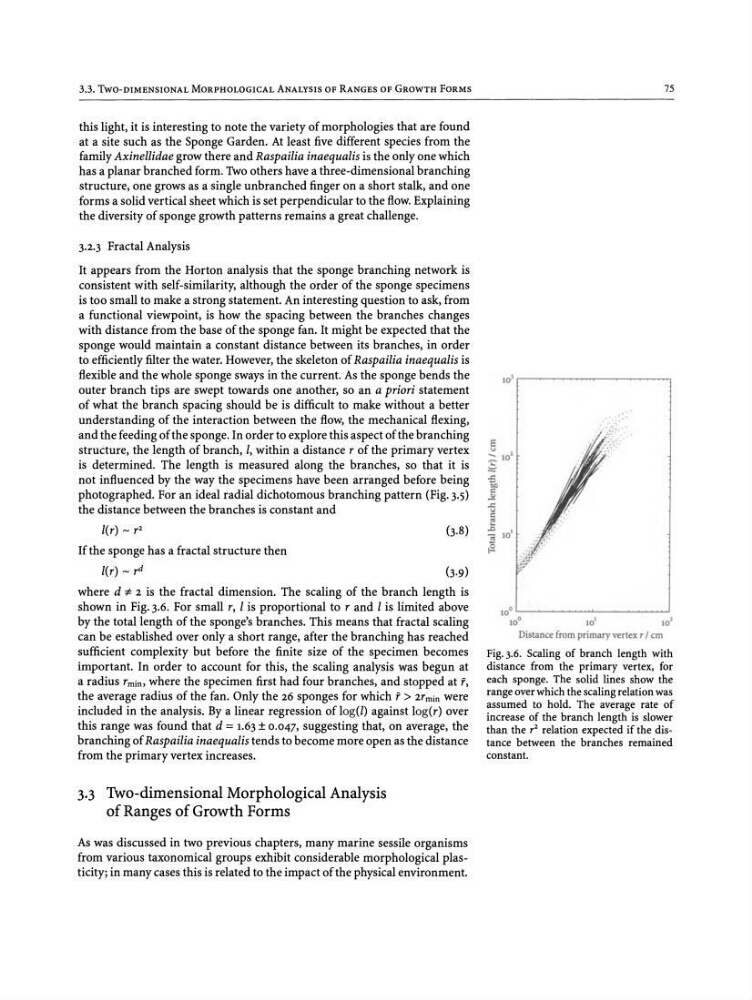
where d * 2 is the fractal dimension. The scaling of the branch length is
shown in Fig.3.6. For small r, 1is proportional to r and I is limited above
by the total length of the sponge's branches. This means that fractal scaling
can be established over only a short range, after the branching has reached
sufficient complexity but before the finite size of the specimen becomes
important. In order to account for this, the scaling analysis was begun at
a radius rmin , where the specimen first had four branches, and stopped at i
the average radius of the fan. Only the 26 sponges for which, > 2r m in were
included in the analysis. By a linear regression of log(l) against log(r) over
this range was found that d = 1.63 ± 0.047, suggesting that, on average, the
branching of Raspailia inaequalis tends to become more open as the distance
from the primary vertex increases.
3.2.3 Fractal Analysis
It appears from the Horton analysis that the sponge branching network is
consistent with self-similarity, although the order of the sponge specimens
is too small to make a strong statement. An interesting question to ask, from
a functional viewpoint, is how the spacing between the branches changes
with distance from the base of the sponge fan. It might be expected that the
sponge would maintain a constant distance between its branches, in order
to efficiently filter the water. However, the skeleton of Raspailia inaequalis is
flexible and the whole sponge sways in the current. As the sponge bends the
outer branch tips are swept towards one another, so an a priori statement
of what the branch spacing should be is difficult to make without a better
understanding of the interaction between the flow, the mechanical flexing,
and the feeding of the sponge . In order to explore this aspect of the branching
structure, the length of branch, 1, within a distance r of the primary vertex
is determined. The length is measured along the branches, so that it is
not influenced by the way the specimens have been arranged before being
photographed. For an ideal radial dichotomous branching pattern (Fig.3.5)
the distance between the branches is constant and
1(r) - r
2
If the sponge has a fractal structure then
1(r) - rt
(3.8)
10 3 , - - - - - - ......- - - - --,
10 0
L.~..........
....J
10
0
10'
10'
Distance from prima ry vertex r I cm
Fig. 3.6. Scaling of branch length with
distance from the primary vertex, for
each sponge. The solid lines show the
range over which the scaling relation was
assumed to hold. The average rate of
increase of the branch length is slower
than the r
2 relation expected if the distance between the branches remained
constant.
3.3 Two-dimensional Morphological Analysis
of Ranges of Growth Forms
As was discussed in two previous chapters, many marine sessile organisms
from various taxonomical groups exhibit considerable morphological plasticity ; in many cases this is related to the impact of the physical environment.
this light, it is interesting to note the variety of morphologies that are found
at a site such as the Sponge Garden . At least five different species from the
family Axinellidae grow there and Raspailia inaequalis is the only one which
has a planar branched form . Twoothers have a three -dimensional branching
structure, one grows as a single unbranched finger on a short stalk, and one
forms a solid vertical sheet which is set perpendicular to the flow. Explaining
the diversity of sponge growth patterns remains a great challenge.
75
where d * 2 is the fractal dimension. The scaling of the branch length is
shown in Fig.3.6. For small r, 1is proportional to r and I is limited above
by the total length of the sponge's branches. This means that fractal scaling
can be established over only a short range, after the branching has reached
sufficient complexity but before the finite size of the specimen becomes
important. In order to account for this, the scaling analysis was begun at
a radius rmin , where the specimen first had four branches, and stopped at i
the average radius of the fan. Only the 26 sponges for which, > 2r m in were
included in the analysis. By a linear regression of log(l) against log(r) over
this range was found that d = 1.63 ± 0.047, suggesting that, on average, the
branching of Raspailia inaequalis tends to become more open as the distance
from the primary vertex increases.
3.2.3 Fractal Analysis
It appears from the Horton analysis that the sponge branching network is
consistent with self-similarity, although the order of the sponge specimens
is too small to make a strong statement. An interesting question to ask, from
a functional viewpoint, is how the spacing between the branches changes
with distance from the base of the sponge fan. It might be expected that the
sponge would maintain a constant distance between its branches, in order
to efficiently filter the water. However, the skeleton of Raspailia inaequalis is
flexible and the whole sponge sways in the current. As the sponge bends the
outer branch tips are swept towards one another, so an a priori statement
of what the branch spacing should be is difficult to make without a better
understanding of the interaction between the flow, the mechanical flexing,
and the feeding of the sponge . In order to explore this aspect of the branching
structure, the length of branch, 1, within a distance r of the primary vertex
is determined. The length is measured along the branches, so that it is
not influenced by the way the specimens have been arranged before being
photographed. For an ideal radial dichotomous branching pattern (Fig.3.5)
the distance between the branches is constant and
1(r) - r
2
If the sponge has a fractal structure then
1(r) - rt
(3.8)
10 3 , - - - - - - ......- - - - --,
10 0
L.~..........
....J
10
0
10'
10'
Distance from prima ry vertex r I cm
Fig. 3.6. Scaling of branch length with
distance from the primary vertex, for
each sponge. The solid lines show the
range over which the scaling relation was
assumed to hold. The average rate of
increase of the branch length is slower
than the r
2 relation expected if the distance between the branches remained
constant.
3.3 Two-dimensional Morphological Analysis
of Ranges of Growth Forms
As was discussed in two previous chapters, many marine sessile organisms
from various taxonomical groups exhibit considerable morphological plasticity ; in many cases this is related to the impact of the physical environment.