

2.2. THE CASE STUDIES
63
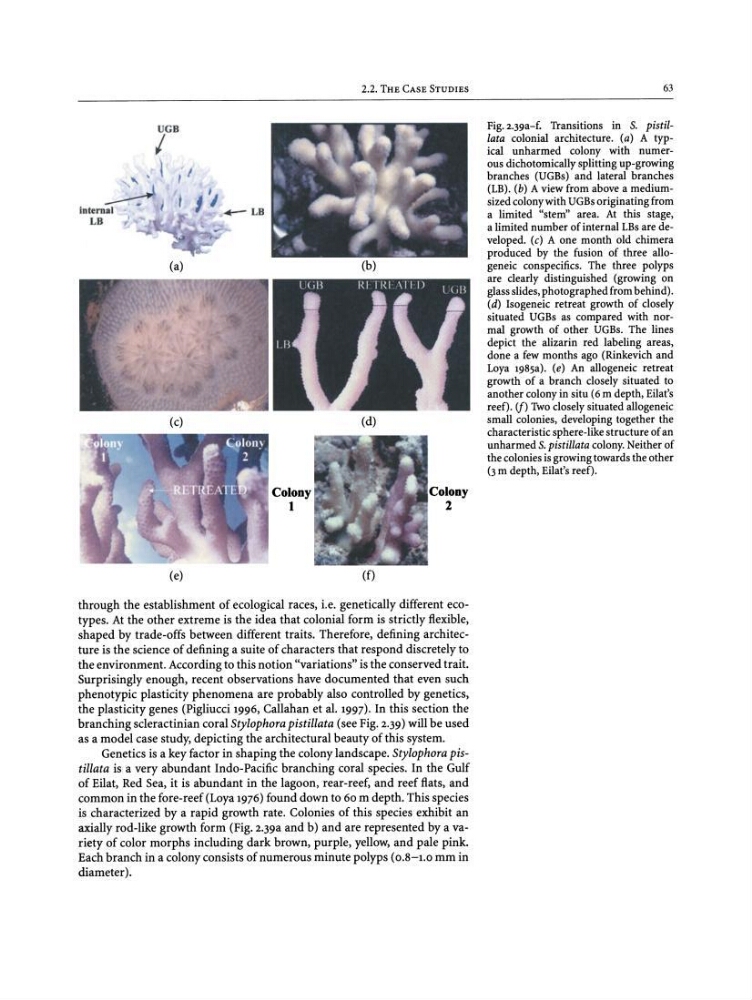
Fig.2.39a-f. Transitions in S. pistillata colonial architecture. (a) A typ -
ical unharmed colony with numerous dichotomicallysplitting up-growing
branches (UGBs) and lateral branches
(LB). (b) A view from above a mediumsizedcolonywith UGBs originating from
a limited "stem" area. At this stage,
a limited number of internal LBs are developed. (c) A one month old chimera
produced by the fusion of three allogeneic conspecifics. The three polyps
are clearly distinguished (growing on
glassslides,photographed frombehind).
(d) Isogeneic retreat growth of closely
situated UGBs as compared with normal growth of other UGBs. The lines
depict the alizarin red labeling areas,
done a few months ago (Rinkevich and
Loya 198sa). (e) An allogeneic retreat
growth of a branch closely situated to
another colonyin situ (6 m depth, Eilat's
reef). if) Two closely situated allogeneic
small colonies, developing together the
characteristicsphere-likestructure ofan
unharmed S. pistillata colony. Neither of
the coloniesisgrowingtowardsthe other
(3m depth, Eilat's reef).
(b)
(d)
Colony
1
, I
I
"
I .-LB
I
~
(c)
(a)
UGB
I
, l
--d
Internal
LB
(e)
(f)
through the establishment of ecological races, i.e. genetically different ecotypes. At the other extreme is the idea that colonial form is strictly flexible,
shaped by trade-offs between different traits. Therefore, defining architecture is the science of defining a suite of characters that respond discretely to
the environment. According to this notion "variations" is the conserved trait.
Surprisingly enough, recent observations have documented that even such
phenotypic plasticity phenomena are probably also controlled by genetics,
the plasticity genes (Pigliucci 1996, Callahan et al. 1997). In this section the
branching scleractinian coral Stylophora pistillata (see Fig. 2.39) will be used
as a model case study, depicting the architectural beauty of this system.
Genetics is a key factor in shaping the colony landscape. Stylophora pistillata is a very abundant Indo-Pacific branching coral species . In the Gulf
of Eilat, Red Sea, it is abundant in the lagoon, rear-reef, and reef flats, and
common in the fore-reef (Loya 1976) found down to 60 m depth. This species
is characterized by a rapid growth rate. Colonies of this species exhibit an
axially rod-like growth form (Fig. 2.39a and b) and are represented by a variety of color morphs including dark brown, purple, yellow, and pale pink.
Each branch in a colony consists of numerous minute polyps (0.8-1.0 mm in
diameter).
63
Fig.2.39a-f. Transitions in S. pistillata colonial architecture. (a) A typ -
ical unharmed colony with numerous dichotomicallysplitting up-growing
branches (UGBs) and lateral branches
(LB). (b) A view from above a mediumsizedcolonywith UGBs originating from
a limited "stem" area. At this stage,
a limited number of internal LBs are developed. (c) A one month old chimera
produced by the fusion of three allogeneic conspecifics. The three polyps
are clearly distinguished (growing on
glassslides,photographed frombehind).
(d) Isogeneic retreat growth of closely
situated UGBs as compared with normal growth of other UGBs. The lines
depict the alizarin red labeling areas,
done a few months ago (Rinkevich and
Loya 198sa). (e) An allogeneic retreat
growth of a branch closely situated to
another colonyin situ (6 m depth, Eilat's
reef). if) Two closely situated allogeneic
small colonies, developing together the
characteristicsphere-likestructure ofan
unharmed S. pistillata colony. Neither of
the coloniesisgrowingtowardsthe other
(3m depth, Eilat's reef).
(b)
(d)
Colony
1
, I
I
"
I .-LB
I
~
(c)
(a)
UGB
I
, l
--d
Internal
LB
(e)
(f)
through the establishment of ecological races, i.e. genetically different ecotypes. At the other extreme is the idea that colonial form is strictly flexible,
shaped by trade-offs between different traits. Therefore, defining architecture is the science of defining a suite of characters that respond discretely to
the environment. According to this notion "variations" is the conserved trait.
Surprisingly enough, recent observations have documented that even such
phenotypic plasticity phenomena are probably also controlled by genetics,
the plasticity genes (Pigliucci 1996, Callahan et al. 1997). In this section the
branching scleractinian coral Stylophora pistillata (see Fig. 2.39) will be used
as a model case study, depicting the architectural beauty of this system.
Genetics is a key factor in shaping the colony landscape. Stylophora pistillata is a very abundant Indo-Pacific branching coral species . In the Gulf
of Eilat, Red Sea, it is abundant in the lagoon, rear-reef, and reef flats, and
common in the fore-reef (Loya 1976) found down to 60 m depth. This species
is characterized by a rapid growth rate. Colonies of this species exhibit an
axially rod-like growth form (Fig. 2.39a and b) and are represented by a variety of color morphs including dark brown, purple, yellow, and pale pink.
Each branch in a colony consists of numerous minute polyps (0.8-1.0 mm in
diameter).