

62
2. ENVIRONMENTALLY DRIVEN PLASTICITY
so matic cell lineages
Telomerase acti vity
Telomere lengt h
Porifera : (germ - and) somat ic cell lineages - tissue and prim mo rphs
tfu: he r Metazoa: germ cell lineages
typically do not fully immortalize the cells. Without transformation by viral
oncoproteins or acquisition of other mutational events the transition from
the immortal to the mortal state is very rare.
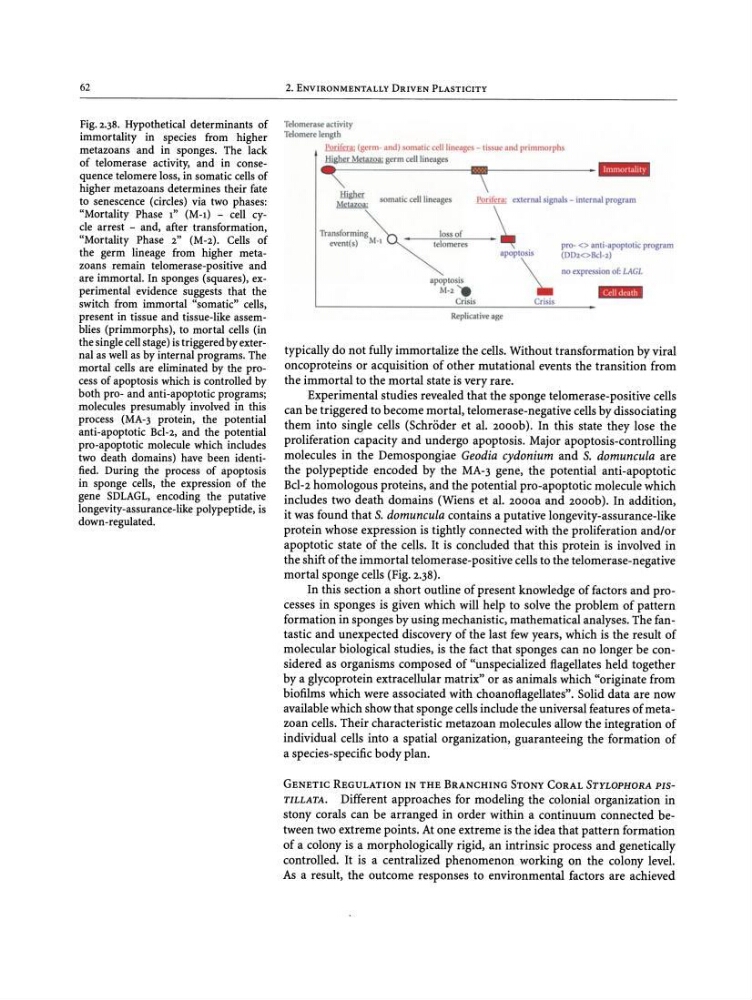
Experimental studies revealed that the sponge telornerase-positive cells
can be triggered to become mortal, telomerase-negative cells by dissociating
them into single cells (Schroder et al. 2000b). In this state they lose the
proliferation capacity and undergo apoptosis. Major apoptosis-controlling
molecules in the Demospongiae Geodia cydonium and S. domuncula are
the polypeptide encoded by the MA-3 gene, the potential anti-apoptotic
Bcl-z homologous proteins, and the potential pro-apoptotic molecule which
includes two death domains (Wiens et al. 2000a and 2000b) . In addition,
it was found that S. domuncula contains a putative longevity-assurance-like
protein whose expression is tightly connected with the proliferation and/or
apoptotic state of the cells. It is concluded that this protein is involved in
the shift of the immortal telomerase-positive cells to the telomerase-negative
mortal sponge cells (Fig. 2.38).
In this section a short outline of present knowledge of factors and processes in sponges is given which will help to solve the problem of pattern
formation in sponges by using mechanistic, mathematical analyses. The fantastic and unexpected discovery of the last few years, which is the result of
molecular biological studies, is the fact that sponges can no longer be considered as organisms composed of "unspecialized flagellates held together
by a glycoprotein extracellular matrix" or as animals which "originate from
biofilms which were associated with choanoflagellates". Solid data are now
available which show that sponge cells include the universal features of metazoan cells. Their characteristic metazoan molecules allow the integration of
individual cells into a spatial organization, guaranteeing the formation of
a species-specific body plan.
Replicative age
no expressio n of: I.AGl.
'~' \.
Crisis
loss of
relomcres
apop tosis
M'l 'e
Crisis
Transforming
eventts)
~I -I
Fig.2.38. Hypothetical determinants of
immortality in species from higher
metazoans and in sponges. The lack
of telomerase activity, and in consequence telomereloss,in somatic cells of
higher metazoans determines their fate
to senescence (circles) via two phases:
"Mortality Phase 1" (Me) - cell cycle arrest - and, after transformation,
"Mortality Phase 2" (M-2). Cells of
the germ lineage from higher metazoans remain telomerase-positive and
are immortal. In sponges (squares), experimental evidence suggests that the
switch from immortal "somatic" cells,
present in tissue and tissue-like assemblies (primmorphs), to mortal cells (in
the singlecellstage)istriggeredbyexternal as wellas by internal programs.The
mortal cells are eliminated by the process of apoptosis which is controlled by
both pro- and anti-apoptotic programs;
molecules presumably involved in this
process (MA-3 protein, the potential
anti-apoptotic Bcl-z, and the potential
pro-apoptotic molecule which includes
two death domains) have been identified. During the process of apoptosis
in sponge cells, the expression of the
gene SDLAGL, encoding the putative
longevity-assurance-like polypeptide,is
down-regulated.
GENETIC REGULATION IN THE BRANCHING STONY CORAL STYLOPHORA PISTILLATA.
Different approaches for modeling the colonial organization in
stony corals can be arranged in order within a continuum connected between two extreme points. At one extreme is the idea that pattern formation
of a colony is a morphologically rigid, an intrinsic process and genetically
controlled. It is a centralized phenomenon working on the colony level.
As a result, the outcome responses to environmental factors are achieved
2. ENVIRONMENTALLY DRIVEN PLASTICITY
so matic cell lineages
Telomerase acti vity
Telomere lengt h
Porifera : (germ - and) somat ic cell lineages - tissue and prim mo rphs
tfu: he r Metazoa: germ cell lineages
typically do not fully immortalize the cells. Without transformation by viral
oncoproteins or acquisition of other mutational events the transition from
the immortal to the mortal state is very rare.
Experimental studies revealed that the sponge telornerase-positive cells
can be triggered to become mortal, telomerase-negative cells by dissociating
them into single cells (Schroder et al. 2000b). In this state they lose the
proliferation capacity and undergo apoptosis. Major apoptosis-controlling
molecules in the Demospongiae Geodia cydonium and S. domuncula are
the polypeptide encoded by the MA-3 gene, the potential anti-apoptotic
Bcl-z homologous proteins, and the potential pro-apoptotic molecule which
includes two death domains (Wiens et al. 2000a and 2000b) . In addition,
it was found that S. domuncula contains a putative longevity-assurance-like
protein whose expression is tightly connected with the proliferation and/or
apoptotic state of the cells. It is concluded that this protein is involved in
the shift of the immortal telomerase-positive cells to the telomerase-negative
mortal sponge cells (Fig. 2.38).
In this section a short outline of present knowledge of factors and processes in sponges is given which will help to solve the problem of pattern
formation in sponges by using mechanistic, mathematical analyses. The fantastic and unexpected discovery of the last few years, which is the result of
molecular biological studies, is the fact that sponges can no longer be considered as organisms composed of "unspecialized flagellates held together
by a glycoprotein extracellular matrix" or as animals which "originate from
biofilms which were associated with choanoflagellates". Solid data are now
available which show that sponge cells include the universal features of metazoan cells. Their characteristic metazoan molecules allow the integration of
individual cells into a spatial organization, guaranteeing the formation of
a species-specific body plan.
Replicative age
no expressio n of: I.AGl.
'~' \.
Crisis
loss of
relomcres
apop tosis
M'l 'e
Crisis
Transforming
eventts)
~I -I
Fig.2.38. Hypothetical determinants of
immortality in species from higher
metazoans and in sponges. The lack
of telomerase activity, and in consequence telomereloss,in somatic cells of
higher metazoans determines their fate
to senescence (circles) via two phases:
"Mortality Phase 1" (Me) - cell cycle arrest - and, after transformation,
"Mortality Phase 2" (M-2). Cells of
the germ lineage from higher metazoans remain telomerase-positive and
are immortal. In sponges (squares), experimental evidence suggests that the
switch from immortal "somatic" cells,
present in tissue and tissue-like assemblies (primmorphs), to mortal cells (in
the singlecellstage)istriggeredbyexternal as wellas by internal programs.The
mortal cells are eliminated by the process of apoptosis which is controlled by
both pro- and anti-apoptotic programs;
molecules presumably involved in this
process (MA-3 protein, the potential
anti-apoptotic Bcl-z, and the potential
pro-apoptotic molecule which includes
two death domains) have been identified. During the process of apoptosis
in sponge cells, the expression of the
gene SDLAGL, encoding the putative
longevity-assurance-like polypeptide,is
down-regulated.
GENETIC REGULATION IN THE BRANCHING STONY CORAL STYLOPHORA PISTILLATA.
Different approaches for modeling the colonial organization in
stony corals can be arranged in order within a continuum connected between two extreme points. At one extreme is the idea that pattern formation
of a colony is a morphologically rigid, an intrinsic process and genetically
controlled. It is a centralized phenomenon working on the colony level.
As a result, the outcome responses to environmental factors are achieved