

2.2. THE CASE STUDIES
61
r&1i:iAllYI.GQ~I EDK~~ ~~~ : 132
r DlH:ix£RYL* NS - - miIlimV ~~,amrEmJm;mS& : 132
SilICA SubDo : HI'
SIL I CA ) et hya : or,
(a)
(b)
,
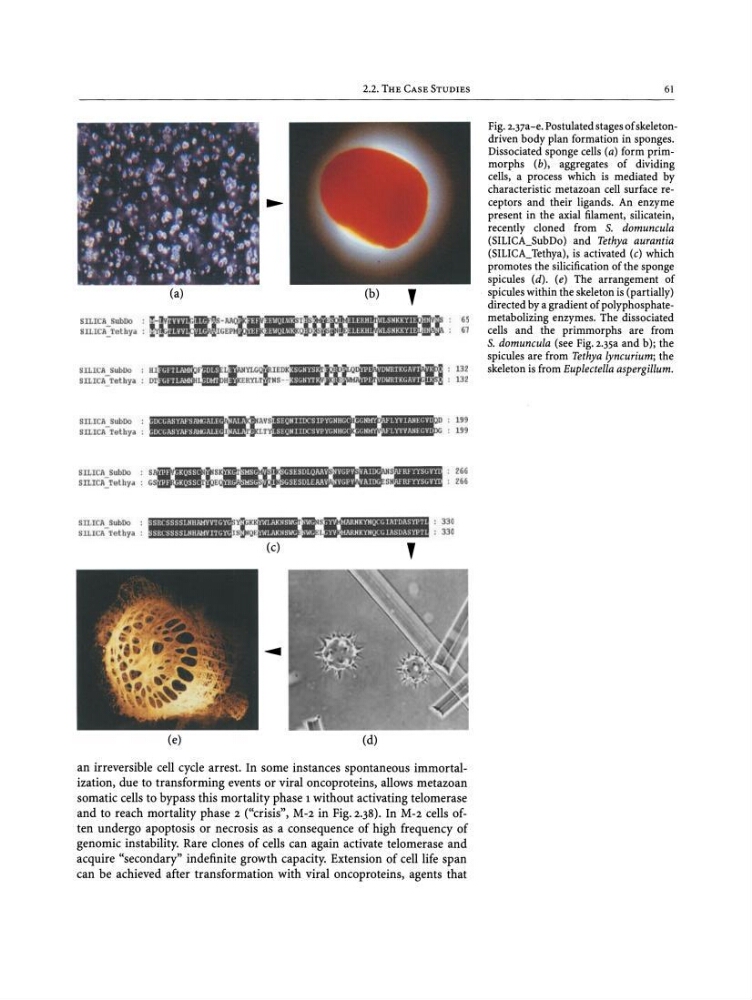
Fig. 2.37a-e. Postulated stages ofskeletondriven body plan formation in sponges.
Dissociated sponge cells (a) form primmorphs (b), aggregates of dividing
cells, a process which is mediated by
characteristic metazoan cell surface receptors and their ligands. An enzyme
present in the axial filament, silicatein,
recently cloned from S. domuncula
(SILICA_SubDo) and Tethya aurantia
(SILICA_Tethya), is activated (c) which
promotes the silicification of the sponge
spicules (d). (e) The arrangement of
spicules within the skeleton is (partially)
directed by a gradient of polyphosphatemetabolizing enzymes. The dissociated
cells and the primmorphs are from
S. domuncula (see Fig. 2.35a and b); the
spicules are from Tethya lyncurium; the
skeleton is from Euplectella aspergillum.
SI LI CA SubDo : ~~ }\V S I
SILICA ) ethya : ~ rEr:i)(lT
I~D : 1 9 9
Ev~ : 19 9
SI LI CA SubDo : S~iISK r~ 'I ' ·tI~
SILICA)ethya : GS~ ~E . ~
IS ~ : 2 6 6
S H~ : 266
SIL I CA SubDo : ~ $KK~
SilICA -T e thya : ~ [ S~Qf:~
(c)
......
(e)
I S~ : 33 0
. ~: 3 3 0
,
(d)
an irreversible cell cycle arrest. In some instances spontaneous immortalization, due to transforming events or viral oncoproteins, allows metazoan
somatic cells to bypass this mortality phase 1 without activating telomerase
and to reach mortality phase 2 ("crisis", M-2 in Fig. 2.38). In M-2 cells often undergo apoptosis or necrosis as a consequence of high frequency of
genomic instability. Rare clones of cells can again activate telomerase and
acquire "secondary" indefinite growth capacity. Extension of cell life span
can be achieved after transformation with viral oncoproteins, agents that
61
r&1i:iAllYI.GQ~I EDK~~ ~~~ : 132
r DlH:ix£RYL* NS - - miIlimV ~~,amrEmJm;mS& : 132
SilICA SubDo : HI'
SIL I CA ) et hya : or,
(a)
(b)
,
Fig. 2.37a-e. Postulated stages ofskeletondriven body plan formation in sponges.
Dissociated sponge cells (a) form primmorphs (b), aggregates of dividing
cells, a process which is mediated by
characteristic metazoan cell surface receptors and their ligands. An enzyme
present in the axial filament, silicatein,
recently cloned from S. domuncula
(SILICA_SubDo) and Tethya aurantia
(SILICA_Tethya), is activated (c) which
promotes the silicification of the sponge
spicules (d). (e) The arrangement of
spicules within the skeleton is (partially)
directed by a gradient of polyphosphatemetabolizing enzymes. The dissociated
cells and the primmorphs are from
S. domuncula (see Fig. 2.35a and b); the
spicules are from Tethya lyncurium; the
skeleton is from Euplectella aspergillum.
SI LI CA SubDo : ~~ }\V S I
SILICA ) ethya : ~ rEr:i)(lT
I~D : 1 9 9
Ev~ : 19 9
SI LI CA SubDo : S~iISK r~ 'I ' ·tI~
SILICA)ethya : GS~ ~E . ~
IS ~ : 2 6 6
S H~ : 266
SIL I CA SubDo : ~ $KK~
SilICA -T e thya : ~ [ S~Qf:~
(c)
......
(e)
I S~ : 33 0
. ~: 3 3 0
,
(d)
an irreversible cell cycle arrest. In some instances spontaneous immortalization, due to transforming events or viral oncoproteins, allows metazoan
somatic cells to bypass this mortality phase 1 without activating telomerase
and to reach mortality phase 2 ("crisis", M-2 in Fig. 2.38). In M-2 cells often undergo apoptosis or necrosis as a consequence of high frequency of
genomic instability. Rare clones of cells can again activate telomerase and
acquire "secondary" indefinite growth capacity. Extension of cell life span
can be achieved after transformation with viral oncoproteins, agents that