

64
2. ENVIRONMENTALLY DRIVEN PLASTICITY
Several morphological rules govern the formation of a typical S. pistillata
colony. Primary polyps start to deposit calcareous skeletons about one day
following metamorphosis. One week thereafter additional polyps are added
extra-tentacularly from the peripheral tissue, forming a sheet-like structure.
Growth rates in term of new polyps over time are highly variable among
young colonies (Frank et al. 1997). As in Pocillopora (see Fig. 1.1, Stephenson
1931) the first established polyp "buds" simultaneously, usually forming six
polyps that are arranged in a circle around the primary polyp. This kind of
lateral expansion continues until at some, as yet unidentified, stage branches
develop by apical growth. Establishing a chimera of young « four months
old) S.pistillata colonies before alloimmune maturation was achieved (Frank
et al. 1997) not only resulted in tissue fusion, marked by a continuous layer of
tissue and skeleton across the contact area, but also led to an unusual center
of more than one polyp (Fig. 2.39C).
A single apical ramified structure is developed from each "base plate",
produced either from a single genotype (founder polyp) or several fused
genotypes, in the case of a chimera. New structures are then added, and
develop in conformity with the basic architectural rules of this species. These
structures are reiterated complexes. Looking at a mature S. pistillata colony
(Fig.2.39b) from above, it is clear that the available space left between the
branches developed (up-growing and side-growing, see below) tends to be
filled by the reiterated complexes (Dauget 1991) in such a way that branches
will not come into tissue-to-tissue contact (Fig. 2.39a, d-f).
The resulting symmetry of a typical S. pistillata colony approximates
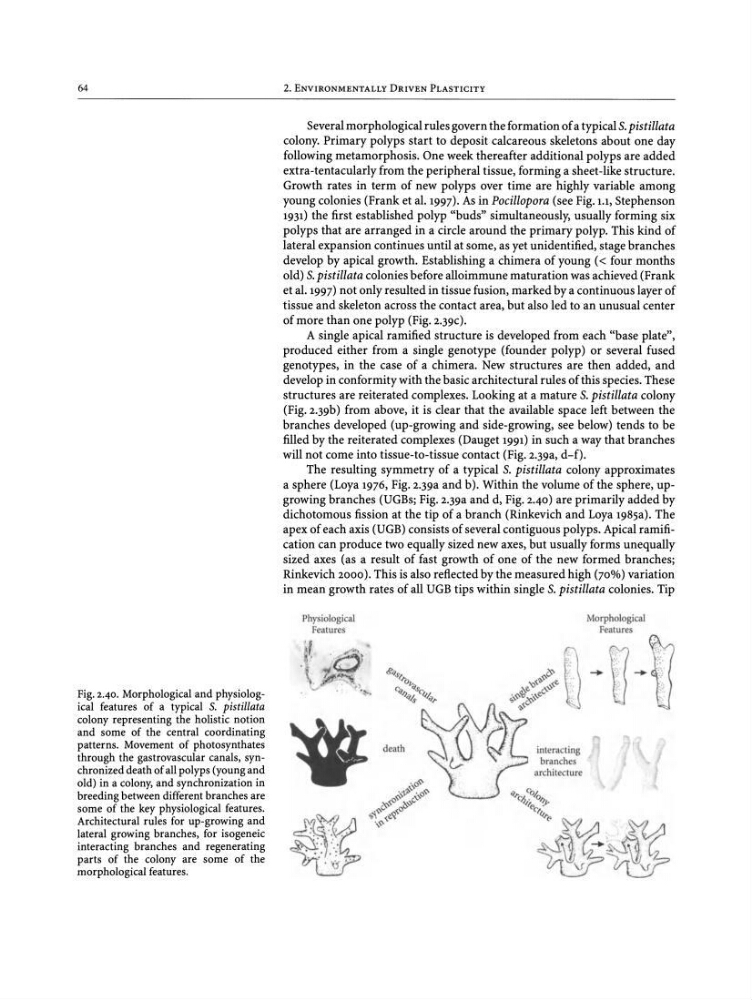
a sphere (Loya 1976, Fig. 2.39a and b). Within the volume of the sphere, upgrowing branches (UGBs; Fig. 2.39a and d, Fig. 2.40) are primarily added by
dichotomous fission at the tip of a branch (Rinkevich and Loya 198sa). The
apex of each axis (UGB) consists of several contiguous polyps. Apical ramification can produce two equally sized new axes, but usually forms unequally
sized axes (as a result of fast growth of one of the new formed branches;
Rinkevich 2000). This is also reflected by the measured high (70%) variation
in mean growth rates of all UGB tips within single S. pistillata colonies . Tip
Fig.2.40. Morphological and physiological features of a typical S. pistillata
colony representing the holistic notion
and some of the central coordinating
patterns. Movement of photosynthates
through the gastrovascular canals, synchronizeddeath ofallpolyps(youngand
old) in a colony, and synchronization in
breedingbetweendifferent branches are
some of the key physiological features.
Architectural rules for up-growing and
lateral growing branches, for isogeneic
interacting branches and regenerating
parts of the colony are some of the
morphological features.
Physiological
Features
interacting
branches
architectu re
Morp hological
Features
U
\· t · : :· :·
;' :'
:". '
... ':: : ... . . .:• .,
.
,,0"
" :" ::
}
2. ENVIRONMENTALLY DRIVEN PLASTICITY
Several morphological rules govern the formation of a typical S. pistillata
colony. Primary polyps start to deposit calcareous skeletons about one day
following metamorphosis. One week thereafter additional polyps are added
extra-tentacularly from the peripheral tissue, forming a sheet-like structure.
Growth rates in term of new polyps over time are highly variable among
young colonies (Frank et al. 1997). As in Pocillopora (see Fig. 1.1, Stephenson
1931) the first established polyp "buds" simultaneously, usually forming six
polyps that are arranged in a circle around the primary polyp. This kind of
lateral expansion continues until at some, as yet unidentified, stage branches
develop by apical growth. Establishing a chimera of young « four months
old) S.pistillata colonies before alloimmune maturation was achieved (Frank
et al. 1997) not only resulted in tissue fusion, marked by a continuous layer of
tissue and skeleton across the contact area, but also led to an unusual center
of more than one polyp (Fig. 2.39C).
A single apical ramified structure is developed from each "base plate",
produced either from a single genotype (founder polyp) or several fused
genotypes, in the case of a chimera. New structures are then added, and
develop in conformity with the basic architectural rules of this species. These
structures are reiterated complexes. Looking at a mature S. pistillata colony
(Fig.2.39b) from above, it is clear that the available space left between the
branches developed (up-growing and side-growing, see below) tends to be
filled by the reiterated complexes (Dauget 1991) in such a way that branches
will not come into tissue-to-tissue contact (Fig. 2.39a, d-f).
The resulting symmetry of a typical S. pistillata colony approximates
a sphere (Loya 1976, Fig. 2.39a and b). Within the volume of the sphere, upgrowing branches (UGBs; Fig. 2.39a and d, Fig. 2.40) are primarily added by
dichotomous fission at the tip of a branch (Rinkevich and Loya 198sa). The
apex of each axis (UGB) consists of several contiguous polyps. Apical ramification can produce two equally sized new axes, but usually forms unequally
sized axes (as a result of fast growth of one of the new formed branches;
Rinkevich 2000). This is also reflected by the measured high (70%) variation
in mean growth rates of all UGB tips within single S. pistillata colonies . Tip
Fig.2.40. Morphological and physiological features of a typical S. pistillata
colony representing the holistic notion
and some of the central coordinating
patterns. Movement of photosynthates
through the gastrovascular canals, synchronizeddeath ofallpolyps(youngand
old) in a colony, and synchronization in
breedingbetweendifferent branches are
some of the key physiological features.
Architectural rules for up-growing and
lateral growing branches, for isogeneic
interacting branches and regenerating
parts of the colony are some of the
morphological features.
Physiological
Features
interacting
branches
architectu re
Morp hological
Features
U
\· t · : :· :·
;' :'
:". '
... ':: : ... . . .:• .,
.
,,0"
" :" ::
}