

2.2. THE CASE STUDIES
flow around a branch does not directly influence the growth speed of the
corresponding tip.
There appears to be genetic variation in the branching pattern. The
majority of the specimens show a dichotomous pattern with branches
forming symmetric pairs. The specimen in Fig. 2.11 is unusual because
it has a triple branching structure, the branch-tips dividing into three
symmetric branches. Triple branchings were otherwise very rare among
the eighty sponges which were photographed and it seems likely that
this is an example of genetic variation between the individuals.
Mechanical interaction is important (Fig. 2.12). In some cases tips showed
evidence of being knocked against neighboring branches. The sponge
is flexible so mechanical interaction between branches will be common,
particularly when the sponges become larger. It is possible that this is
an important factor in structuring the branching pattern. The increased
flexibility of the longer fingers may then explain why the spacing between
branches tends to increase with distance from the base of the fan.
Growth may be prevented by other objects (Fig. 2.13). This photograph
shows a Raspailia inaequalis sponge which has been prevented from
growing into a normal fan-like shape by another sponge of a related
species, Raspailia topsenti, that happened to be directly above it. The
tips on the left have not grown around the obstacle but have simply
stopped growing. The branches to the right of the sponge are developing
normally.
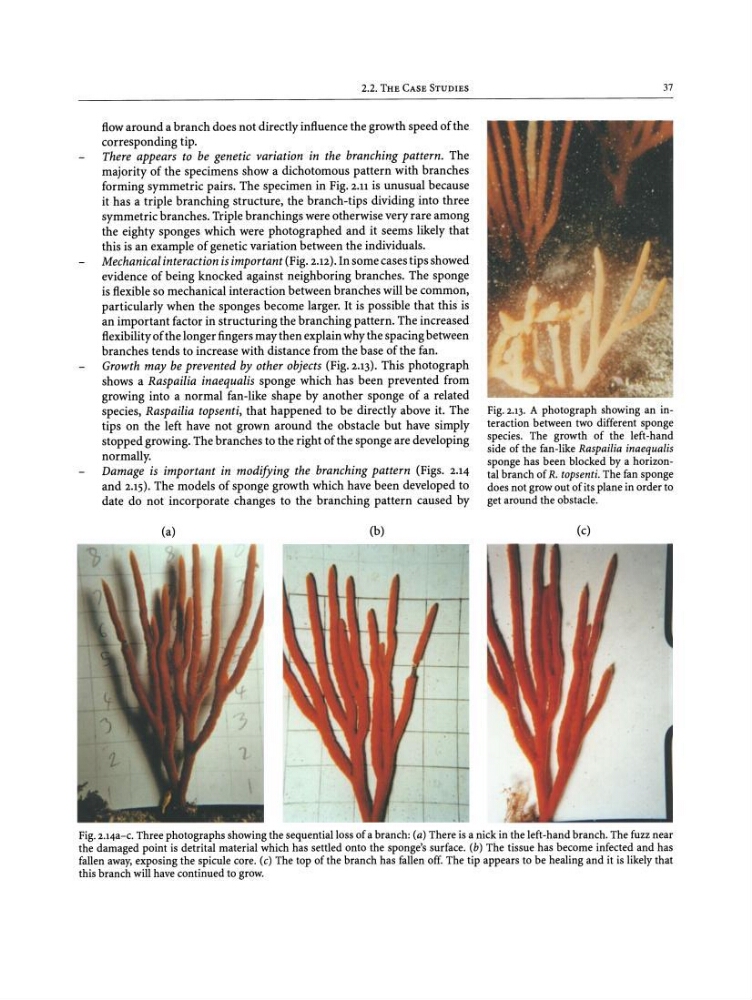
Damage is important in modifying the branching pattern (Figs. 2.14
and 2.15). The models of sponge growth which have been developed to
date do not incorporate changes to the branching pattern caused by
37
Fig.2.13. A photograph showing an interaction between two different sponge
species. The growth of the left-hand
side of the fan-like Raspailia inaequalis
sponge has been blocked by a horizontal branch of R. topsenti. The fan sponge
does not growout of its plane in order to
get around the obstacle.
(a)
(b)
(c)
Fig.2.14a-c. Three photographs showingthe sequentialloss of a branch: (a) There is a nick in the left-hand branch. The fuzz near
the damaged point is detrital material which has settled onto the sponge's surface. (b) The tissue has become infected and has
fallen away, exposing the spicule core. (c) The top of the branch has fallen off. The tip appears to be healing and it is likelythat
this branch willhavecontinued to grow.
flow around a branch does not directly influence the growth speed of the
corresponding tip.
There appears to be genetic variation in the branching pattern. The
majority of the specimens show a dichotomous pattern with branches
forming symmetric pairs. The specimen in Fig. 2.11 is unusual because
it has a triple branching structure, the branch-tips dividing into three
symmetric branches. Triple branchings were otherwise very rare among
the eighty sponges which were photographed and it seems likely that
this is an example of genetic variation between the individuals.
Mechanical interaction is important (Fig. 2.12). In some cases tips showed
evidence of being knocked against neighboring branches. The sponge
is flexible so mechanical interaction between branches will be common,
particularly when the sponges become larger. It is possible that this is
an important factor in structuring the branching pattern. The increased
flexibility of the longer fingers may then explain why the spacing between
branches tends to increase with distance from the base of the fan.
Growth may be prevented by other objects (Fig. 2.13). This photograph
shows a Raspailia inaequalis sponge which has been prevented from
growing into a normal fan-like shape by another sponge of a related
species, Raspailia topsenti, that happened to be directly above it. The
tips on the left have not grown around the obstacle but have simply
stopped growing. The branches to the right of the sponge are developing
normally.
Damage is important in modifying the branching pattern (Figs. 2.14
and 2.15). The models of sponge growth which have been developed to
date do not incorporate changes to the branching pattern caused by
37
Fig.2.13. A photograph showing an interaction between two different sponge
species. The growth of the left-hand
side of the fan-like Raspailia inaequalis
sponge has been blocked by a horizontal branch of R. topsenti. The fan sponge
does not growout of its plane in order to
get around the obstacle.
(a)
(b)
(c)
Fig.2.14a-c. Three photographs showingthe sequentialloss of a branch: (a) There is a nick in the left-hand branch. The fuzz near
the damaged point is detrital material which has settled onto the sponge's surface. (b) The tissue has become infected and has
fallen away, exposing the spicule core. (c) The top of the branch has fallen off. The tip appears to be healing and it is likelythat
this branch willhavecontinued to grow.