

38
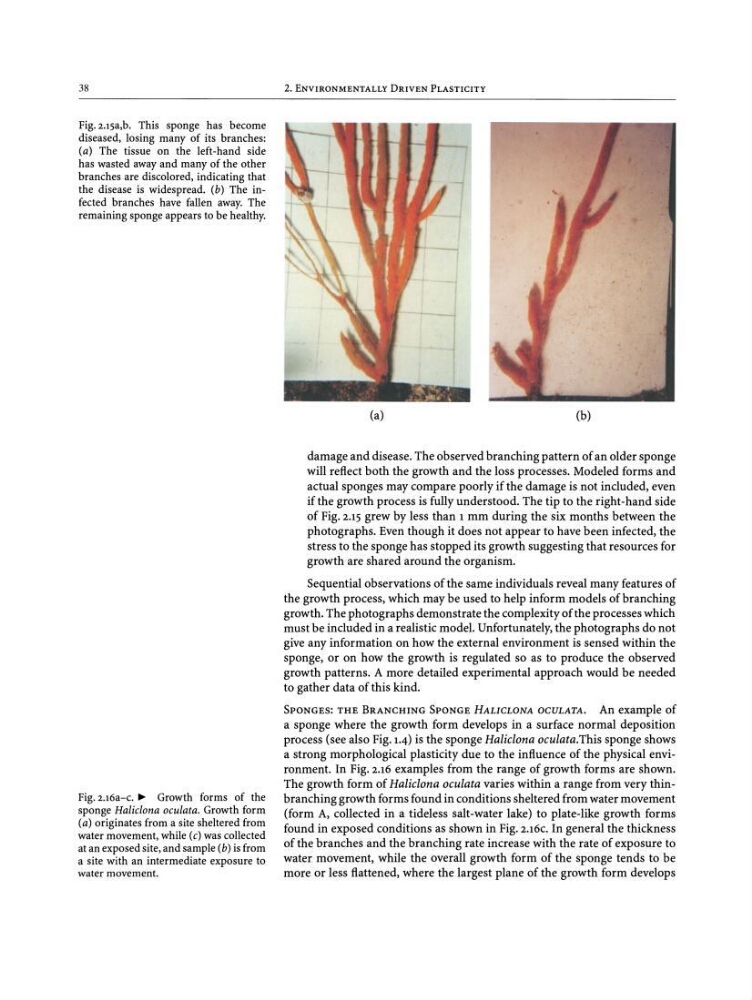
Fig.z.isa.b. This sponge has become
diseased, losing many of its branches:
(a) The tissue on the left-hand side
has wasted awayand many of the other
branches are discolored, indicating that
the disease is widespread. (b) The infected branches have fallen away. The
remaining sponge appears to be healthy.
2. ENVIRONMENTALLY DRIVEN PLASTICITY
(a)
(b)
Fig. 2.I6a-c. ~ Growth forms of the
sponge Haliclona oculata . Growth form
(a) originates from a site sheltered from
water movement, while (c) was collected
at an exposed site, and sample (b) isfrom
a site with an intermediate exposure to
water movement.
damage and disease. The observed branching pattern of an older sponge
will reflect both the growth and the loss processes. Modeled forms and
actual sponges may compare poorly if the damage is not included, even
if the growth process is fully understood. The tip to the right-hand side
of Fig. 2.15 grew by less than 1 mm during the six months between the
photographs. Even though it does not appear to have been infected, the
stress to the sponge has stopped its growth suggesting that resources for
growth are shared around the organism.
Sequential observations of the same individuals reveal many features of
the growth process, which may be used to help inform models of branching
growth. The photographs demonstrate the complexity of the processes which
must be included in a realistic model. Unfortunately, the photographs do not
give any information on how the external environment is sensed within the
sponge, or on how the growth is regulated so as to produce the observed
growth patterns. A more detailed experimental approach would be needed
to gather data of this kind.
SPONGES: THE BRANCHING SPONGE HALICLONA OCULATA. An example of
a sponge where the growth form develops in a surface normal deposition
process (see also Fig. 1.4) is the sponge Haliclona oculata.This sponge shows
a strong morphological plasticity due to the influence of the physical envi -
ronment. In Fig. 2.16 examples from the range of growth forms are shown.
The growth form of Haliclona oculata varies within a range from very thinbranching growth forms found in conditions sheltered from water movement
(form A, collected in a tideless salt-water lake) to plate-like growth forms
found in exposed conditions as shown in Fig. 2.16c. In general the thickness
of the branches and the branching rate increase with the rate of exposure to
water movement, while the overall growth form of the sponge tends to be
more or less flattened, where the largest plane of the growth form develops
Fig.z.isa.b. This sponge has become
diseased, losing many of its branches:
(a) The tissue on the left-hand side
has wasted awayand many of the other
branches are discolored, indicating that
the disease is widespread. (b) The infected branches have fallen away. The
remaining sponge appears to be healthy.
2. ENVIRONMENTALLY DRIVEN PLASTICITY
(a)
(b)
Fig. 2.I6a-c. ~ Growth forms of the
sponge Haliclona oculata . Growth form
(a) originates from a site sheltered from
water movement, while (c) was collected
at an exposed site, and sample (b) isfrom
a site with an intermediate exposure to
water movement.
damage and disease. The observed branching pattern of an older sponge
will reflect both the growth and the loss processes. Modeled forms and
actual sponges may compare poorly if the damage is not included, even
if the growth process is fully understood. The tip to the right-hand side
of Fig. 2.15 grew by less than 1 mm during the six months between the
photographs. Even though it does not appear to have been infected, the
stress to the sponge has stopped its growth suggesting that resources for
growth are shared around the organism.
Sequential observations of the same individuals reveal many features of
the growth process, which may be used to help inform models of branching
growth. The photographs demonstrate the complexity of the processes which
must be included in a realistic model. Unfortunately, the photographs do not
give any information on how the external environment is sensed within the
sponge, or on how the growth is regulated so as to produce the observed
growth patterns. A more detailed experimental approach would be needed
to gather data of this kind.
SPONGES: THE BRANCHING SPONGE HALICLONA OCULATA. An example of
a sponge where the growth form develops in a surface normal deposition
process (see also Fig. 1.4) is the sponge Haliclona oculata.This sponge shows
a strong morphological plasticity due to the influence of the physical envi -
ronment. In Fig. 2.16 examples from the range of growth forms are shown.
The growth form of Haliclona oculata varies within a range from very thinbranching growth forms found in conditions sheltered from water movement
(form A, collected in a tideless salt-water lake) to plate-like growth forms
found in exposed conditions as shown in Fig. 2.16c. In general the thickness
of the branches and the branching rate increase with the rate of exposure to
water movement, while the overall growth form of the sponge tends to be
more or less flattened, where the largest plane of the growth form develops