

8
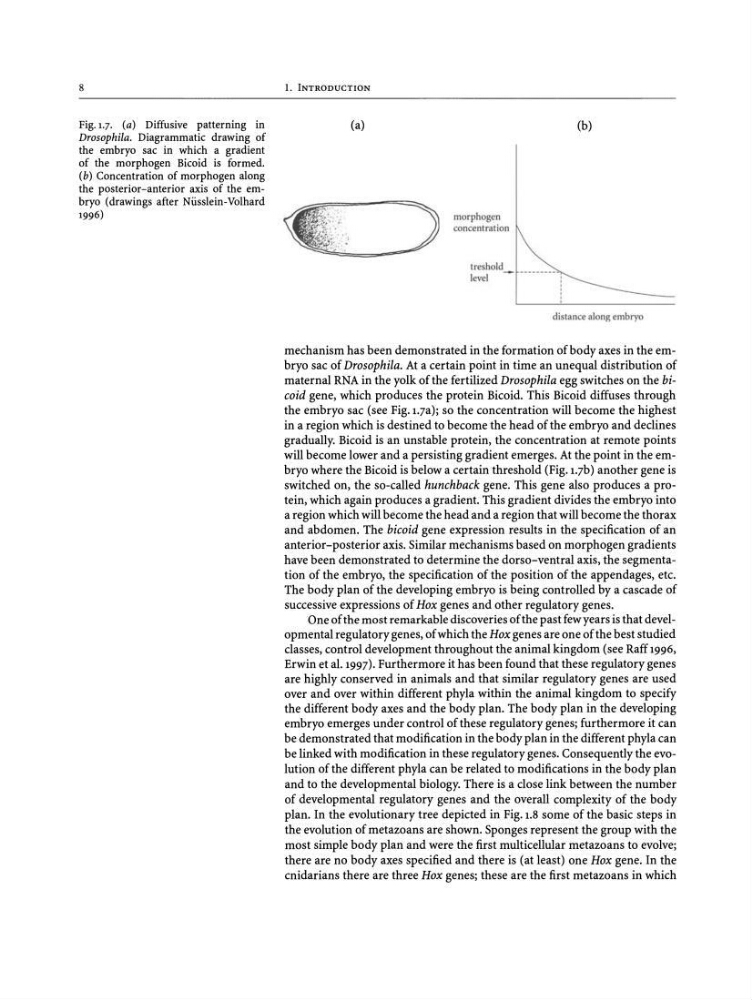
Fig. 1.7. (a) Diffusive patterning in
Drosophila. Diagrammatic drawing of
the embryo sac in which a gradient
of the morphogen Bicoid is formed .
(b) Concentration of morphogen along
the posterior-anterior axis of the embryo (drawings after Niisslein-Volhard
1996)
1. INTRODUCTION
(a)
(b)
mor phoge n
concen t ratio n
tres hold
level - --------d istance along embryo
mechanism has been demonstrated in the formation of body axes in the embryo sac of Drosophila. At a certain point in time an unequal distribution of
maternal RNA in the yolk of the fertilized Drosophila egg switches on the bicoid gene, which produces the protein Bicoid. This Bicoid diffuses through
the embryo sac (see Pig.r.za): so the concentration will become the highest
in a region which is destined to become the head of the embryo and declines
gradually. Bicoid is an unstable protein, the concentration at remote points
will become lower and a persisting gradient emerges. At the point in the embryo where the Bicoid is below a certain threshold (Fig. i.zb) another gene is
switched on, the so-called hunchback gene. This gene also produces a protein, which again produces a gradient. This gradient divides the embryo into
a region which will become the head and a region that will become the thorax
and abdomen. The bicoid gene expression results in the specification of an
anterior-posterior axis. Similar mechanisms based on morphogen gradients
have been demonstrated to determine the dorso-ventral axis, the segmentation of the embryo, the specification of the position of the appendages, etc.
The body plan of the developing embryo is being controlled by a cascade of
successive expressions of Hox genes and other regulatory genes.
One of the most remarkable discoveries of the past fewyears is that developmental regulatory genes, of which the Hox genes are one of the best studied
classes, control development throughout the animal kingdom (see Raff 1996,
Erwin et al. 1997) . Furthermore it has been found that these regulatory genes
are highly conserved in animals and that similar regulatory genes are used
over and over within different phyla within the animal kingdom to specify
the different body axes and the body plan . The body plan in the developing
embryo emerges under control of these regulatory genes; furthermore it can
be demonstrated that modification in the body plan in the different phyla can
be linked with modification in these regulatory genes. Consequently the evolution of the different phyla can be related to modifications in the body plan
and to the developmental biology. There is a close link between the number
of developmental regulatory genes and the overall complexity of the body
plan . In the evolutionary tree depicted in Fig. 1.8 some of the basic steps in
the evolution of metazoans are shown. Sponges represent the group with the
most simple body plan and were the first multicellul ar metazoans to evolve;
there are no body axes specified and there is (at least) one Hox gene. In the
cnidarians there are three Hox genes; these are the first metazoans in which
Fig. 1.7. (a) Diffusive patterning in
Drosophila. Diagrammatic drawing of
the embryo sac in which a gradient
of the morphogen Bicoid is formed .
(b) Concentration of morphogen along
the posterior-anterior axis of the embryo (drawings after Niisslein-Volhard
1996)
1. INTRODUCTION
(a)
(b)
mor phoge n
concen t ratio n
tres hold
level - --------d istance along embryo
mechanism has been demonstrated in the formation of body axes in the embryo sac of Drosophila. At a certain point in time an unequal distribution of
maternal RNA in the yolk of the fertilized Drosophila egg switches on the bicoid gene, which produces the protein Bicoid. This Bicoid diffuses through
the embryo sac (see Pig.r.za): so the concentration will become the highest
in a region which is destined to become the head of the embryo and declines
gradually. Bicoid is an unstable protein, the concentration at remote points
will become lower and a persisting gradient emerges. At the point in the embryo where the Bicoid is below a certain threshold (Fig. i.zb) another gene is
switched on, the so-called hunchback gene. This gene also produces a protein, which again produces a gradient. This gradient divides the embryo into
a region which will become the head and a region that will become the thorax
and abdomen. The bicoid gene expression results in the specification of an
anterior-posterior axis. Similar mechanisms based on morphogen gradients
have been demonstrated to determine the dorso-ventral axis, the segmentation of the embryo, the specification of the position of the appendages, etc.
The body plan of the developing embryo is being controlled by a cascade of
successive expressions of Hox genes and other regulatory genes.
One of the most remarkable discoveries of the past fewyears is that developmental regulatory genes, of which the Hox genes are one of the best studied
classes, control development throughout the animal kingdom (see Raff 1996,
Erwin et al. 1997) . Furthermore it has been found that these regulatory genes
are highly conserved in animals and that similar regulatory genes are used
over and over within different phyla within the animal kingdom to specify
the different body axes and the body plan . The body plan in the developing
embryo emerges under control of these regulatory genes; furthermore it can
be demonstrated that modification in the body plan in the different phyla can
be linked with modification in these regulatory genes. Consequently the evolution of the different phyla can be related to modifications in the body plan
and to the developmental biology. There is a close link between the number
of developmental regulatory genes and the overall complexity of the body
plan . In the evolutionary tree depicted in Fig. 1.8 some of the basic steps in
the evolution of metazoans are shown. Sponges represent the group with the
most simple body plan and were the first multicellul ar metazoans to evolve;
there are no body axes specified and there is (at least) one Hox gene. In the
cnidarians there are three Hox genes; these are the first metazoans in which