

6.2. CORAL RECORDS
6.2 Coral Records
An extensive literature indicates that coral skeletons are excellent archives of
environmental information and contain a more diverse range of information
than any other proxy environmental recorder. The discovery by Knutson et al.
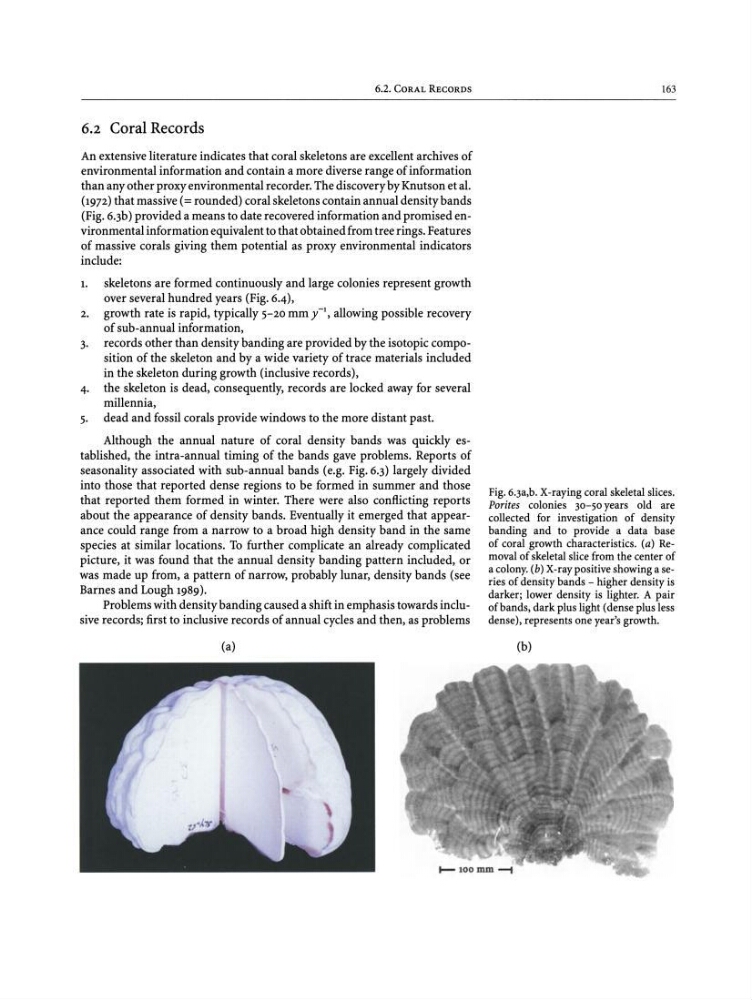
(1972) that massive (= rounded) coral skeletons contain annual density bands
(Fig. 6.3b) provided a means to date recovered information and promised environmental information equivalent to that obtained from tree rings . Features
of massive corals giving them potential as proxy environmental indicators
include:
1.
skeletons are formed continuously and large colonies represent growth
over several hundred years (Fig. 6.4),
2.
growth rate is rapid, typically 5-20 mm y-1, allowing possible recovery
of sub-annual information,
3. records other than density banding are provided by the isotopic composition of the skeleton and by a wide variety of trace materials included
in the skeleton during growth (inclusive records),
4. the skeleton is dead, consequently, records are locked away for several
millennia,
5. dead and fossil corals provide windows to the more distant past.
Although the annual nature of coral density bands was quickly established, the intra-annual timing of the bands gave problems. Reports of
seasonality associated with sub-annual bands (e.g. Fig. 6.3) largely divided
into those that reported dense regions to be formed in summer and those
that reported them formed in winter. There were also conflicting reports
about the appearance of density bands. Eventually it emerged that appearance could range from a narrow to a broad high density band in the same
species at similar locations. To further complicate an already complicated
picture, it was found that the annual density banding pattern included, or
was made up from, a pattern of narrow, probably lunar, density bands (see
Barnes and Lough 1989).
Problems with density banding caused a shift in emphasis towards inclusive records; first to inclusive records of annual cycles and then, as problems
(a)
163
Fig. 6.3a,b. X-rayingcoralskeletal slices.
Porites colonies 30-50 years old are
collected for investigation of density
banding and to provide a data base
of coral growth characteristics. (a) Removal of skeletal slice from the centerof
a colony. (b) X-ray positive showing a series of densitybands - higher density is
darker; lower density is lighter. A pair
of bands, dark pluslight (denseplusless
dense), represents one year'sgrowth.
(b)
I-- 10 0 mm --t
6.2 Coral Records
An extensive literature indicates that coral skeletons are excellent archives of
environmental information and contain a more diverse range of information
than any other proxy environmental recorder. The discovery by Knutson et al.
(1972) that massive (= rounded) coral skeletons contain annual density bands
(Fig. 6.3b) provided a means to date recovered information and promised environmental information equivalent to that obtained from tree rings . Features
of massive corals giving them potential as proxy environmental indicators
include:
1.
skeletons are formed continuously and large colonies represent growth
over several hundred years (Fig. 6.4),
2.
growth rate is rapid, typically 5-20 mm y-1, allowing possible recovery
of sub-annual information,
3. records other than density banding are provided by the isotopic composition of the skeleton and by a wide variety of trace materials included
in the skeleton during growth (inclusive records),
4. the skeleton is dead, consequently, records are locked away for several
millennia,
5. dead and fossil corals provide windows to the more distant past.
Although the annual nature of coral density bands was quickly established, the intra-annual timing of the bands gave problems. Reports of
seasonality associated with sub-annual bands (e.g. Fig. 6.3) largely divided
into those that reported dense regions to be formed in summer and those
that reported them formed in winter. There were also conflicting reports
about the appearance of density bands. Eventually it emerged that appearance could range from a narrow to a broad high density band in the same
species at similar locations. To further complicate an already complicated
picture, it was found that the annual density banding pattern included, or
was made up from, a pattern of narrow, probably lunar, density bands (see
Barnes and Lough 1989).
Problems with density banding caused a shift in emphasis towards inclusive records; first to inclusive records of annual cycles and then, as problems
(a)
163
Fig. 6.3a,b. X-rayingcoralskeletal slices.
Porites colonies 30-50 years old are
collected for investigation of density
banding and to provide a data base
of coral growth characteristics. (a) Removal of skeletal slice from the centerof
a colony. (b) X-ray positive showing a series of densitybands - higher density is
darker; lower density is lighter. A pair
of bands, dark pluslight (denseplusless
dense), represents one year'sgrowth.
(b)
I-- 10 0 mm --t