

162
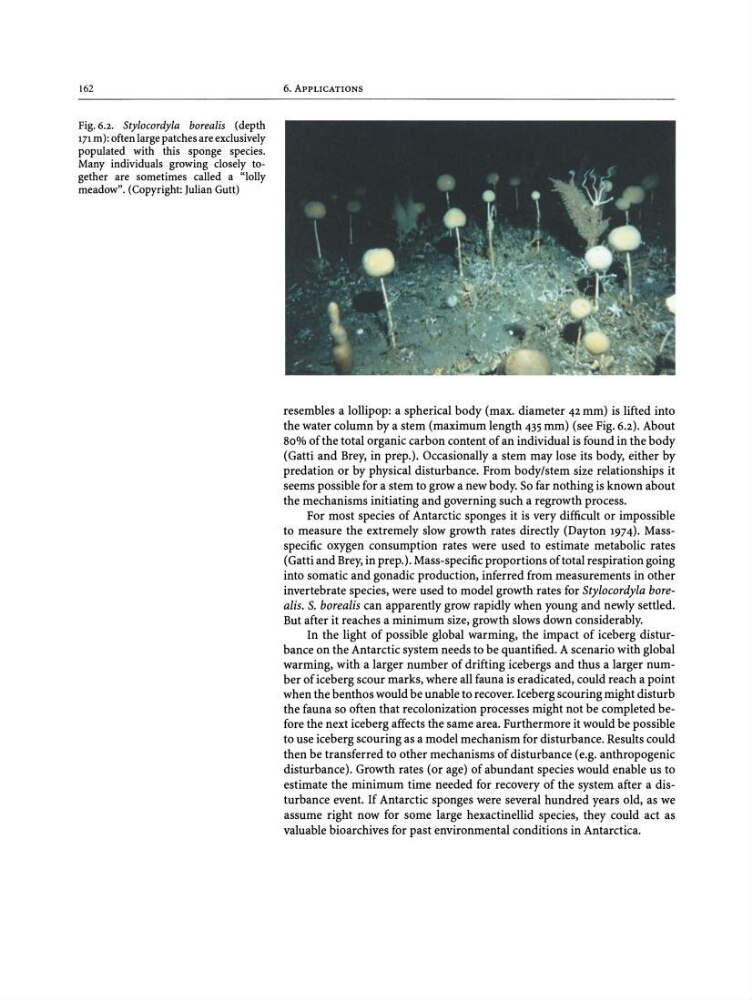
Fig. 6.2. Stylocordyla borealis (depth
171 m):oftenlargepatchesare exclusively
populated with this sponge species.
Many individuals growing closely together are sometimes called a "lolly
meadow". (Copyright: Julian Gutt)
6. ApPLICATIONS
resembles a lollipop: a spherical body (max. diameter 42 mm) is lifted into
the water column by a stem (maximum length 435 mm) (see Fig. 6.2). About
80% of the total organic carbon content of an individual is found in the body
(Gatti and Brey, in prep.), Occasionally a stem may lose its body, either by
predation or by physical disturbance. From body/stem size relationships it
seems possible for a stem to grow a new body. So far nothing is known about
the mechanisms initiating and governing such a regrowth process.
For most species of Antarctic sponges it is very difficult or impossible
to measure the extremely slow growth rates directly (Dayton 1974). Massspecific oxygen consumption rates were used to estimate metabolic rates
(Gatti and Brey,in prep.). Mass-specific proportions of total respiration going
into somatic and gonadic production, inferred from measurements in other
invertebrate species, were used to model growth rates for Stylocordyla borealis. S. borealis can apparently grow rapidly when young and newly settled.
But after it reaches a minimum size, growth slows down considerably.
In the light of possible global warming, the impact of iceberg disturbance on the Antarctic system needs to be quantified. A scenario with global
warming, with a larger number of drifting icebergs and thus a larger number of iceberg scour marks, where all fauna is eradicated, could reach a point
when the benthos would be unable to recover. Iceberg scouring might disturb
the fauna so often that recolonization processes might not be completed before the next iceberg affects the same area . Furthermore it would be possible
to use iceberg scouring as a model mechanism for disturbance. Results could
then be transferred to other mechanisms of disturbance (e.g. anthropogenic
disturbance). Growth rates (or age) of abundant species would enable us to
estimate the minimum time needed for recovery of the system after a disturbance event. If Antarctic sponges were several hundred years old, as we
assume right now for some large hexactinellid species, they could act as
valuable bioarchives for past environmental conditions in Antarctica.
Fig. 6.2. Stylocordyla borealis (depth
171 m):oftenlargepatchesare exclusively
populated with this sponge species.
Many individuals growing closely together are sometimes called a "lolly
meadow". (Copyright: Julian Gutt)
6. ApPLICATIONS
resembles a lollipop: a spherical body (max. diameter 42 mm) is lifted into
the water column by a stem (maximum length 435 mm) (see Fig. 6.2). About
80% of the total organic carbon content of an individual is found in the body
(Gatti and Brey, in prep.), Occasionally a stem may lose its body, either by
predation or by physical disturbance. From body/stem size relationships it
seems possible for a stem to grow a new body. So far nothing is known about
the mechanisms initiating and governing such a regrowth process.
For most species of Antarctic sponges it is very difficult or impossible
to measure the extremely slow growth rates directly (Dayton 1974). Massspecific oxygen consumption rates were used to estimate metabolic rates
(Gatti and Brey,in prep.). Mass-specific proportions of total respiration going
into somatic and gonadic production, inferred from measurements in other
invertebrate species, were used to model growth rates for Stylocordyla borealis. S. borealis can apparently grow rapidly when young and newly settled.
But after it reaches a minimum size, growth slows down considerably.
In the light of possible global warming, the impact of iceberg disturbance on the Antarctic system needs to be quantified. A scenario with global
warming, with a larger number of drifting icebergs and thus a larger number of iceberg scour marks, where all fauna is eradicated, could reach a point
when the benthos would be unable to recover. Iceberg scouring might disturb
the fauna so often that recolonization processes might not be completed before the next iceberg affects the same area . Furthermore it would be possible
to use iceberg scouring as a model mechanism for disturbance. Results could
then be transferred to other mechanisms of disturbance (e.g. anthropogenic
disturbance). Growth rates (or age) of abundant species would enable us to
estimate the minimum time needed for recovery of the system after a disturbance event. If Antarctic sponges were several hundred years old, as we
assume right now for some large hexactinellid species, they could act as
valuable bioarchives for past environmental conditions in Antarctica.