

6.1. ANTARCTIC SPONGES
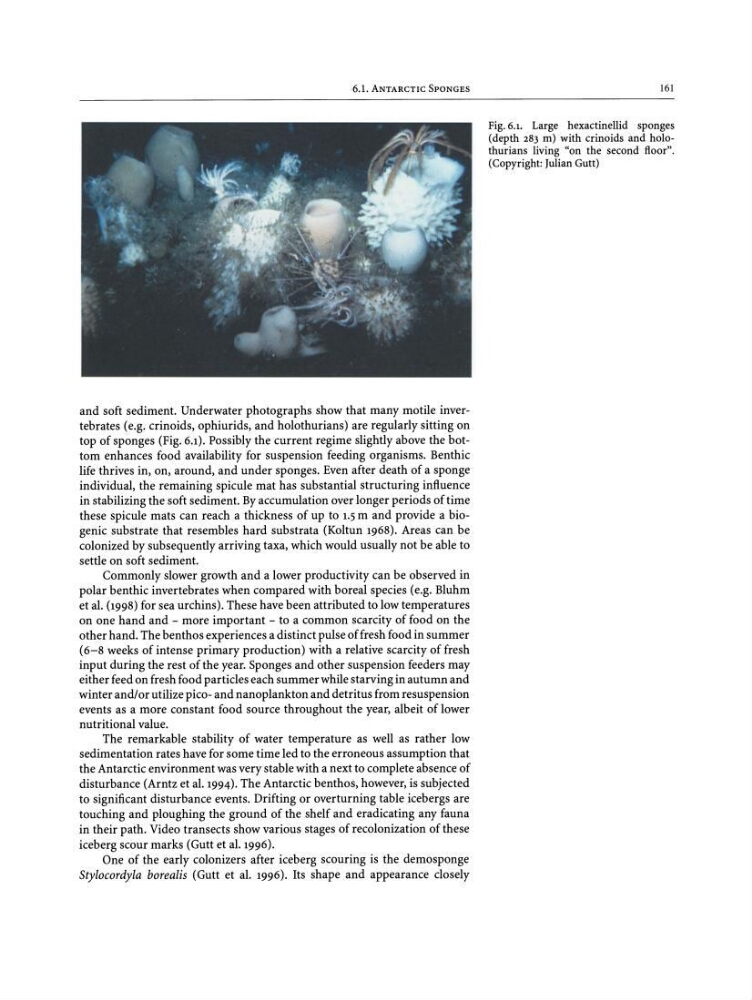
and soft sediment. Underwater photographs show that many motile invertebrates (e.g. crinoids, ophiurids, and holothurians) are regularly sitting on
top of sponges (Fig. 6.1). Possibly the current regime slightly above the bottom enhances food availability for suspension feeding organisms. Benthic
life thrives in, on, around, and under sponges. Even after death of a sponge
individual, the remaining spicule mat has substantial structuring influence
in stabilizing the soft sediment. By accumulation over longer periods of time
these spicule mats can reach a thickness of up to 1.5 m and provide a biogenic substrate that resembles hard substrata (Koltun 1968). Areas can be
colonized by subsequently arriving taxa, which would usually not be able to
settle on soft sediment.
Commonly slower growth and a lower productivity can be observed in
polar benthic invertebrates when compared with boreal species (e.g. Bluhm
et al. (1998) for sea urchins). These have been attributed to low temperatures
on one hand and - more important - to a common scarcity of food on the
other hand. The benthos experiences a distinct pulse of fresh food in summer
(6-8 weeks of intense primary production) with a relative scarcity of fresh
input during the rest of the year. Sponges and other suspension feeders may
either feed on fresh food particles each summer while starving in autumn and
winter and/or utilize pico- and nanoplankton and detritus from resuspension
events as a more constant food source throughout the year, albeit of lower
nutritional value.
The remarkable stability of water temperature as well as rather low
sedimentation rates have for some time led to the erroneous assumption that
the Antarctic environment was very stable with a next to complete absence of
disturbance (Arntz et al. 1994). The Antarctic benthos, however, is subjected
to significant disturbance events. Drifting or overturning table icebergs are
touching and ploughing the ground of the shelf and eradicating any fauna
in their path. Video transects show various stages of recolonization of these
iceberg scour marks (Gutt et al. 1996).
One of the early colonizers after iceberg scouring is the demosponge
Stylocordyla borealis (Gutt et al. 1996). Its shape and appearance closely
161
Fig. 6.1. Large hexactinellid sponges
(depth 283 m) with crinoids and holothurians living "on the second floor".
(Copyright: Julian Gutt)
and soft sediment. Underwater photographs show that many motile invertebrates (e.g. crinoids, ophiurids, and holothurians) are regularly sitting on
top of sponges (Fig. 6.1). Possibly the current regime slightly above the bottom enhances food availability for suspension feeding organisms. Benthic
life thrives in, on, around, and under sponges. Even after death of a sponge
individual, the remaining spicule mat has substantial structuring influence
in stabilizing the soft sediment. By accumulation over longer periods of time
these spicule mats can reach a thickness of up to 1.5 m and provide a biogenic substrate that resembles hard substrata (Koltun 1968). Areas can be
colonized by subsequently arriving taxa, which would usually not be able to
settle on soft sediment.
Commonly slower growth and a lower productivity can be observed in
polar benthic invertebrates when compared with boreal species (e.g. Bluhm
et al. (1998) for sea urchins). These have been attributed to low temperatures
on one hand and - more important - to a common scarcity of food on the
other hand. The benthos experiences a distinct pulse of fresh food in summer
(6-8 weeks of intense primary production) with a relative scarcity of fresh
input during the rest of the year. Sponges and other suspension feeders may
either feed on fresh food particles each summer while starving in autumn and
winter and/or utilize pico- and nanoplankton and detritus from resuspension
events as a more constant food source throughout the year, albeit of lower
nutritional value.
The remarkable stability of water temperature as well as rather low
sedimentation rates have for some time led to the erroneous assumption that
the Antarctic environment was very stable with a next to complete absence of
disturbance (Arntz et al. 1994). The Antarctic benthos, however, is subjected
to significant disturbance events. Drifting or overturning table icebergs are
touching and ploughing the ground of the shelf and eradicating any fauna
in their path. Video transects show various stages of recolonization of these
iceberg scour marks (Gutt et al. 1996).
One of the early colonizers after iceberg scouring is the demosponge
Stylocordyla borealis (Gutt et al. 1996). Its shape and appearance closely
161
Fig. 6.1. Large hexactinellid sponges
(depth 283 m) with crinoids and holothurians living "on the second floor".
(Copyright: Julian Gutt)