

152
5. VERIFYING MODELS
Pig.v.za.b, Contours of sponges before
and after the transplantation experiments.Sample (a) wastransplanted from
a sheltered site to an exposed site; with
sample (b) the reverse experiment was
carried out «a) 3.5 and (b) 1.5 month
experiment). Parts of the sponges are
marked with smallsteelneedles(seealso
Fig. 2.21).
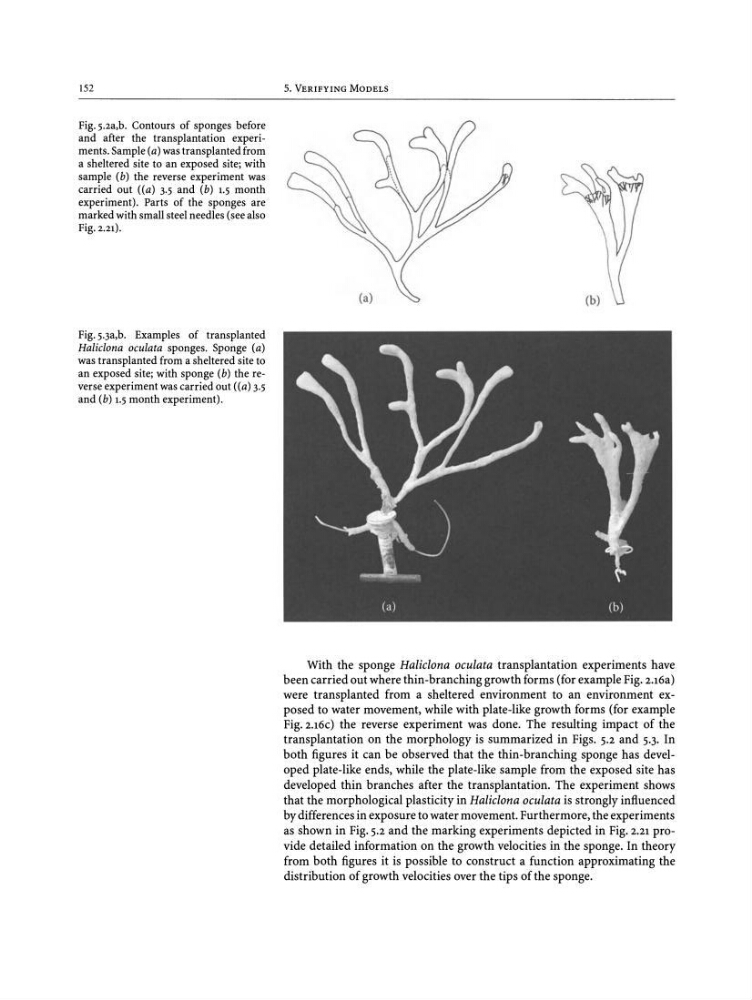
Fig.y.ja.b. Examples of transplanted
Haliclona oculata sponges. Sponge (a)
wastransplanted from a shelteredsite to
an exposed site; with sponge (b) the reverseexperimentwascarried out «a) 3.5
and (b) 1.5month experiment).
With the sponge Haliclona oculata transplantation experiments have
been carried out where thin-branching growth forms (for example Fig. 2.16a)
were transplanted from a sheltered environment to an environment exposed to water movement, while with plate-like growth forms (for example
Fig.2.16c) the reverse experiment was done. The resulting impact of the
transplantation on the morphology is summarized in Figs. 5.2 and 5.3. In
both figures it can be observed that the thin-branching sponge has developed plate-like ends, while the plate-like sample from the exposed site has
developed thin branches after the transplantation. The experiment shows
that the morphological plasticity in Haliclona oculata is strongly influenced
by differences in exposure to water movement. Furthermore, the experiments
as shown in Fig. 5.2 and the marking experiments depicted in Fig. 2.21 provide detailed information on the growth velocities in the sponge. In theory
from both figures it is possible to construct a function approximating the
distribution of growth velocities over the tips of the sponge.
5. VERIFYING MODELS
Pig.v.za.b, Contours of sponges before
and after the transplantation experiments.Sample (a) wastransplanted from
a sheltered site to an exposed site; with
sample (b) the reverse experiment was
carried out «a) 3.5 and (b) 1.5 month
experiment). Parts of the sponges are
marked with smallsteelneedles(seealso
Fig. 2.21).
Fig.y.ja.b. Examples of transplanted
Haliclona oculata sponges. Sponge (a)
wastransplanted from a shelteredsite to
an exposed site; with sponge (b) the reverseexperimentwascarried out «a) 3.5
and (b) 1.5month experiment).
With the sponge Haliclona oculata transplantation experiments have
been carried out where thin-branching growth forms (for example Fig. 2.16a)
were transplanted from a sheltered environment to an environment exposed to water movement, while with plate-like growth forms (for example
Fig.2.16c) the reverse experiment was done. The resulting impact of the
transplantation on the morphology is summarized in Figs. 5.2 and 5.3. In
both figures it can be observed that the thin-branching sponge has developed plate-like ends, while the plate-like sample from the exposed site has
developed thin branches after the transplantation. The experiment shows
that the morphological plasticity in Haliclona oculata is strongly influenced
by differences in exposure to water movement. Furthermore, the experiments
as shown in Fig. 5.2 and the marking experiments depicted in Fig. 2.21 provide detailed information on the growth velocities in the sponge. In theory
from both figures it is possible to construct a function approximating the
distribution of growth velocities over the tips of the sponge.