

5.2. TRA N S PLANTATIO N A ND OTHER P ER TURBATION E XP ER IM ENTS
lSI
min
max
med
min
max
med
n
high-light
high-light
high-light
low-light
low-light
low-light
number of buds
0
8
2
0
0
7
initial surface area (ern")
3·17
16.96
4·93
5·41
8.87
7·44
7
growth rate of surface area (%)
17.26
86.23
49.98
- 4.16
119·22
56.48
7
growth rate of projected area (%)
13.64
76.92
46.25
-4·12
115·75
56-48
7
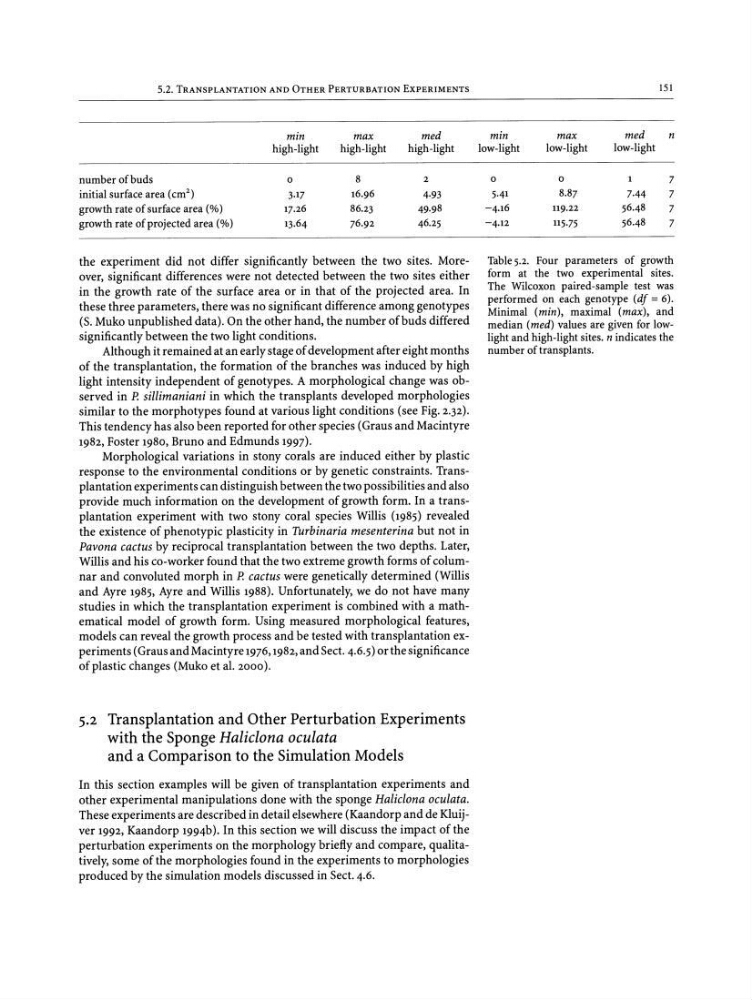
the experiment did not differ significantly between the two sites. Moreover, significant differences were not detected between the two sites either
in the growth rate of the surface area or in that of the projected area. In
these three parameters, there was no significant difference among genotypes
(S. Muko unpublished data). On the other hand, the number of buds differed
significantly between the two light conditions.
Although it remained at an early stage of development after eight months
of the transplantation, the formation of the branches was induced by high
light intensity independent of genotypes. A morphological change was observed in P. sillimaniani in which the transplants developed morphologies
similar to the morphotypes found at various light conditions (see Fig. 2.32).
This tendency has also been reported for other species (Graus and Macintyre
1982, Foster 1980, Bruno and Edmunds 1997).
Morphological variations in stony corals are induced either by plastic
response to the environmental conditions or by genetic constraints. Transplantation experiments can distinguish between the two possibilities and also
provide much information on the development of growth form . In a transplantation experiment with two stony coral species Willis (1985) revealed
the existence of phenotypic plasticity in Turbin aria mesenterina but not in
Pavona cactus by reciprocal transplantation between the two depths. Later,
Willis and his co-worker found that th e two extreme growth forms of columnar and convoluted morph in P. cactus were genetically determined (Willis
and Ayre 1985, Ayre and Willis 1988). Unfortunately, we do not have many
studies in which the transplantation experiment is combined with a mathematical model of growth form. Using measured morphological features,
models can reveal the growth pro cess and be test ed with transplantation experiments (Graus and Macintyre 1976, 1982, and Sect. 4.6.5) or the significance
of plastic changes (Muko et al. 2000).
5.2 Transplantation and Other Perturbation Experiments
with the Sponge Haliclona oculata
and a Comparison to the Simulation Models
In th is section examples will be given of transplantation experiments and
other experimental manipulations done with the sponge Haliclona oculata.
These experiments are described in detail elsewhere (Kaandorp and de Kluijver 1992, Kaandorp 1994b). In this section we will discuss the impact of the
perturbation experiments on the morphology br iefly and comp are, qualitatively, some of the morphologies found in the experiments to morphologies
produced by the simulation models discussed in Sect. 4.6.
Table 5.2. Four parameters of growth
form at the two experimental sites.
The Wilcoxon paired-sample test was
performed on each genotype (d! = 6).
Minimal (min), maximal (ma x) , and
median (med) values are given for lowlight and high-light sites. n indicates the
number of transplants.
lSI
min
max
med
min
max
med
n
high-light
high-light
high-light
low-light
low-light
low-light
number of buds
0
8
2
0
0
7
initial surface area (ern")
3·17
16.96
4·93
5·41
8.87
7·44
7
growth rate of surface area (%)
17.26
86.23
49.98
- 4.16
119·22
56.48
7
growth rate of projected area (%)
13.64
76.92
46.25
-4·12
115·75
56-48
7
the experiment did not differ significantly between the two sites. Moreover, significant differences were not detected between the two sites either
in the growth rate of the surface area or in that of the projected area. In
these three parameters, there was no significant difference among genotypes
(S. Muko unpublished data). On the other hand, the number of buds differed
significantly between the two light conditions.
Although it remained at an early stage of development after eight months
of the transplantation, the formation of the branches was induced by high
light intensity independent of genotypes. A morphological change was observed in P. sillimaniani in which the transplants developed morphologies
similar to the morphotypes found at various light conditions (see Fig. 2.32).
This tendency has also been reported for other species (Graus and Macintyre
1982, Foster 1980, Bruno and Edmunds 1997).
Morphological variations in stony corals are induced either by plastic
response to the environmental conditions or by genetic constraints. Transplantation experiments can distinguish between the two possibilities and also
provide much information on the development of growth form . In a transplantation experiment with two stony coral species Willis (1985) revealed
the existence of phenotypic plasticity in Turbin aria mesenterina but not in
Pavona cactus by reciprocal transplantation between the two depths. Later,
Willis and his co-worker found that th e two extreme growth forms of columnar and convoluted morph in P. cactus were genetically determined (Willis
and Ayre 1985, Ayre and Willis 1988). Unfortunately, we do not have many
studies in which the transplantation experiment is combined with a mathematical model of growth form. Using measured morphological features,
models can reveal the growth pro cess and be test ed with transplantation experiments (Graus and Macintyre 1976, 1982, and Sect. 4.6.5) or the significance
of plastic changes (Muko et al. 2000).
5.2 Transplantation and Other Perturbation Experiments
with the Sponge Haliclona oculata
and a Comparison to the Simulation Models
In th is section examples will be given of transplantation experiments and
other experimental manipulations done with the sponge Haliclona oculata.
These experiments are described in detail elsewhere (Kaandorp and de Kluijver 1992, Kaandorp 1994b). In this section we will discuss the impact of the
perturbation experiments on the morphology br iefly and comp are, qualitatively, some of the morphologies found in the experiments to morphologies
produced by the simulation models discussed in Sect. 4.6.
Table 5.2. Four parameters of growth
form at the two experimental sites.
The Wilcoxon paired-sample test was
performed on each genotype (d! = 6).
Minimal (min), maximal (ma x) , and
median (med) values are given for lowlight and high-light sites. n indicates the
number of transplants.