

138
4. SIMULATING GROWTH AND FORM
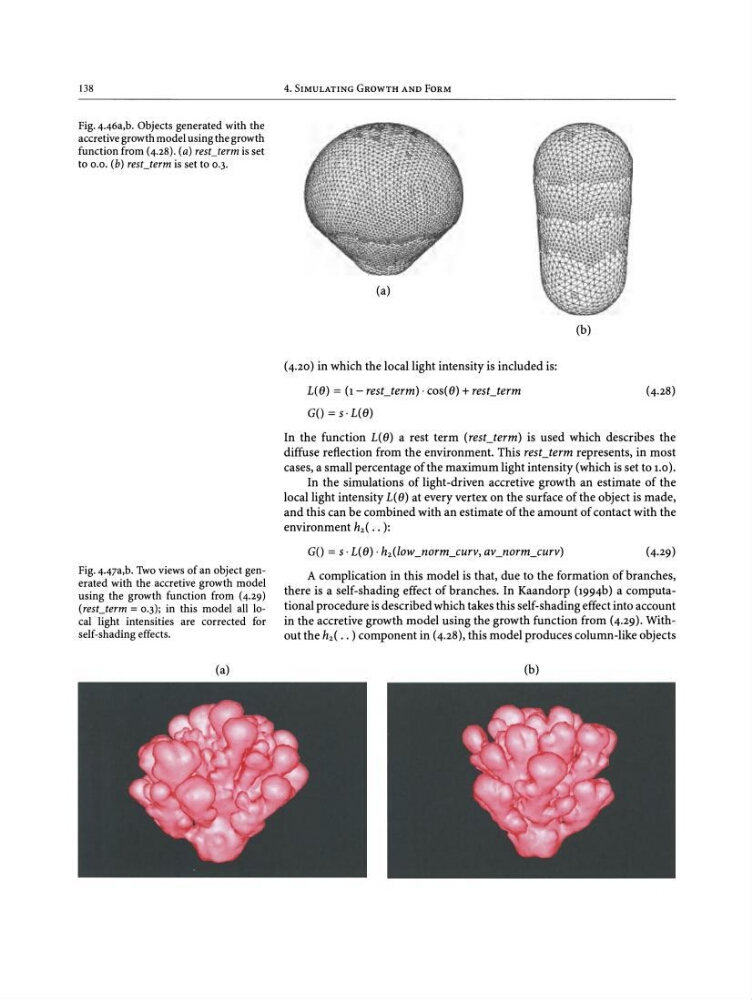
Fig.4.46a,b. Objectsgenerated with the
accretive growthmodelusingthegrowth
function from (4.28). (a) restterm is set
to 0.0. (b) rest_term is set to 0.3.
(a)
Fig.4.47a,b. Two views of an object generated with the accretive growth model
using the growth function from (4.29)
(restterm = 0.3); in this model all local light intensities are corrected for
self-shading effects.
(a)
(b)
(4.20) in which the local light intensity is included is:
L«(J) = (1- resttermi cos«(J) + restterm
GO = s· L«(J)
In the function L«(J) a rest term (resCterm) is used which describes the
diffuse reflection from the environment. This rest_term represents, in most
cases, a small percentage of the maximum light intensity (which is set to 1.0).
In the simulations of light-driven accretive growth an estimate of the
local light intensity L( (J) at every vertex on the surface of the object is made,
and this can be combined with an estimate of the amount of contact with the
environment h 2 ( • • ):
A complication in this model is that, due to the formation of branches,
there is a self-shading effect of branches. In Kaandorp (1994b) a computational procedure is described which takes this self-shading effect into account
in the accretive growth model using the growth function from (4.29). Without the h 2 ( •• ) component in (4.28), this model produces column-like objects
(b)
4. SIMULATING GROWTH AND FORM
Fig.4.46a,b. Objectsgenerated with the
accretive growthmodelusingthegrowth
function from (4.28). (a) restterm is set
to 0.0. (b) rest_term is set to 0.3.
(a)
Fig.4.47a,b. Two views of an object generated with the accretive growth model
using the growth function from (4.29)
(restterm = 0.3); in this model all local light intensities are corrected for
self-shading effects.
(a)
(b)
(4.20) in which the local light intensity is included is:
L«(J) = (1- resttermi cos«(J) + restterm
GO = s· L«(J)
In the function L«(J) a rest term (resCterm) is used which describes the
diffuse reflection from the environment. This rest_term represents, in most
cases, a small percentage of the maximum light intensity (which is set to 1.0).
In the simulations of light-driven accretive growth an estimate of the
local light intensity L( (J) at every vertex on the surface of the object is made,
and this can be combined with an estimate of the amount of contact with the
environment h 2 ( • • ):
A complication in this model is that, due to the formation of branches,
there is a self-shading effect of branches. In Kaandorp (1994b) a computational procedure is described which takes this self-shading effect into account
in the accretive growth model using the growth function from (4.29). Without the h 2 ( •• ) component in (4.28), this model produces column-like objects
(b)