

4.4. A LAPLACIAN MODEL OF BRANCHING GROWTH
109
o 0
250
150
rip ple surface
o
o
0
••
•••• I •
,
00 0
.. : ...
o
e.
._
0 .005 L-_ _~
--,~_ _-,-_ _-----J
50
0.007
0.01)
x
500
o
...
. g
(a)
(b)
The formation process of ripples is still a controversial topic among
the experts of this field. Several models have been proposed to explain how
ripples form (see for example Anderson and Bunnas 1993). The interest
of the LBM-CA approach compared with many others is that it simulates
the complete process (fluid flow plus grains), without including any ad hoc
hypotheses. The exact same dynamics produces realistic ripples, as well as
realistic large-scale deposits, simply by modifying the boundary conditions
and parameters such as perosion and N thres '
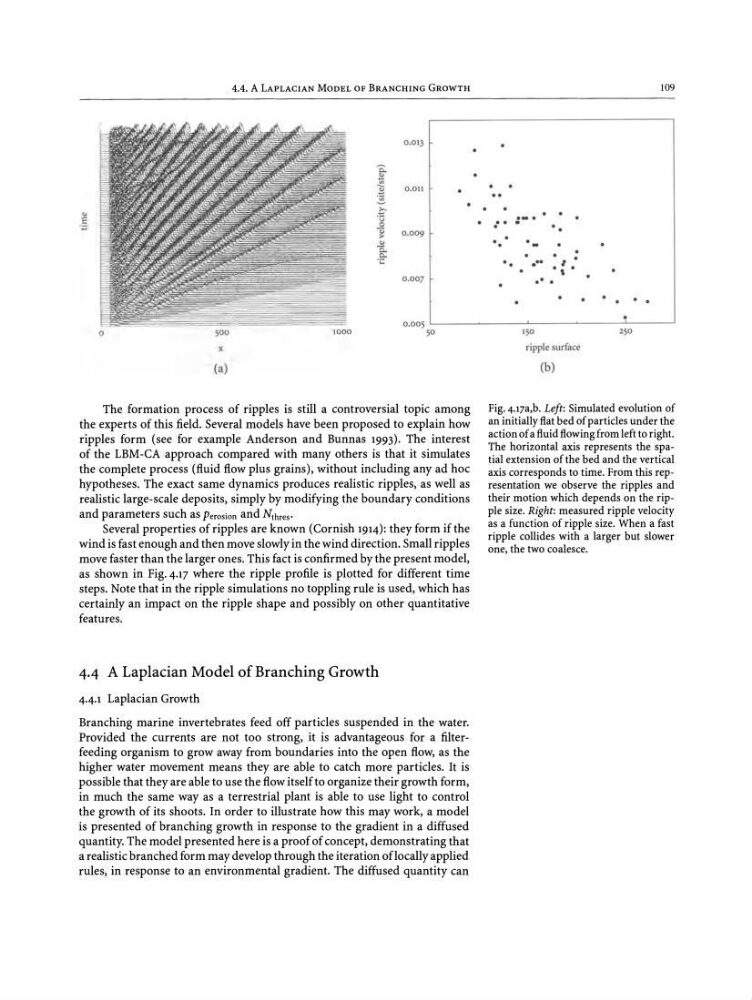
Several properties of ripples are known (Cornish 1914): they form if the
wind is fast enough and then move slowly in the wind direction. Small ripples
move faster than the larger ones. This fact is confirmed by the present model,
as shown in Fig. 4.17 where the ripple profile is plotted for different time
steps. Note that in the ripple simulations no toppling rule is used, which has
certainly an impact on the ripple shape and possibly on other quantitative
features.
Fig.4.17a,b. Left: Simulated evolution of
an initially flatbed ofparticles under the
action ofa fluidflowing from left to right.
The horizontal axis represents the spatial extension of the bed and the vertical
axis corresponds to time. From this representation we observe the ripples and
their motion which depends on the ripple size. Right: measured ripple velocity
as a function of ripple size. When a fast
ripple collides with a larger but slower
one, the two coalesce.
4.4 A Laplacian Model of Branching Growth
4.4 .1 Laplacian Growth
Branching marine invertebrates feed off particles suspended in the water.
Provided the currents are not too strong, it is advantageous for a filterfeeding organism to grow away from boundaries into the open flow, as the
higher water movement means they are able to catch more particles. It is
possible that they are able to use the flow itself to organize their growth form,
in much the same way as a terrestrial plant is able to use light to control
the growth of its shoots. In order to illustrate how this may work, a model
is presented of branching growth in response to the gradient in a diffused
quantity. The model presented here is a proof of concept, demonstrating that
a realistic branched form may develop through the iteration oflocally applied
rules, in response to an environmental gradient. The diffused quantity can
109
o 0
250
150
rip ple surface
o
o
0
••
•••• I •
,
00 0
.. : ...
o
e.
._
0 .005 L-_ _~
--,~_ _-,-_ _-----J
50
0.007
0.01)
x
500
o
...
. g
(a)
(b)
The formation process of ripples is still a controversial topic among
the experts of this field. Several models have been proposed to explain how
ripples form (see for example Anderson and Bunnas 1993). The interest
of the LBM-CA approach compared with many others is that it simulates
the complete process (fluid flow plus grains), without including any ad hoc
hypotheses. The exact same dynamics produces realistic ripples, as well as
realistic large-scale deposits, simply by modifying the boundary conditions
and parameters such as perosion and N thres '
Several properties of ripples are known (Cornish 1914): they form if the
wind is fast enough and then move slowly in the wind direction. Small ripples
move faster than the larger ones. This fact is confirmed by the present model,
as shown in Fig. 4.17 where the ripple profile is plotted for different time
steps. Note that in the ripple simulations no toppling rule is used, which has
certainly an impact on the ripple shape and possibly on other quantitative
features.
Fig.4.17a,b. Left: Simulated evolution of
an initially flatbed ofparticles under the
action ofa fluidflowing from left to right.
The horizontal axis represents the spatial extension of the bed and the vertical
axis corresponds to time. From this representation we observe the ripples and
their motion which depends on the ripple size. Right: measured ripple velocity
as a function of ripple size. When a fast
ripple collides with a larger but slower
one, the two coalesce.
4.4 A Laplacian Model of Branching Growth
4.4 .1 Laplacian Growth
Branching marine invertebrates feed off particles suspended in the water.
Provided the currents are not too strong, it is advantageous for a filterfeeding organism to grow away from boundaries into the open flow, as the
higher water movement means they are able to catch more particles. It is
possible that they are able to use the flow itself to organize their growth form,
in much the same way as a terrestrial plant is able to use light to control
the growth of its shoots. In order to illustrate how this may work, a model
is presented of branching growth in response to the gradient in a diffused
quantity. The model presented here is a proof of concept, demonstrating that
a realistic branched form may develop through the iteration oflocally applied
rules, in response to an environmental gradient. The diffused quantity can