

4.1. L-SYSTEMS
95
~
:-rl l I
r·
v
"
'l
;-'·t
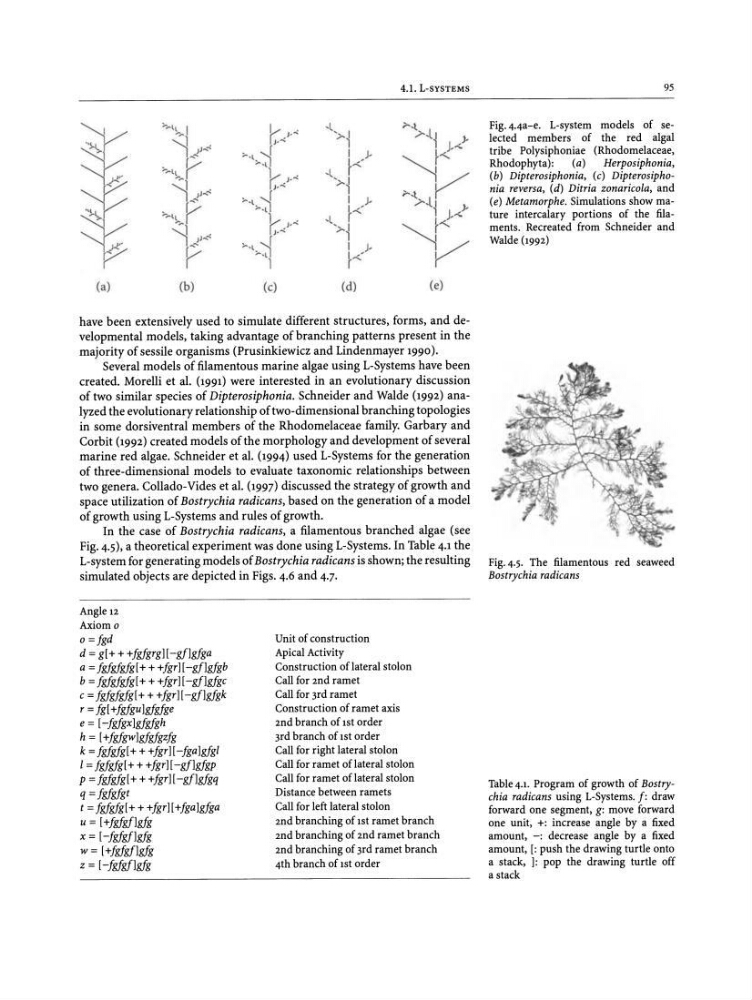
Fig.a.aa-e. L-system models of se~ .
' >-1
.>-,L 1
)_
lected members of the red algal
J.1 J--<.
~
JJ........
:-·l . :f
tribe Polysiphoniae (Rhodomelaceae,
. p
I J~-<..
~' l
(''Rhodophyta): (a) Herposiphonia,
~
- ..... l l
r F "
'l
(b) Dipterosiphonia, (c) Dipterosipho~
~.
J.' >-1
;-',t
V nia reversa, (d) Ditria zonaricola, and
JJ-.. ....
:-·l. :f
- p
I J.>--L I
)(e) Metamorphe. Simulations show mar· l
I "
r r l l
r F "
-l,
( ....
1 J--<.
ture intercalary portions of the fila~
~ .
J.' >-1
~
ments. Recreated from Schneider and
JJ- .....
:-·l . :f
Walde(1992)
p
I Jr ' l
(-<-'
1
(a)
(b)
(c)
(d)
(e)
have bee n extensively use d to simu late different structures, forms, and developmental models, taking advantage of branching patterns present in the
majority of sessile organisms (Prusinkiewicz and Lindenmayer 1990) .
Several models of filamentous marine algae using L-Systems have been
created. Morelli et al. (1991) were interested in an evolutionary discussion
of two similar species of Dipterosiphonia. Schneider and Walde (1992) analyzed the evolut ionary relationship of two -dimensional branching topologies
in some dorsiventral members of the Rhodomelaceae family. Garbary and
Corbit (1992) created models of the morphology and deve lopment of several
m arine red algae. Schneider et al. (1994) used L-Systems for th e generation
of th ree-dimensional models to evaluate taxon omic rela tio nships b etween
two genera. Collado-Vides et al. (1997) disc ussed the strategy of growth and
space utilization of Bostrychia radicans, based on the generation of a model
of growth using L-Systems and rules of growth.
In the case of Bostrychia radicans, a filamentous branched algae (see
Fig. 4.5), a theoretical experiment was done using L-Systems. In Table 4.1the
L-system for generating models ofBostry chia radican s is shown; the resulting
simulated objects are depicted in Figs. 4.6 and 4.7.
Fig.4.5. The filamentous red seaweed
Bostrychia radicans
Angle12
Axiom 0
o =fgd
d = g[++ +fgfgrg][-gf]gfga
a = fgfgfgfg[+ + +fgr) [-gf)gfgb
b =fgfgfgfg[+ + +fgr][ -gf)gfgc
c = fgfgfgfg[++ +fgr) [-gf]gfgk
r =fg[+fgfgu)gfgfge
e = [-fgfgx)gfgfgh
h = [+fgfgw)gfgfgzfg
k = fgfgfg[++ +fgr] [-fga)gfgl
1=fgfgfg [+ + +fgr)[- gf]gfgp
p = fgfgfg[++ +fgr][ -gf)gfgq
q = fgfgfgt
t = fgfgfg[+++fgrJ[+fga]gfga
u = [+fgfgf]gfg
x = [-fgfgflgfg
w = [+fgfgfJgfg
Z = [- fgfgfl gfg
Unit of construction
Apical Activity
Construction oflateral stolon
Callfor znd ramet
Callfor jrd ramet
Construction of ramet axis
znd branch of ist order
3rd branch of ist order
Callfor right lateral stolon
Call for ramet of lateral stolon
Call for ramet oflatera l stolon
Distance between ramets
Callfor left lateral stolon
znd branching of ist ramet branch
znd branching of znd ramet branch
znd branching of jrd ramet branch
4th branch of ist order
Table 4.1. Program of growth of Bostrychia radicans using L-Systems. f : draw
forward one segment, g: move forward
one unit, +: increase angle by a fixed
amount, -: decrease angle by a fixed
amount, [: push the drawing turtle onto
a stack, J: pop the drawing turtle off
a stack
95
~
:-rl l I
r·
v
"
'l
;-'·t
Fig.a.aa-e. L-system models of se~ .
' >-1
.>-,L 1
)_
lected members of the red algal
J.1 J--<.
~
JJ........
:-·l . :f
tribe Polysiphoniae (Rhodomelaceae,
. p
I J~-<..
~' l
(''Rhodophyta): (a) Herposiphonia,
~
- ..... l l
r F "
'l
(b) Dipterosiphonia, (c) Dipterosipho~
~.
J.' >-1
;-',t
V nia reversa, (d) Ditria zonaricola, and
JJ-.. ....
:-·l. :f
- p
I J.>--L I
)(e) Metamorphe. Simulations show mar· l
I "
r r l l
r F "
-l,
( ....
1 J--<.
ture intercalary portions of the fila~
~ .
J.' >-1
~
ments. Recreated from Schneider and
JJ- .....
:-·l . :f
Walde(1992)
p
I Jr ' l
(-<-'
1
(a)
(b)
(c)
(d)
(e)
have bee n extensively use d to simu late different structures, forms, and developmental models, taking advantage of branching patterns present in the
majority of sessile organisms (Prusinkiewicz and Lindenmayer 1990) .
Several models of filamentous marine algae using L-Systems have been
created. Morelli et al. (1991) were interested in an evolutionary discussion
of two similar species of Dipterosiphonia. Schneider and Walde (1992) analyzed the evolut ionary relationship of two -dimensional branching topologies
in some dorsiventral members of the Rhodomelaceae family. Garbary and
Corbit (1992) created models of the morphology and deve lopment of several
m arine red algae. Schneider et al. (1994) used L-Systems for th e generation
of th ree-dimensional models to evaluate taxon omic rela tio nships b etween
two genera. Collado-Vides et al. (1997) disc ussed the strategy of growth and
space utilization of Bostrychia radicans, based on the generation of a model
of growth using L-Systems and rules of growth.
In the case of Bostrychia radicans, a filamentous branched algae (see
Fig. 4.5), a theoretical experiment was done using L-Systems. In Table 4.1the
L-system for generating models ofBostry chia radican s is shown; the resulting
simulated objects are depicted in Figs. 4.6 and 4.7.
Fig.4.5. The filamentous red seaweed
Bostrychia radicans
Angle12
Axiom 0
o =fgd
d = g[++ +fgfgrg][-gf]gfga
a = fgfgfgfg[+ + +fgr) [-gf)gfgb
b =fgfgfgfg[+ + +fgr][ -gf)gfgc
c = fgfgfgfg[++ +fgr) [-gf]gfgk
r =fg[+fgfgu)gfgfge
e = [-fgfgx)gfgfgh
h = [+fgfgw)gfgfgzfg
k = fgfgfg[++ +fgr] [-fga)gfgl
1=fgfgfg [+ + +fgr)[- gf]gfgp
p = fgfgfg[++ +fgr][ -gf)gfgq
q = fgfgfgt
t = fgfgfg[+++fgrJ[+fga]gfga
u = [+fgfgf]gfg
x = [-fgfgflgfg
w = [+fgfgfJgfg
Z = [- fgfgfl gfg
Unit of construction
Apical Activity
Construction oflateral stolon
Callfor znd ramet
Callfor jrd ramet
Construction of ramet axis
znd branch of ist order
3rd branch of ist order
Callfor right lateral stolon
Call for ramet of lateral stolon
Call for ramet oflatera l stolon
Distance between ramets
Callfor left lateral stolon
znd branching of ist ramet branch
znd branching of znd ramet branch
znd branching of jrd ramet branch
4th branch of ist order
Table 4.1. Program of growth of Bostrychia radicans using L-Systems. f : draw
forward one segment, g: move forward
one unit, +: increase angle by a fixed
amount, -: decrease angle by a fixed
amount, [: push the drawing turtle onto
a stack, J: pop the drawing turtle off
a stack