

94
4. S I M ULAT I N G GROWTH AND FORM
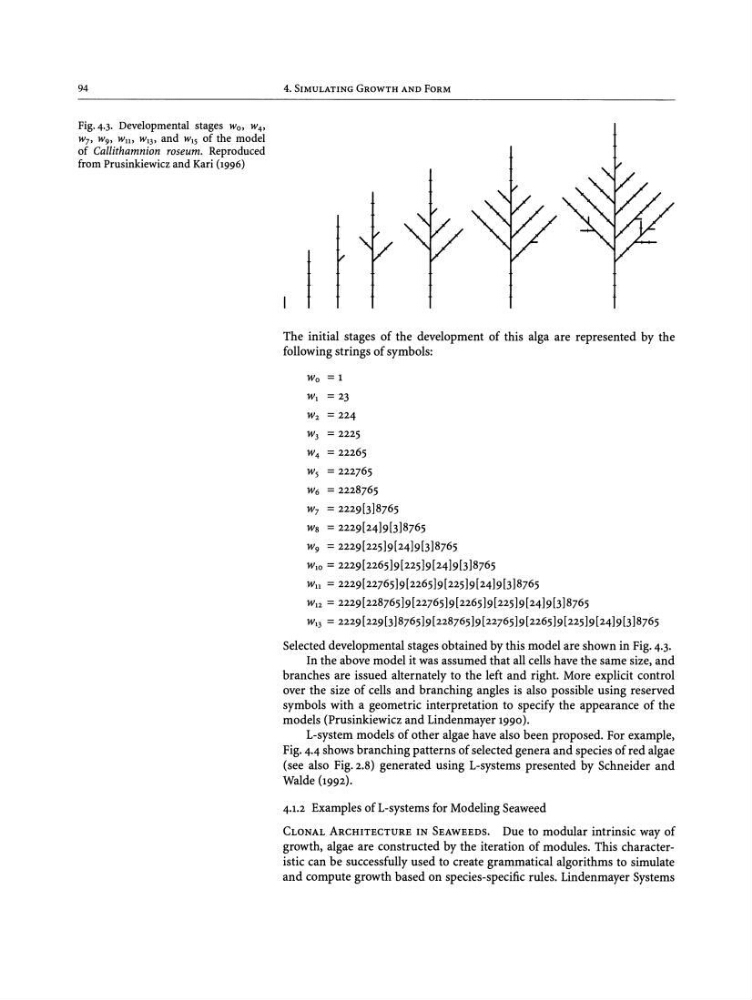
Fig.4.3. Developmental stages Wo. w 4'
w 7 • w 9 • W l1 , w13' and W I 5 of the model
of Callithamnion roseum. Reproduced
from Prusinkiewicz and Kari (1996)
1
The initial stages of the development of this alga are represented by the
following strings of symbols:
W o = 1
WI = 23
w2 = 224
W 3 =2225
W 4 = 22265
W 5 = 222765
W6 = 2228765
w 7 = 2229[3]8765
Ws = 2229[24]9[3]8765
w 9 =2229[225]9[24]9[3]8765
wIO =2229[2265]9[225]9[24]9[3]8765
wl1 = 2229[22765]9[2265]9[225]9[24]9[3]8765
w12 = 2229[228765]9[22765]9[2265]9[225]9[24]9[3]8765
w I3 = 2229[229[3]8765]9[228765]9[22765]9[2265]9[225]9[24]9[3]8765
Selected developmental stages obtained by this model are shown in Fig. 4.3.
In the above model it was assumed that all cells have the same size, and
branches are issued alternately to the left and right. More explicit control
over the size of cells and branching angles is also possible using reserved
symbols with a geometric interpretation to specify the appearance of the
models (Prusinkiewicz and Lindenmayer 1990 ).
L-system models of other algae have also been proposed. For example,
Fig. 4.4 shows branching patterns of selected genera and species of red algae
(see also Fig. 2.8) generated using L-systems presented by Schneider and
Walde (1992).
4.1.2 Example s of L-systems for Modeling Seaweed
CLONAL ARCHITECTURE IN SEAWEEDS. Due to modular intrinsic way of
growth, algae are constructed by the iteration of modules. This characteristic can be successfully used to create grammatical algorithms to simulate
and compute growth based on species-specific rules. Lindenmayer Systems
4. S I M ULAT I N G GROWTH AND FORM
Fig.4.3. Developmental stages Wo. w 4'
w 7 • w 9 • W l1 , w13' and W I 5 of the model
of Callithamnion roseum. Reproduced
from Prusinkiewicz and Kari (1996)
1
The initial stages of the development of this alga are represented by the
following strings of symbols:
W o = 1
WI = 23
w2 = 224
W 3 =2225
W 4 = 22265
W 5 = 222765
W6 = 2228765
w 7 = 2229[3]8765
Ws = 2229[24]9[3]8765
w 9 =2229[225]9[24]9[3]8765
wIO =2229[2265]9[225]9[24]9[3]8765
wl1 = 2229[22765]9[2265]9[225]9[24]9[3]8765
w12 = 2229[228765]9[22765]9[2265]9[225]9[24]9[3]8765
w I3 = 2229[229[3]8765]9[228765]9[22765]9[2265]9[225]9[24]9[3]8765
Selected developmental stages obtained by this model are shown in Fig. 4.3.
In the above model it was assumed that all cells have the same size, and
branches are issued alternately to the left and right. More explicit control
over the size of cells and branching angles is also possible using reserved
symbols with a geometric interpretation to specify the appearance of the
models (Prusinkiewicz and Lindenmayer 1990 ).
L-system models of other algae have also been proposed. For example,
Fig. 4.4 shows branching patterns of selected genera and species of red algae
(see also Fig. 2.8) generated using L-systems presented by Schneider and
Walde (1992).
4.1.2 Example s of L-systems for Modeling Seaweed
CLONAL ARCHITECTURE IN SEAWEEDS. Due to modular intrinsic way of
growth, algae are constructed by the iteration of modules. This characteristic can be successfully used to create grammatical algorithms to simulate
and compute growth based on species-specific rules. Lindenmayer Systems