

4.1. L-SYSTEMS
Specifically,
M(S): s < 5 ~ M(s+l)
~
~
~
M(s) : s == 5 ~ M(2)M(l)
~
~
M(s): s < 0 ~ M(S+l)
~
~
~
M(s) : s == 5 ~ M(l)M(2)
The logical expression condition determines whether or not the production
can be applied to a given module. The non -parametric and parametric Lsystems describing the development of Anabaena are equivalent due to the
one-to-one correspondence between module types in the non-parametric
L-systems and parameter values in its parametric counterpart: S H I, L H 2,
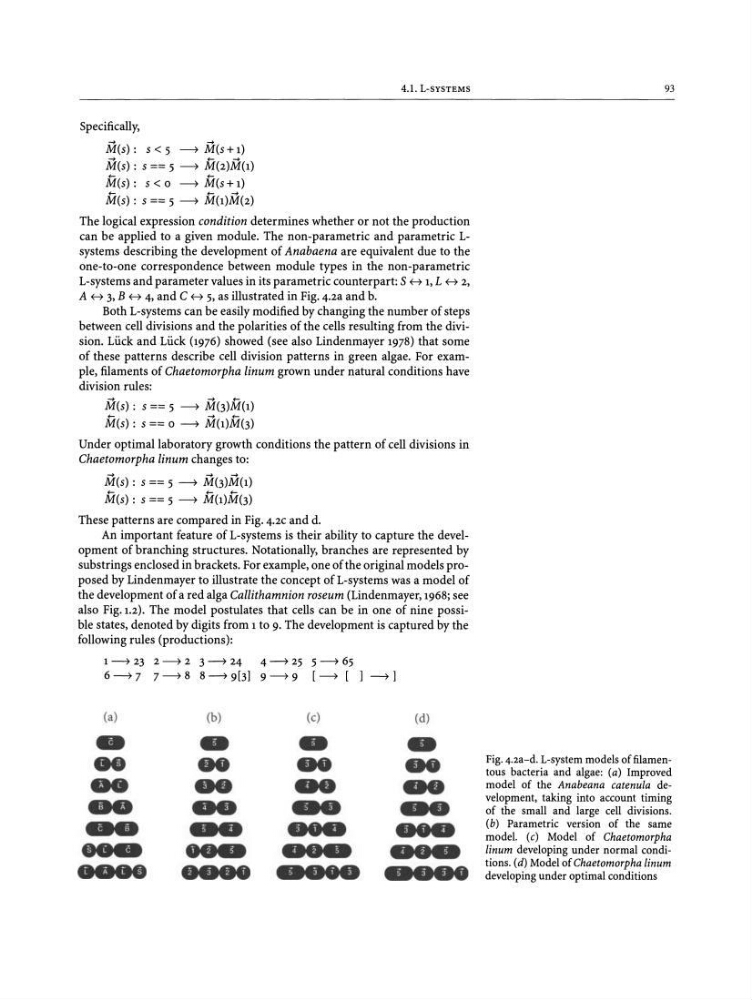
A H 3, B H 4, and C H 5, as illustrated in Fig. 4.2a and b.
Both L-systems can be easily modified by changing the number of steps
between cell divisions and the polarities of the cells resulting from the division. Luck and Luck (1976) showed (see also Lindenmayer 1978) that some
of these patterns describe cell division patterns in green algae. For example, filaments of Chaetomorpha linum grown under natural conditions have
division rules:
~
~
~
M(s) : s == 5 ~ M(3)M(l)
~
~
~
M(s) : s == 0 ~ M(l)M(3)
Under optimal laboratory growth conditions the pattern of cell divisions in
Chaetomorpha linum changes to:
M(s) : s == 5 ~ M(3)M(l)
~
~
~
M(s) : s == 5 ~ M(l)M(3)
These patterns are compared in Fig. 4.2C and d.
An important feature of L-systems is their ability to capture the development of branching structures. Notationally, branches are represented by
substrings enclosed in brackets. For example, one of the original models proposed by Lindenmayer to illustrate the concept of L-systems was a model of
the development of a red alga Callithamnion roseum (Lindenmayer, 1968;see
also Fig. 1.2). The model postulates that cells can be in one of nine possible states, denoted by digits from 1to 9. The development is captured by the
following rules (productions):
1 ~ 23 2 ~ 2 3 ~ 24 4 ~ 25 5 ~ 65
6~7 7~8 8~9[31 9~9
[~[ 1 ~l
93
(a)
(b)
(c)
(d)
Fig. 4.2a-d. L-system models of filamentous bacteria and algae: (a) Improved
model of the Anabeana catenula development, taking into account timing
of the small and large cell divisions.
(b) Parametric version of the same
model. (c) Model of Chaetornorpha
linurn developing under normal conditions. (d) Model of Chaetornorpha linurn
developing under optimal conditions
Specifically,
M(S): s < 5 ~ M(s+l)
~
~
~
M(s) : s == 5 ~ M(2)M(l)
~
~
M(s): s < 0 ~ M(S+l)
~
~
~
M(s) : s == 5 ~ M(l)M(2)
The logical expression condition determines whether or not the production
can be applied to a given module. The non -parametric and parametric Lsystems describing the development of Anabaena are equivalent due to the
one-to-one correspondence between module types in the non-parametric
L-systems and parameter values in its parametric counterpart: S H I, L H 2,
A H 3, B H 4, and C H 5, as illustrated in Fig. 4.2a and b.
Both L-systems can be easily modified by changing the number of steps
between cell divisions and the polarities of the cells resulting from the division. Luck and Luck (1976) showed (see also Lindenmayer 1978) that some
of these patterns describe cell division patterns in green algae. For example, filaments of Chaetomorpha linum grown under natural conditions have
division rules:
~
~
~
M(s) : s == 5 ~ M(3)M(l)
~
~
~
M(s) : s == 0 ~ M(l)M(3)
Under optimal laboratory growth conditions the pattern of cell divisions in
Chaetomorpha linum changes to:
M(s) : s == 5 ~ M(3)M(l)
~
~
~
M(s) : s == 5 ~ M(l)M(3)
These patterns are compared in Fig. 4.2C and d.
An important feature of L-systems is their ability to capture the development of branching structures. Notationally, branches are represented by
substrings enclosed in brackets. For example, one of the original models proposed by Lindenmayer to illustrate the concept of L-systems was a model of
the development of a red alga Callithamnion roseum (Lindenmayer, 1968;see
also Fig. 1.2). The model postulates that cells can be in one of nine possible states, denoted by digits from 1to 9. The development is captured by the
following rules (productions):
1 ~ 23 2 ~ 2 3 ~ 24 4 ~ 25 5 ~ 65
6~7 7~8 8~9[31 9~9
[~[ 1 ~l
93
(a)
(b)
(c)
(d)
Fig. 4.2a-d. L-system models of filamentous bacteria and algae: (a) Improved
model of the Anabeana catenula development, taking into account timing
of the small and large cell divisions.
(b) Parametric version of the same
model. (c) Model of Chaetornorpha
linurn developing under normal conditions. (d) Model of Chaetornorpha linurn
developing under optimal conditions