

12
General Methods
Medium
bottle
Cryotubes
Stoppers
Pipetting
aids
Dissecting
tools
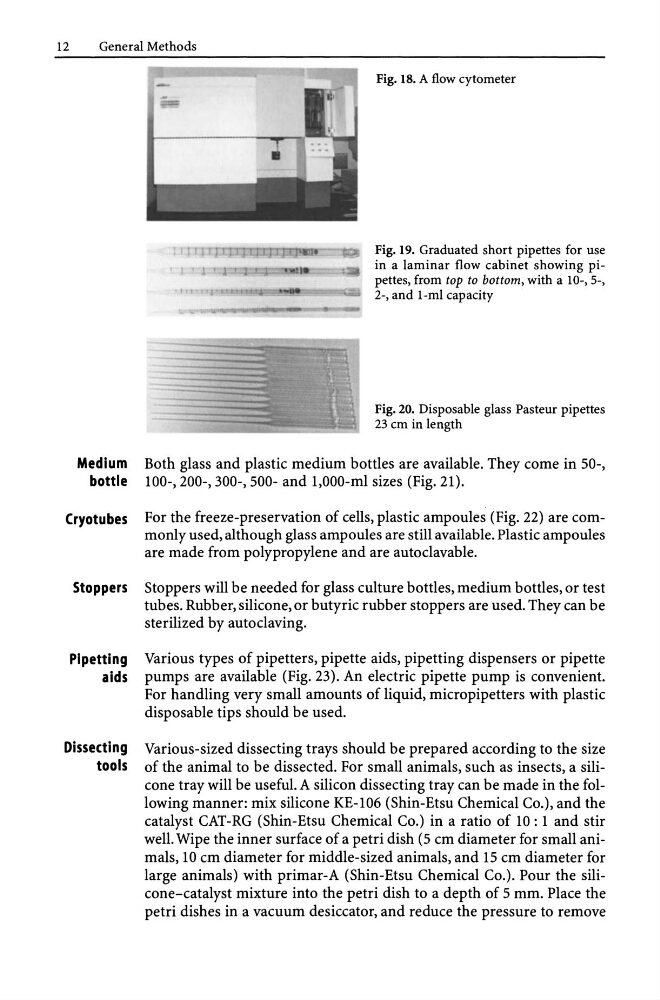
Fig. IS. A flow cytometer
Fig. 19. Graduated short pipettes for use
in a laminar flow cabinet showing pipettes, from top to bottom, with a 10-, 5-,
2-, and l-ml capacity
Fig. 20. Disposable glass Pasteur pipettes
23 cm in length
Both glass and plastic medium bottles are available. They come in 50-,
100-,200-,300-,500- and 1,000-ml sizes (Fig. 21).
For the freeze-preservation of cells, plastic ampoules (Fig. 22) are commonly used, although glass ampoules are still available. Plastic ampoules
are made from polypropylene and are autoclavable.
Stoppers will be needed for glass culture bottles, medium bottles, or test
tubes. Rubber, silicone, or butyric rubber stoppers are used. They can be
sterilized by autoclaving.
Various types of pipetters, pipette aids, pipetting dispensers or pipette
pumps are available (Fig. 23). An electric pipette pump is convenient.
For handling very small amounts of liquid, micropipetters with plastic
disposable tips should be used.
Various-sized dissecting trays should be prepared according to the size
of the animal to be dissected. For small animals, such as insects, a silicone tray will be useful. A silicon dissecting tray can be made in the following manner: mix silicone KE-I06 (Shin-Etsu Chemical Co.), and the
catalyst CAT-RG (Shin-Etsu Chemical Co.) in a ratio of 10 : 1 and stir
well. Wipe the inner surface of a petri dish (5 cm diameter for small animals, 10 cm diameter for middle-sized animals, and 15 cm diameter for
large animals) with primar-A (Shin-Etsu Chemical Co.). Pour the silicone-catalyst mixture into the petri dish to a depth of 5 mm. Place the
petri dishes in a vacuum desiccator, and reduce the pressure to remove
General Methods
Medium
bottle
Cryotubes
Stoppers
Pipetting
aids
Dissecting
tools
Fig. IS. A flow cytometer
Fig. 19. Graduated short pipettes for use
in a laminar flow cabinet showing pipettes, from top to bottom, with a 10-, 5-,
2-, and l-ml capacity
Fig. 20. Disposable glass Pasteur pipettes
23 cm in length
Both glass and plastic medium bottles are available. They come in 50-,
100-,200-,300-,500- and 1,000-ml sizes (Fig. 21).
For the freeze-preservation of cells, plastic ampoules (Fig. 22) are commonly used, although glass ampoules are still available. Plastic ampoules
are made from polypropylene and are autoclavable.
Stoppers will be needed for glass culture bottles, medium bottles, or test
tubes. Rubber, silicone, or butyric rubber stoppers are used. They can be
sterilized by autoclaving.
Various types of pipetters, pipette aids, pipetting dispensers or pipette
pumps are available (Fig. 23). An electric pipette pump is convenient.
For handling very small amounts of liquid, micropipetters with plastic
disposable tips should be used.
Various-sized dissecting trays should be prepared according to the size
of the animal to be dissected. For small animals, such as insects, a silicone tray will be useful. A silicon dissecting tray can be made in the following manner: mix silicone KE-I06 (Shin-Etsu Chemical Co.), and the
catalyst CAT-RG (Shin-Etsu Chemical Co.) in a ratio of 10 : 1 and stir
well. Wipe the inner surface of a petri dish (5 cm diameter for small animals, 10 cm diameter for middle-sized animals, and 15 cm diameter for
large animals) with primar-A (Shin-Etsu Chemical Co.). Pour the silicone-catalyst mixture into the petri dish to a depth of 5 mm. Place the
petri dishes in a vacuum desiccator, and reduce the pressure to remove