

1 Facilities and Equipment
11
a laminar flow cabinet (Fig. 19). Disposable graduated 1-,2-,5-,10-, and
25-ml plastic or glass pipettes are commercially available. The Pasteur
pipette (Fig. 20) is for general use and is used frequently. This can be
obtained as a disposable pipette from commercial sources. Pipettes are
used with bulbs (nipples) or pipetting devices, rather than mouth
pipetting, in order to avoid mycoplasmal infection. It is better to insert a
cotton plug in the top of a pipette before sterilization. Bulbs should be
kept in 70% ethanol when not in use in order to keep the inside of the
bulbs sterile.
Glass or plastic conical or round-bottomed centrifuge tubes can be used.
Some centrifuge tubes are graduated. Centrifuge tubes with screw caps
are preferable.
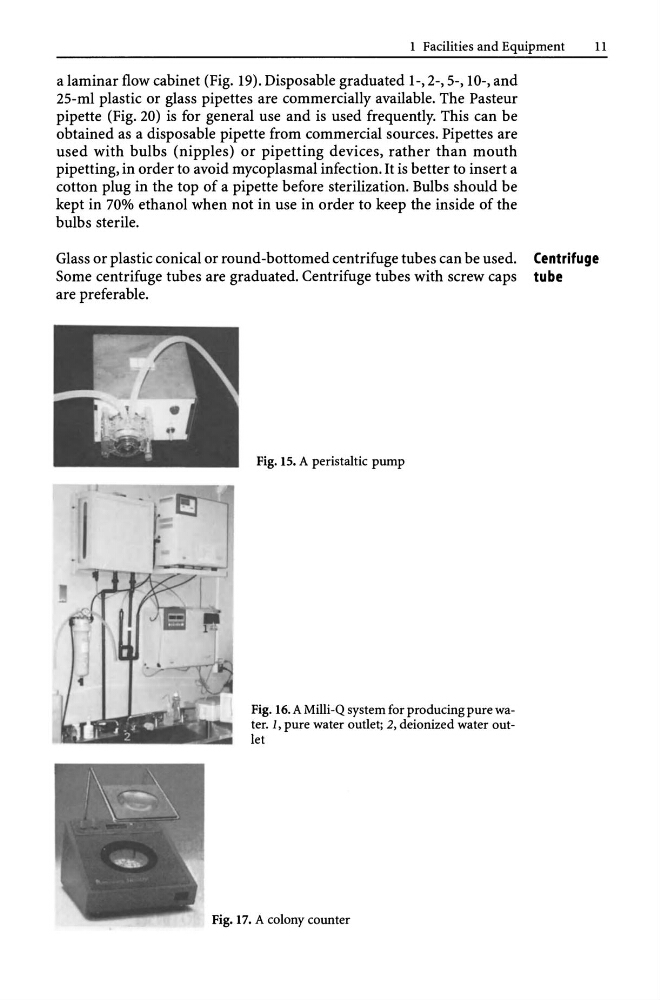
Fig. 15. A peristaltic pump
Fig. 16. A Milli-Q system for producing pure water. 1, pure water outlet; 2, deionized water outlet
Fig. 17. A colony counter
Centrifuge
tube
11
a laminar flow cabinet (Fig. 19). Disposable graduated 1-,2-,5-,10-, and
25-ml plastic or glass pipettes are commercially available. The Pasteur
pipette (Fig. 20) is for general use and is used frequently. This can be
obtained as a disposable pipette from commercial sources. Pipettes are
used with bulbs (nipples) or pipetting devices, rather than mouth
pipetting, in order to avoid mycoplasmal infection. It is better to insert a
cotton plug in the top of a pipette before sterilization. Bulbs should be
kept in 70% ethanol when not in use in order to keep the inside of the
bulbs sterile.
Glass or plastic conical or round-bottomed centrifuge tubes can be used.
Some centrifuge tubes are graduated. Centrifuge tubes with screw caps
are preferable.
Fig. 15. A peristaltic pump
Fig. 16. A Milli-Q system for producing pure water. 1, pure water outlet; 2, deionized water outlet
Fig. 17. A colony counter
Centrifuge
tube