

water occurred, as a result of drinking, through the gut. However, as described in
the previous section, although this is important it rarely contributes more than
about 10% of the total salt taken up by such fish (MOTAIS and MAETZ, 1965 ; POTTS
et al., 1967). The kidney was also found to be only a minor avenue for salt loss in
fish living in the sea. It thus became apparent that the major part of the very large
amount of salt which is exchanged by marine fish takes place through their gills.
It had previously been recognized that the gills of marine fish were the principal
avenue for active extrusion of sodium chloride, but the fact that large amounts of
2
c:
Li..~¥
~
,~r
il
_f/: I 1
I
I
o V81/6 1/4
1/2
3/4
V1
Ext. cone.
3
2
_ _ _ _xfIJ'l.SWad
-:
x/x
x'
/'"
_
_ 25'1.SWad
Z------FWad
o V8116 V4 1/3 1/2
3/4
1/1
1.5/1
Ext. cone.
234
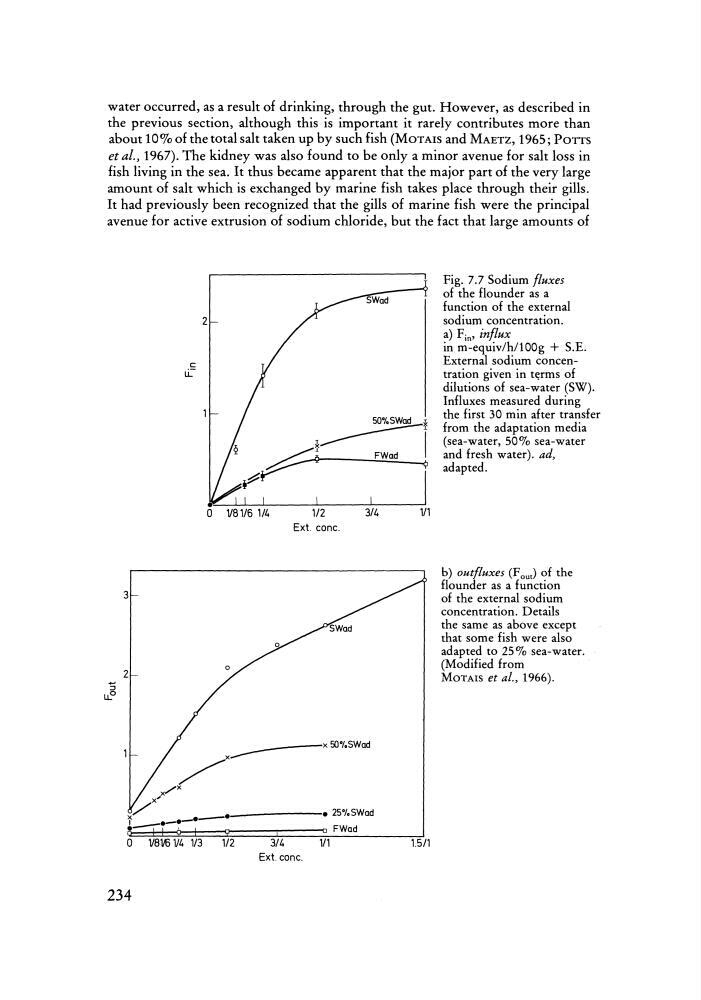
Fig . 7.7 Sodium fluxe s
of the flounder as a
function of the external
sodium concentration.
a) Fin' influx
in m-equiv/h/tOOg + S.E .
External sodium concentration given in terms of
dilutions of sea-water (SW).
Influxes measured during
the first 30 min after transfer
from the adaptation media
(sea-water, 50% sea-water
and fresh water). ad,
adapted .
b) out/luxes (Fou,) of the
flounder as a function
of th e external sodium
concentration. Details
the same as above except
that some fish were also
adapted to 25% sea-water.
(Modified from
MOTAIS et al., 1966).
the previous section, although this is important it rarely contributes more than
about 10% of the total salt taken up by such fish (MOTAIS and MAETZ, 1965 ; POTTS
et al., 1967). The kidney was also found to be only a minor avenue for salt loss in
fish living in the sea. It thus became apparent that the major part of the very large
amount of salt which is exchanged by marine fish takes place through their gills.
It had previously been recognized that the gills of marine fish were the principal
avenue for active extrusion of sodium chloride, but the fact that large amounts of
2
c:
Li..~¥
~
,~r
il
_f/: I 1
I
I
o V81/6 1/4
1/2
3/4
V1
Ext. cone.
3
2
_ _ _ _xfIJ'l.SWad
-:
x/x
x'
/'"
_
_ 25'1.SWad
Z------FWad
o V8116 V4 1/3 1/2
3/4
1/1
1.5/1
Ext. cone.
234
Fig . 7.7 Sodium fluxe s
of the flounder as a
function of the external
sodium concentration.
a) Fin' influx
in m-equiv/h/tOOg + S.E .
External sodium concentration given in terms of
dilutions of sea-water (SW).
Influxes measured during
the first 30 min after transfer
from the adaptation media
(sea-water, 50% sea-water
and fresh water). ad,
adapted .
b) out/luxes (Fou,) of the
flounder as a function
of th e external sodium
concentration. Details
the same as above except
that some fish were also
adapted to 25% sea-water.
(Modified from
MOTAIS et al., 1966).