

3
Anguilla
Fundulus
R
~
SW
FW
2
•
o
II
z
... N
l
J
~
.........."""'''''
/
~
~
..~.......
0
0
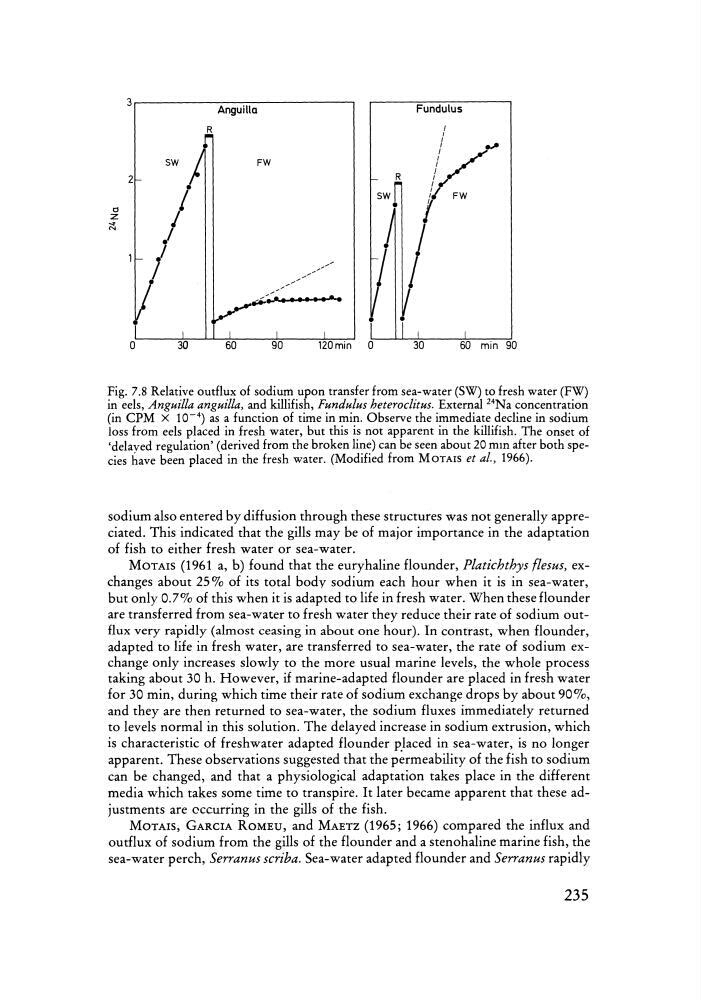
Fig. 7.8 Relative outflux of sodium upon transfer from sea-water(SW) to fresh water (FW)
in eels, Anguilla anguilla, and killifish, Fundulus beteroclitus. External 2
4
Na concentration
(in CPM X 104 ) as a function of time in min. Observe the immediatedecline in sodium
loss from eels placed in fresh water, but this is not apparent in the killifish. The onset of
'delaved regulation' (derivedfrom the broken line) can be seen about 20 min after both species have been placed in the fresh water. (Modified from MOTAlS et al., 1966).
sodium also entered by diffusion through these structures was not generally appreciated. This indicated that the gills may be of major importance in the adaptation
of fish to either fresh water or sea-water.
MOTAlS (1961 a, b) found that the euryhaline flounder, Platichthys [lesus, exchanges about 25% of its total body sodium each hour when it is in sea-water,
but only 0.7% of this when it is adapted to life in fresh water. When these flounder
are transferred from sea-water to fresh water they reduce their rate of sodium outflux very rapidly (almost ceasing in about one hour). In contrast, when flounder,
adapted to life in fresh water, are transferred to sea-water, the rate of sodium exchange only increases slowly to the more usual marine levels, the whole process
taking about 30 h. However, if marine-adapted flounder are placed in fresh water
for 30 min, during which time their rate of sodium exchange drops by about 90%,
and they are then returned to sea-water, the sodium fluxes immediately returned
to levels normal in this solution. The delayed increase in sodium extrusion, which
is characteristic of freshwater adapted flounder placed in sea-water, is no longer
apparent. These observations suggested that the permeability of the fish to sodium
can be changed, and that a physiological adaptation takes place in the different
media which takes some time to transpire. It later became apparent that these adjustments are occurring in the gills of the fish.
MOTAIS, GARCIA ROMEU, and MAETZ (1965; 1966) compared the influx and
outflux of sodium from the gills of the flounder and a stenohaline marine fish, the
sea-water perch, Serranus scriba. Sea-water adapted flounder and Serranus rapidly
235
Anguilla
Fundulus
R
~
SW
FW
2
•
o
II
z
... N
l
J
~
.........."""'''''
/
~
~
..~.......
0
0
Fig. 7.8 Relative outflux of sodium upon transfer from sea-water(SW) to fresh water (FW)
in eels, Anguilla anguilla, and killifish, Fundulus beteroclitus. External 2
4
Na concentration
(in CPM X 104 ) as a function of time in min. Observe the immediatedecline in sodium
loss from eels placed in fresh water, but this is not apparent in the killifish. The onset of
'delaved regulation' (derivedfrom the broken line) can be seen about 20 min after both species have been placed in the fresh water. (Modified from MOTAlS et al., 1966).
sodium also entered by diffusion through these structures was not generally appreciated. This indicated that the gills may be of major importance in the adaptation
of fish to either fresh water or sea-water.
MOTAlS (1961 a, b) found that the euryhaline flounder, Platichthys [lesus, exchanges about 25% of its total body sodium each hour when it is in sea-water,
but only 0.7% of this when it is adapted to life in fresh water. When these flounder
are transferred from sea-water to fresh water they reduce their rate of sodium outflux very rapidly (almost ceasing in about one hour). In contrast, when flounder,
adapted to life in fresh water, are transferred to sea-water, the rate of sodium exchange only increases slowly to the more usual marine levels, the whole process
taking about 30 h. However, if marine-adapted flounder are placed in fresh water
for 30 min, during which time their rate of sodium exchange drops by about 90%,
and they are then returned to sea-water, the sodium fluxes immediately returned
to levels normal in this solution. The delayed increase in sodium extrusion, which
is characteristic of freshwater adapted flounder placed in sea-water, is no longer
apparent. These observations suggested that the permeability of the fish to sodium
can be changed, and that a physiological adaptation takes place in the different
media which takes some time to transpire. It later became apparent that these adjustments are occurring in the gills of the fish.
MOTAIS, GARCIA ROMEU, and MAETZ (1965; 1966) compared the influx and
outflux of sodium from the gills of the flounder and a stenohaline marine fish, the
sea-water perch, Serranus scriba. Sea-water adapted flounder and Serranus rapidly
235