

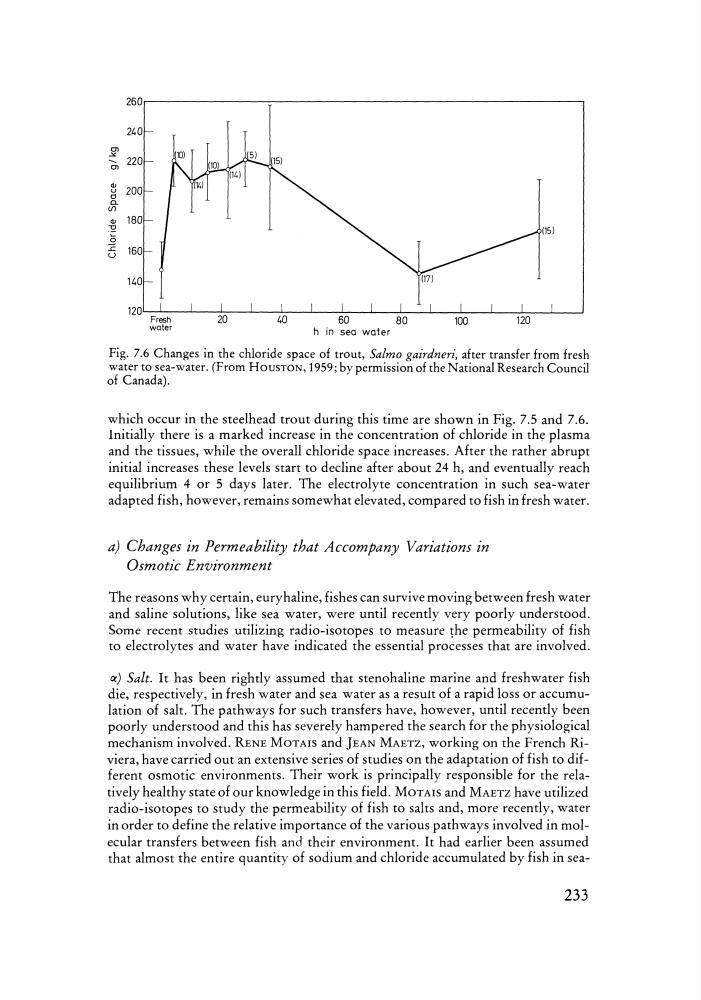
Fig. 7.6 Changes in the chloride space of trout, Salmo gairdneri, after transfer from fresh
water to sea-water. (From HOUSTON, 1959; by permissionof the National Research Council
of Canada).
which occur in the steel head trout during this time are shown in Fig. 7.5 and 7.6.
Initially there is a marked increase in the con centration of chloride in the plasma
and the tissues, while the overall chloride space increases. After the rather abrupt
initial increases these levels start to decline after about 24 h, and eventually reach
equilibrium 4 or 5 days later. The electrolyte concentration in such sea-water
adapted fish, however, remains somewhat elevated, compared to fish in fresh water.
a) Changes in Permeability that Accompany Variations in
Osmotic Environment
The reasons why certain, euryhaline, fishes can survive moving between fresh water
and saline solutions, like sea water, were until recently very poorly understood.
Some recent studies utilizing radio-isotopes to measure the permeability of fish
to electrolytes and water have indicated the essential processes that are involved.
IX) Salt. It has been rightly assumed that stenohaline marine and freshwater fish
die, respectively, in fresh water and sea water as a result of a rapid loss or accumulation of salt . The pathways for such transfers have , however, until recently been
poorly understood and this has severely hampered the search for the ph ysiological
mechanism involved. RENEMOTAIS and J EAN MAETZ, working on the French Riviera, have carried out an extensive series of studies on the adaptation of fish to different osmotic environments . Their work is principally responsible for the relatively healthy state of our knowledge in this field. MOTAIS and MAETZ have utilized
radio-isotopes to study the permeability of fish to salts and, more recently, water
in order to define the relative importance of the various pathways involved in molecular transfers between fish and their environment. It had earlier been assumed
that almost the entire quantity of sodium and chloride accumulated by fish in sea233
water to sea-water. (From HOUSTON, 1959; by permissionof the National Research Council
of Canada).
which occur in the steel head trout during this time are shown in Fig. 7.5 and 7.6.
Initially there is a marked increase in the con centration of chloride in the plasma
and the tissues, while the overall chloride space increases. After the rather abrupt
initial increases these levels start to decline after about 24 h, and eventually reach
equilibrium 4 or 5 days later. The electrolyte concentration in such sea-water
adapted fish, however, remains somewhat elevated, compared to fish in fresh water.
a) Changes in Permeability that Accompany Variations in
Osmotic Environment
The reasons why certain, euryhaline, fishes can survive moving between fresh water
and saline solutions, like sea water, were until recently very poorly understood.
Some recent studies utilizing radio-isotopes to measure the permeability of fish
to electrolytes and water have indicated the essential processes that are involved.
IX) Salt. It has been rightly assumed that stenohaline marine and freshwater fish
die, respectively, in fresh water and sea water as a result of a rapid loss or accumulation of salt . The pathways for such transfers have , however, until recently been
poorly understood and this has severely hampered the search for the ph ysiological
mechanism involved. RENEMOTAIS and J EAN MAETZ, working on the French Riviera, have carried out an extensive series of studies on the adaptation of fish to different osmotic environments . Their work is principally responsible for the relatively healthy state of our knowledge in this field. MOTAIS and MAETZ have utilized
radio-isotopes to study the permeability of fish to salts and, more recently, water
in order to define the relative importance of the various pathways involved in molecular transfers between fish and their environment. It had earlier been assumed
that almost the entire quantity of sodium and chloride accumulated by fish in sea233