

138
The Migrant Biota
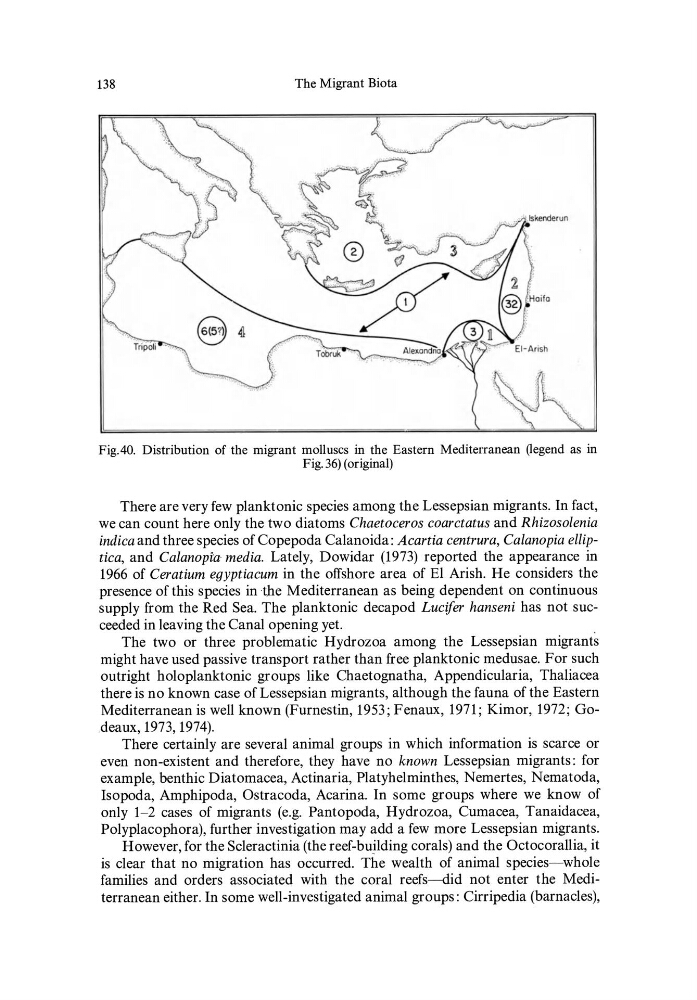
Fig.40. Distribution of the migrant molluscs in the Eastern Mediterranean Oegend as in
Fig. 36) (original)
There are very few planktonic species among the Lessepsian migrants. In fact,
we can count here only the two diatoms Chaetoceros coarctatus and Rhizosolenia
indica and three species of Copepoda Calanoida: Acartia centrura, Calanopia elliptica, and Calanopia media. Lately, Dowidar (1973) reported the appearance in
1966 of Ceratium egyptiacum in the offshore area of EI Arish. He considers the
presence of this species in the Mediterranean as being dependent on continuous
supply from the Red Sea. The planktonic decapod Luci/er hanseni has not succeeded in leaving the Canal opening yet.
The two or three problematic Hydrozoa among the Lessepsian migrants
might have used passive transport rather than free planktonic medusae. For such
outright holoplanktonic groups like Chaetognatha, Appendicularia, Thaliacea
there is no known case of Lessepsian migrants, although the fauna of the Eastern
Mediterranean is weIl known (Furnestin, 1953; Fenaux, 1971; Kimor, 1972; Godeaux, 1973, 1974).
There certainly are several animal groups in which information is scarce or
even non-existent and therefore, they have no known Lessepsian migrants : for
example, benthic Diatomacea, Actinaria, Platyhelminthes, Nemertes, Nematoda,
Isopoda, Amphipoda, Ostracoda, Acarina. In some groups where we know of
only 1- 2 cases of migrants (e.g. Pantopoda, Hydrozoa, Cumacea, Tanaidacea,
Polyplacophora), further investigation may add a few more Lessepsian migrants.
However, for the Scleractinia (the reef-bujlding corals) and the OctocoraIlia, it
is clear that no migration has occurred. The wealth of animal species- whole
families and orders associated with the coral reefs-did not enter the Mediterranean either. In some weIl-investigated animal groups: Cirripedia (barnacles),
The Migrant Biota
Fig.40. Distribution of the migrant molluscs in the Eastern Mediterranean Oegend as in
Fig. 36) (original)
There are very few planktonic species among the Lessepsian migrants. In fact,
we can count here only the two diatoms Chaetoceros coarctatus and Rhizosolenia
indica and three species of Copepoda Calanoida: Acartia centrura, Calanopia elliptica, and Calanopia media. Lately, Dowidar (1973) reported the appearance in
1966 of Ceratium egyptiacum in the offshore area of EI Arish. He considers the
presence of this species in the Mediterranean as being dependent on continuous
supply from the Red Sea. The planktonic decapod Luci/er hanseni has not succeeded in leaving the Canal opening yet.
The two or three problematic Hydrozoa among the Lessepsian migrants
might have used passive transport rather than free planktonic medusae. For such
outright holoplanktonic groups like Chaetognatha, Appendicularia, Thaliacea
there is no known case of Lessepsian migrants, although the fauna of the Eastern
Mediterranean is weIl known (Furnestin, 1953; Fenaux, 1971; Kimor, 1972; Godeaux, 1973, 1974).
There certainly are several animal groups in which information is scarce or
even non-existent and therefore, they have no known Lessepsian migrants : for
example, benthic Diatomacea, Actinaria, Platyhelminthes, Nemertes, Nematoda,
Isopoda, Amphipoda, Ostracoda, Acarina. In some groups where we know of
only 1- 2 cases of migrants (e.g. Pantopoda, Hydrozoa, Cumacea, Tanaidacea,
Polyplacophora), further investigation may add a few more Lessepsian migrants.
However, for the Scleractinia (the reef-bujlding corals) and the OctocoraIlia, it
is clear that no migration has occurred. The wealth of animal species- whole
families and orders associated with the coral reefs-did not enter the Mediterranean either. In some weIl-investigated animal groups: Cirripedia (barnacles),