

Movement
1. Active swimmers
2. Possibilities of
short-distance
passive transport
3. Free roaming
benthic organisms
The Diversity of Lessepsian Migrants
Table 7
Ecological Valency
4. Euryhalinity of the
metahaline type
(hyper -euryhalines)
5. Species with nonselective substrate
requirements
6. Eurythermy for
lowered temperatures
Reproduction
7. Long reproduction
season
8. Short-lived
(lecithotrophic)
planktonic larvae, or
direct reproduction
9. Asexual
reproduction
139
Food
10. Euryphagy
(nonselective
feeding)
Echinodermata, Cephalopoda, Selachia (sharks), migration did not occur or was
minimal.
From all these, and also from some facts to be discussed in more detail below,
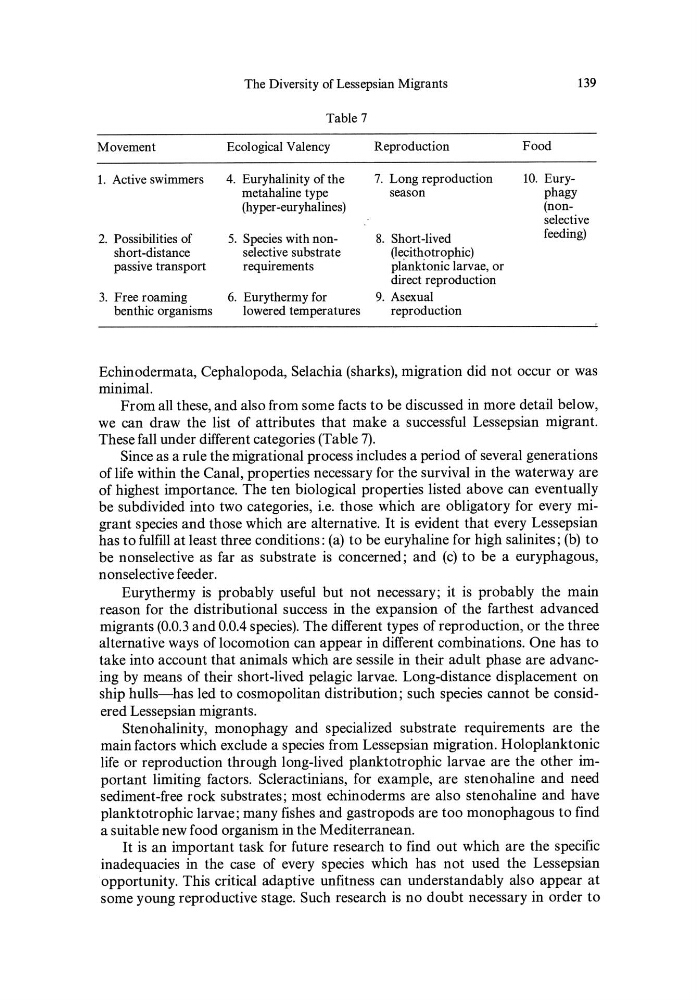
we can draw the list of attributes that make a successful Lessepsian migrant.
These fall under different categories (Table 7).
Since as a rule the migrational process includes aperiod of several generations
of life within the Canal, properties necessary for the survival in the waterway are
of highest importance. The ten biological properties listed above can eventually
be subdivided into two categories, i.e. those which are obligatory for every migrant species and those which are alternative. It is evident that every Lessepsian
has to fulfill at least three conditions: (a) to be euryhaline for high salinites; (b) to
be nonselective as far as substrate is concerned; and (c) to be a euryphagous,
nonselective feeder.
Eurythermy is probably useful but not necessary; it is probably the main
reason for the distributional success in the expansion of the farthest advanced
migrants (0.0.3 and 0.0.4 species). The different types of reproduction, or the three
alternative ways of locomotion can appear in different combinations. One has to
take into account that animals which are sessile in their adult phase are advancing by means of their short-lived pelagic larvae. Long-distance displacement on
ship hulls-has led to cosmopolitan distribution; such species cannot be considered Lessepsian migrants.
Stenohalinity, monophagy and specialized substrate requirements are the
main factors which exclude a species from Lessepsian migration. Holoplanktonic
life or reproduction through long-lived planktotrophic larvae are the other important limiting factors. Scleractinians, for example, are stenohaline and need
sediment-free rock substrates; most echinoderms are also stenohaline and have
planktotrophic larvae; many fishes and gastropods are too monophagous to find
a suitable new food organism in the Mediterranean.
It is an important task for future research to find out wh ich are the specific
inadequacies in the case of every species which has not used the Lessepsian
opportunity. This critical adaptive unfitness can understandably also appear at
some young reproductive stage. Such research is no doubt necessary in order to
1. Active swimmers
2. Possibilities of
short-distance
passive transport
3. Free roaming
benthic organisms
The Diversity of Lessepsian Migrants
Table 7
Ecological Valency
4. Euryhalinity of the
metahaline type
(hyper -euryhalines)
5. Species with nonselective substrate
requirements
6. Eurythermy for
lowered temperatures
Reproduction
7. Long reproduction
season
8. Short-lived
(lecithotrophic)
planktonic larvae, or
direct reproduction
9. Asexual
reproduction
139
Food
10. Euryphagy
(nonselective
feeding)
Echinodermata, Cephalopoda, Selachia (sharks), migration did not occur or was
minimal.
From all these, and also from some facts to be discussed in more detail below,
we can draw the list of attributes that make a successful Lessepsian migrant.
These fall under different categories (Table 7).
Since as a rule the migrational process includes aperiod of several generations
of life within the Canal, properties necessary for the survival in the waterway are
of highest importance. The ten biological properties listed above can eventually
be subdivided into two categories, i.e. those which are obligatory for every migrant species and those which are alternative. It is evident that every Lessepsian
has to fulfill at least three conditions: (a) to be euryhaline for high salinites; (b) to
be nonselective as far as substrate is concerned; and (c) to be a euryphagous,
nonselective feeder.
Eurythermy is probably useful but not necessary; it is probably the main
reason for the distributional success in the expansion of the farthest advanced
migrants (0.0.3 and 0.0.4 species). The different types of reproduction, or the three
alternative ways of locomotion can appear in different combinations. One has to
take into account that animals which are sessile in their adult phase are advancing by means of their short-lived pelagic larvae. Long-distance displacement on
ship hulls-has led to cosmopolitan distribution; such species cannot be considered Lessepsian migrants.
Stenohalinity, monophagy and specialized substrate requirements are the
main factors which exclude a species from Lessepsian migration. Holoplanktonic
life or reproduction through long-lived planktotrophic larvae are the other important limiting factors. Scleractinians, for example, are stenohaline and need
sediment-free rock substrates; most echinoderms are also stenohaline and have
planktotrophic larvae; many fishes and gastropods are too monophagous to find
a suitable new food organism in the Mediterranean.
It is an important task for future research to find out wh ich are the specific
inadequacies in the case of every species which has not used the Lessepsian
opportunity. This critical adaptive unfitness can understandably also appear at
some young reproductive stage. Such research is no doubt necessary in order to