

The Diversity of Lessepsian Migrants
137
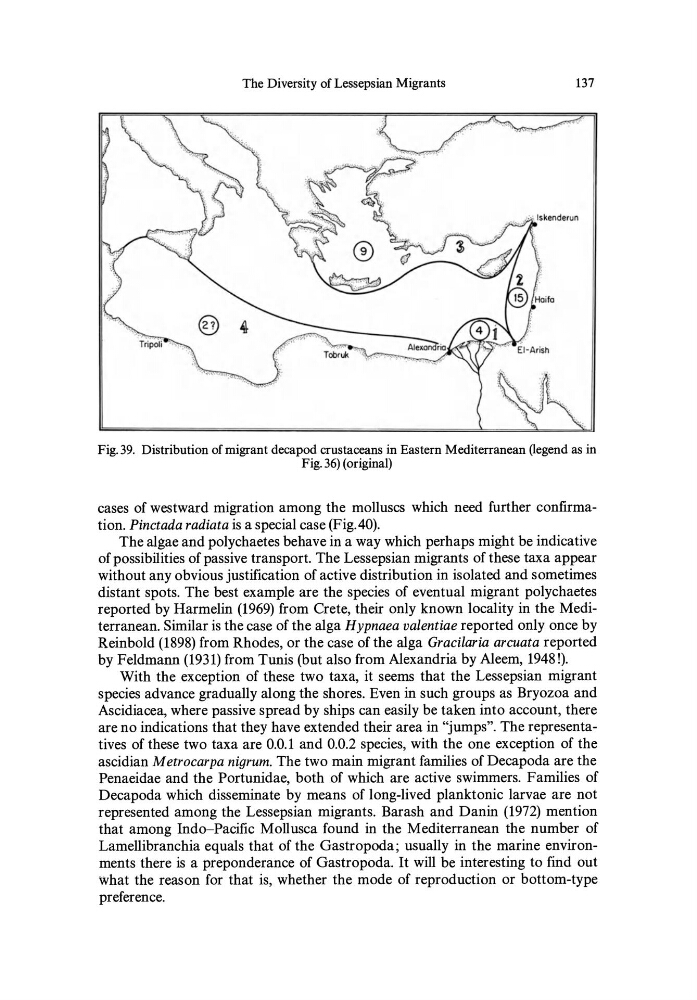
Fig.39. Distribution of migrant decapod crustaceans in Eastern Mediterranean Oegend as in
Fig. 36) (original)
cases of westward migration among the molluscs which need further confirrnation. Pinctada radiata is a special case (Fig.40).
The algae and polychaetes behave in a way which perhaps might be indicative
of possibilities of passive transport. The Lessepsian migrants of these taxa appear
without any obvious justification of active distribution in isolated and sometimes
distant spots. The best example are the species of eventual migrant polychaetes
reported by Harmelin (1969) from Crete, their only known locality in the Mediterranean. Similar is the case of the alga Hypnaea valentiae reported only once by
Reinbold (1898) from Rhodes, or the case of the alga Gracilaria arcuata reported
by Feldmann (1931) from Tunis (hut also from Alexandria by Aleern, 1948!).
With the exception of these two taxa, it seems that the Lessepsian migrant
species advance gradually along the shores. Even in such groups as Bryozoa and
Ascidiacea, where passive spread by ships can easily be taken into account, there
are no indications that they have extended their area in "jumps". The representatives of these two taxa are 0.0.1 and 0.0.2 species, with the one exception of the
ascidian M etrocarpa nigrum. The two main migrant families of Decapoda are the
Penaeidae and the Portunidae, both of which are active swimmers. Families of
Decapoda which disseminate by means of long-lived planktonic larvae are not
represented among the Lessepsian migrants. Barash and Danin (1972) mention
that among Indo-Pacific Mollusca found in the Mediterranean the number of
Lamellibranchia equals that of the Gastropoda; usually in the marine environments there is a preponderance of Gastropoda. It will be interesting to find out
what the reason for that is, whether the mode of reproduction or bottom-type
preference.
137
Fig.39. Distribution of migrant decapod crustaceans in Eastern Mediterranean Oegend as in
Fig. 36) (original)
cases of westward migration among the molluscs which need further confirrnation. Pinctada radiata is a special case (Fig.40).
The algae and polychaetes behave in a way which perhaps might be indicative
of possibilities of passive transport. The Lessepsian migrants of these taxa appear
without any obvious justification of active distribution in isolated and sometimes
distant spots. The best example are the species of eventual migrant polychaetes
reported by Harmelin (1969) from Crete, their only known locality in the Mediterranean. Similar is the case of the alga Hypnaea valentiae reported only once by
Reinbold (1898) from Rhodes, or the case of the alga Gracilaria arcuata reported
by Feldmann (1931) from Tunis (hut also from Alexandria by Aleern, 1948!).
With the exception of these two taxa, it seems that the Lessepsian migrant
species advance gradually along the shores. Even in such groups as Bryozoa and
Ascidiacea, where passive spread by ships can easily be taken into account, there
are no indications that they have extended their area in "jumps". The representatives of these two taxa are 0.0.1 and 0.0.2 species, with the one exception of the
ascidian M etrocarpa nigrum. The two main migrant families of Decapoda are the
Penaeidae and the Portunidae, both of which are active swimmers. Families of
Decapoda which disseminate by means of long-lived planktonic larvae are not
represented among the Lessepsian migrants. Barash and Danin (1972) mention
that among Indo-Pacific Mollusca found in the Mediterranean the number of
Lamellibranchia equals that of the Gastropoda; usually in the marine environments there is a preponderance of Gastropoda. It will be interesting to find out
what the reason for that is, whether the mode of reproduction or bottom-type
preference.